The big why
Why are most chloroplasts near the top of a leaf?
That's where the light is strongest. Tall palisade cells packed with chloroplasts sit just under the leaf's clear upper surface.
On this page
- The short answer at every level
- In the plant: the leaves
- In the leaf: the palisade layer
- In the cell: the chloroplast
- Inside the chloroplast: thylakoids and stroma
- Does photosynthesis happen anywhere other than plants?
- When does photosynthesis happen?
- Key facts to remember
- Check your understanding
- Quizzes, worksheets and labs
- Frequently asked questions
Quick answer
Photosynthesis takes place in the . In plants, most chloroplasts are in the cells of the leaves, especially the layer near the top of the leaf. Inside each chloroplast, the light-dependent reactions happen on the membranes, and the Calvin cycle happens in the .
The short answer at every level
Photosynthesis can be described at different levels, from the whole plant down to the inside of a chloroplast. Your teacher may want any one of these, so here they all are.
| Level | Where photosynthesis happens |
|---|---|
| Plant | Mostly in the leaves, and in green stems |
| Leaf | Mostly in the palisade mesophyll cells, near the top surface |
| Cell | In the chloroplasts |
| Inside the chloroplast | Light-dependent reactions on the thylakoid membranes; Calvin cycle in the stroma |
In the plant: the leaves
Leaves are a plant's food factories. They are thin and flat, which gives them a large surface to catch sunlight, and they hold most of the plant's chloroplasts. Any green part of a plant can photosynthesise, including young stems and unripe fruit. Roots grow in the dark soil and have no chloroplasts, so they can't. They rely on sugar sent down from the leaves.
In the leaf: the palisade layer
Inside a leaf there are several layers of cells. The palisade mesophyll cells are tall, tightly packed and full of chloroplasts. They sit just under the clear upper surface, where light is strongest, so they carry out most of the photosynthesis. The below has fewer chloroplasts and plenty of air spaces, which let carbon dioxide reach the cells.
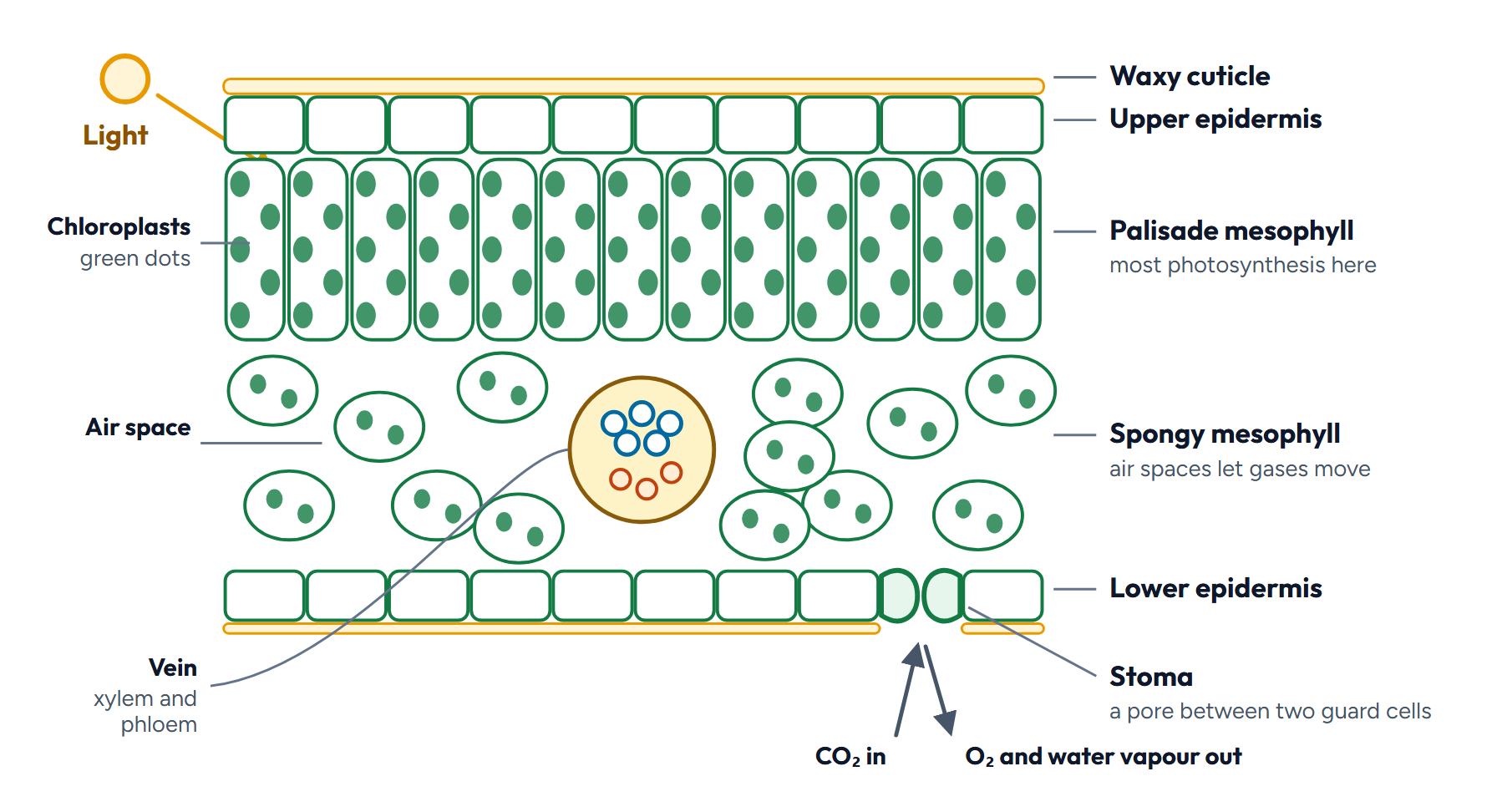
Water reaches the leaf through the in the veins. Carbon dioxide enters through tiny pores called stomata, mostly on the underside. For a full set of labelled diagrams, see the photosynthesis diagram guide.
In the cell: the chloroplast
Chloroplasts are small oval structures () found in plant and algae cells. One leaf cell can hold dozens of them. They are green because they contain chlorophyll, the pigment that absorbs light energy.
Chloroplasts can even move around inside the cell. In dim light they spread out to catch as much light as possible. In very bright light they line up along the cell walls to avoid damage.
Inside the chloroplast: thylakoids and stroma
Each chloroplast is filled with stacks of flat discs called thylakoids. A stack is called a (plural: grana). The fluid around the stacks is the stroma. The two stages of photosynthesis happen in these two different places.
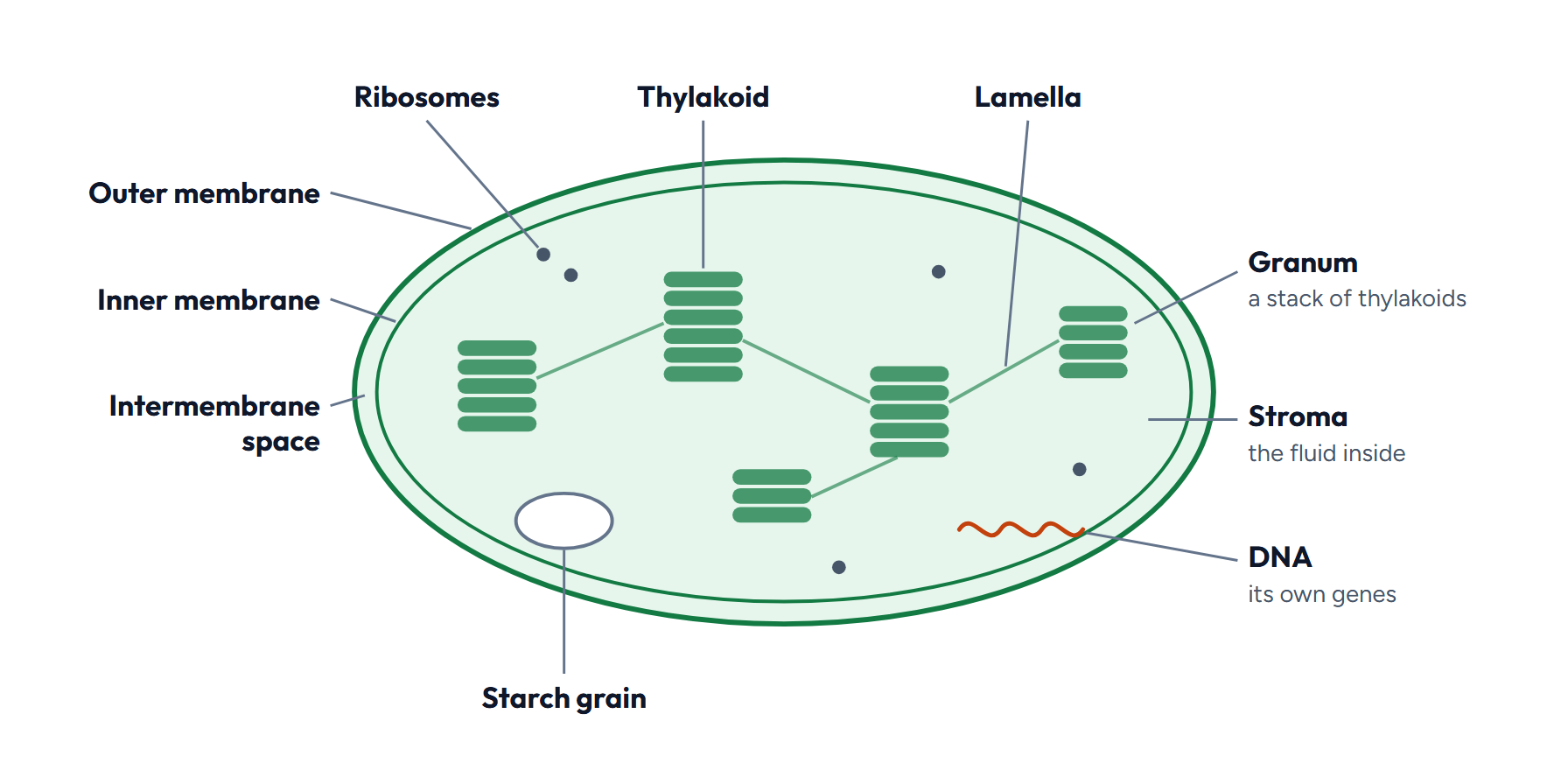
- On the thylakoid membranes: the light-dependent reactions use light to split water, release oxygen, and make ATP and NADPH.
- In the stroma: the Calvin cycle uses that ATP and NADPH to turn carbon dioxide into sugar.
You can see every part of the chloroplast labelled in our chloroplast diagram guide.
Does photosynthesis happen anywhere other than plants?
Yes. Plants are not the only living things that photosynthesise.
- Algae, from seaweeds to tiny single cells in ponds and oceans, have chloroplasts and photosynthesise just like plants. Together, ocean algae and bacteria make around half of the oxygen produced on Earth each year.
- Cyanobacteria are bacteria that photosynthesise. They have no chloroplasts. Instead, they have thylakoid membranes inside the cell itself. Scientists think chloroplasts first came from cyanobacteria that were taken in by larger cells long ago, which is why chloroplasts still have their own DNA.
When does photosynthesis happen?
Photosynthesis needs light, so it happens during the day. It goes faster in brighter light, in warmer temperatures (up to a point) and with more carbon dioxide. At night the light-dependent reactions stop, and the Calvin cycle soon stops too. Respiration carries on day and night.
Cheat sheet
Key facts to remember
Where does photosynthesis take place?
- Photosynthesis takes place in the chloroplasts.
- In plants, most chloroplasts are in the leaves.
- In a leaf, most photosynthesis happens in the palisade mesophyll, near the top.
- The light-dependent reactions happen on the thylakoid membranes.
- The Calvin cycle happens in the stroma.
- Algae and some bacteria photosynthesise too.
From Cluecub · www.cluecub.com/where-does-photosynthesis-take-place
Practice questions
Check your understanding
5 questions
1. In which organelle does photosynthesis take place?
Chloroplasts contain chlorophyll and the enzymes for photosynthesis. Mitochondria carry out respiration.
2. Which leaf cells carry out the most photosynthesis?
Palisade cells are packed with chloroplasts and sit near the top of the leaf, where they get the most light.
3. Where in the chloroplast do the light-dependent reactions happen?
Chlorophyll and the other light-catching proteins sit in the thylakoid membranes.
4. Why can't roots photosynthesise?
Roots grow underground away from light and have no chloroplasts. They get sugar from the leaves through the phloem.
5. Which living thing photosynthesises without chloroplasts?
Cyanobacteria are bacteria, so they have no chloroplasts. Their thylakoid membranes sit directly inside the cell.
Frequently asked questions
Where does photosynthesis take place in a plant cell?
In the chloroplasts. The light-dependent reactions happen on the thylakoid membranes, and the Calvin cycle happens in the stroma.
In which organelle does photosynthesis occur?
The chloroplast.
Where does photosynthesis take place in a leaf?
Mostly in the palisade mesophyll cells just below the upper surface, with some in the spongy mesophyll and guard cells.
Where does the Calvin cycle take place?
In the stroma, the fluid inside the chloroplast that surrounds the thylakoids.
Does photosynthesis happen at night?
No. It needs light. The light-dependent reactions stop in the dark, and the Calvin cycle stops soon after because it runs out of ATP and NADPH.