The big why
Why do you need to breathe oxygen at all?
Oxygen waits at the very end of a chain in your mitochondria, catching used electrons. Without it, most of your energy supply stops.
On this page
- Where does the electron transport chain take place?
- What goes in and what comes out
- The steps, one at a time
- Why oxygen is essential
- The ATP count for one glucose
- The electron transport chain in photosynthesis
- Key facts to remember
- Check your understanding
- Quizzes, worksheets and labs
- Frequently asked questions
Quick answer
The electron transport chain is the final stage of aerobic cellular respiration. It is a series of proteins in the inner membrane that pass electrons from and down the chain. The energy released pumps hydrogen ions across the membrane, and their flow back through makes about 26 to 28 per . Oxygen accepts the electrons at the end, forming water.
Where does the electron transport chain take place?
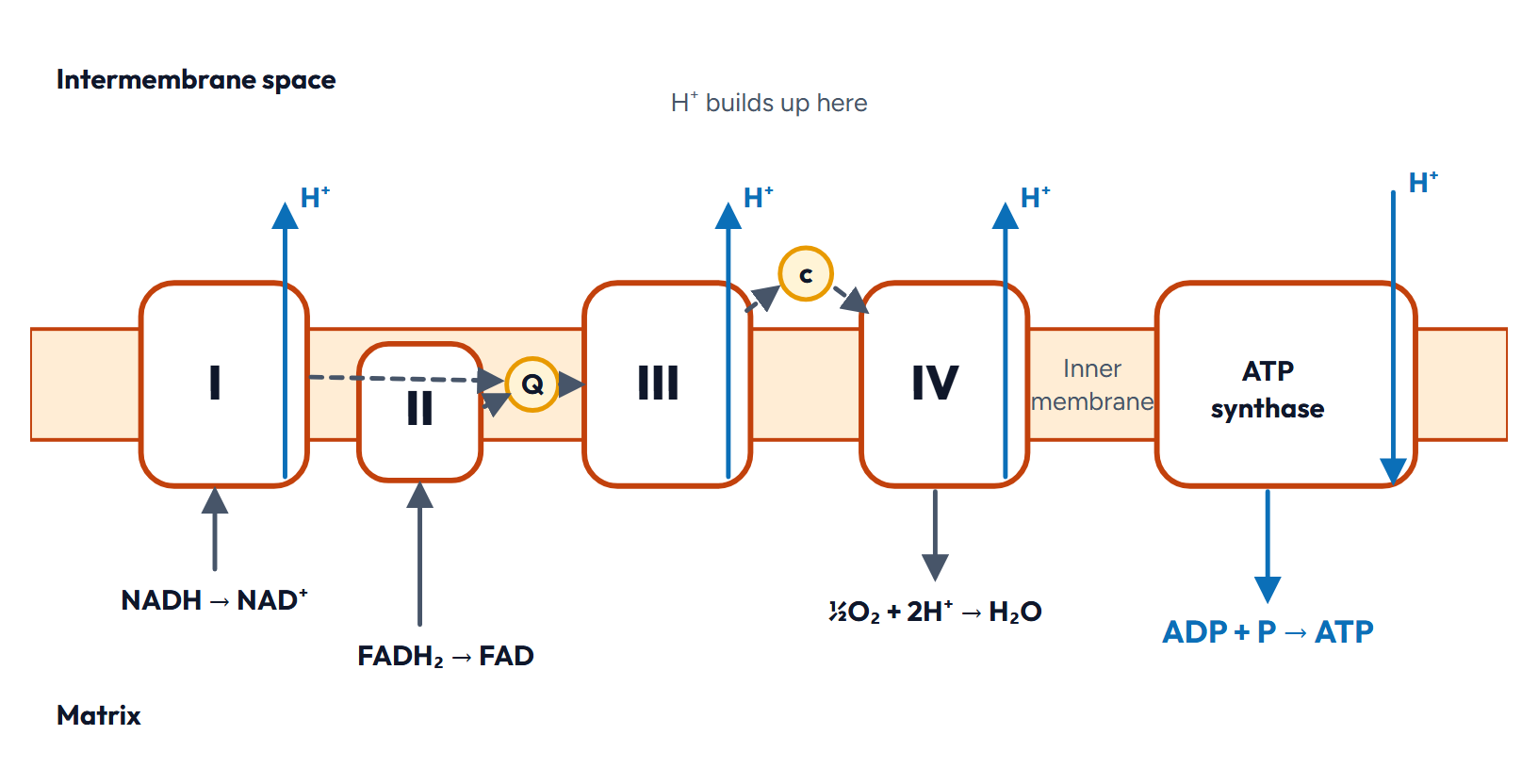
The electron transport chain takes place in the inner membrane of the mitochondrion. This membrane is folded into cristae, which pack far more chain proteins into each mitochondrion. Bacteria have no mitochondria, so their electron transport chain sits in their cell membrane instead.
Two spaces matter. The matrix is the fluid inside the inner membrane, where the Krebs cycle happens. The intermembrane space is the narrow gap between the inner and outer membranes, where hydrogen ions build up.
What goes in and what comes out
| Goes in | Comes out |
|---|---|
| NADH and FADH₂ from glycolysis, the link reaction and the Krebs cycle | NAD⁺ and FAD, returned to be reused |
| Oxygen (O2) | Water (H2O) |
| ADP and phosphate | About 26 to 28 ATP per glucose |
The steps, one at a time
Step 1
NADH and FADH₂ drop off electrons
NADH hands its high-energy electrons to complex I. FADH₂ hands its electrons to complex II, a little further along the chain.
- Where
- Inner mitochondrial membrane
Step 2
Electrons pass down the chain
A small carrier called ubiquinone (Q) takes the electrons to complex III. Another carrier, cytochrome c, takes them on to complex IV. At each step the electrons drop to a lower energy level.
- Order
- I or II → Q → III → cytochrome c → IV
Step 3
Hydrogen ions are pumped out
Complexes I, III and IV use the energy released by the electrons to pump hydrogen ions from the matrix into the intermembrane space. A steep concentration gradient builds up.
- Pumps
- Complexes I, III and IV
Step 4
Oxygen accepts the electrons
At complex IV, oxygen picks up the electrons along with hydrogen ions and becomes water. This is why you need to breathe oxygen.
- Reaction
- ½O2 + 2H⁺ + 2 electrons → H2O
Step 5
ATP synthase makes ATP
Hydrogen ions flow back into the matrix through ATP synthase, a protein that spins like a tiny turbine. Its movement joins ADP and phosphate to make ATP. This is called chemiosmosis.
- Makes
- About 26 to 28 ATP per glucose
Together, the electron transport chain and chemiosmosis are called oxidative phosphorylation. The idea that a hydrogen ion gradient drives ATP synthesis was proposed by Peter Mitchell, who won the Nobel Prize in Chemistry for it in 1978.
Why oxygen is essential
Oxygen is the final electron acceptor. If there is no oxygen, electrons have nowhere to go, the chain backs up, and it stops pumping hydrogen ions. Without the chain, NADH can't be recycled into NAD⁺, so the Krebs cycle stops too. The cell is left with only glycolysis, which makes just 2 ATP per glucose. That is anaerobic respiration.
Cyanide is deadly for the same reason. It blocks complex IV, so electrons can't reach oxygen and the chain stops, even when there is plenty of oxygen in the blood.
The ATP count for one glucose
| Stage | ATP made |
|---|---|
| Glycolysis | 2 |
| Krebs cycle | 2 |
| Electron transport chain | About 26 to 28 |
| Total | About 30 to 32 |
Some textbooks give 34 ATP for the chain and 36 or 38 in total. These older figures assumed whole numbers of ATP per NADH. Use the figure from your own course's textbook. The full breakdown of all four stages is in the cellular respiration equation guide.
The electron transport chain in photosynthesis
Plants have a second electron transport chain, in the membranes of their . The light-dependent reactions also pass electrons along membrane proteins, pump hydrogen ions and use ATP synthase. The big differences are where the energy comes from and where the electrons end up.
| Respiration (mitochondria) | Photosynthesis (chloroplasts) | |
|---|---|---|
| Membrane | Inner mitochondrial membrane | Thylakoid membrane |
| Energy source | Electrons from food (NADH, FADH₂) | Light |
| Electrons come from | NADH and FADH₂ | Water, which is split |
| Final electron acceptor | Oxygen, making water | NADP⁺, making |
| Makes | ATP | ATP and NADPH |
Cheat sheet
Key facts to remember
The electron transport chain
- The electron transport chain is the last stage of .
- It is in the inner mitochondrial membrane.
- NADH and FADH₂ hand over electrons, which pass down a chain of proteins.
- The energy released pumps hydrogen ions across the membrane.
- The ions flow back through ATP synthase, making about 26 to 28 ATP per glucose.
- Oxygen accepts the electrons at the end and forms water.
From Cluecub · www.cluecub.com/electron-transport-chain
Practice questions
Check your understanding
5 questions
1. Where is the electron transport chain in a eukaryotic cell?
The chain's proteins sit in the inner membrane, which is folded into cristae.
2. What is the final electron acceptor in the chain?
Oxygen accepts electrons at complex IV and combines with hydrogen ions to form water.
3. What directly powers ATP synthase?
The pumped hydrogen ions flow back down their gradient through ATP synthase. That flow, called chemiosmosis, drives ATP production.
4. Why does FADH₂ produce less ATP than NADH?
FADH₂ gives its electrons to complex II, skipping complex I, so its electrons pump fewer hydrogen ions.
5. Why is cyanide so poisonous?
With complex IV blocked, the whole chain stops and cells can make only a tiny amount of ATP from glycolysis.
Frequently asked questions
What is the electron transport chain?
It is a series of proteins in the inner mitochondrial membrane that pass electrons from NADH and FADH₂ to oxygen, using the energy released to make most of the cell's ATP.
Where does the electron transport chain take place?
In the inner membrane of the mitochondria. In bacteria, it takes place in the cell membrane.
How much ATP does the electron transport chain make?
About 26 to 28 ATP per glucose molecule, out of a total of about 30 to 32 for aerobic respiration.
What is the role of oxygen in the electron transport chain?
Oxygen is the final electron acceptor. It picks up electrons at the end of the chain and combines with hydrogen ions to form water.
What is the difference between the electron transport chain and chemiosmosis?
The electron transport chain moves electrons and pumps hydrogen ions to build a gradient. Chemiosmosis is the flow of those ions back through ATP synthase, which makes ATP.