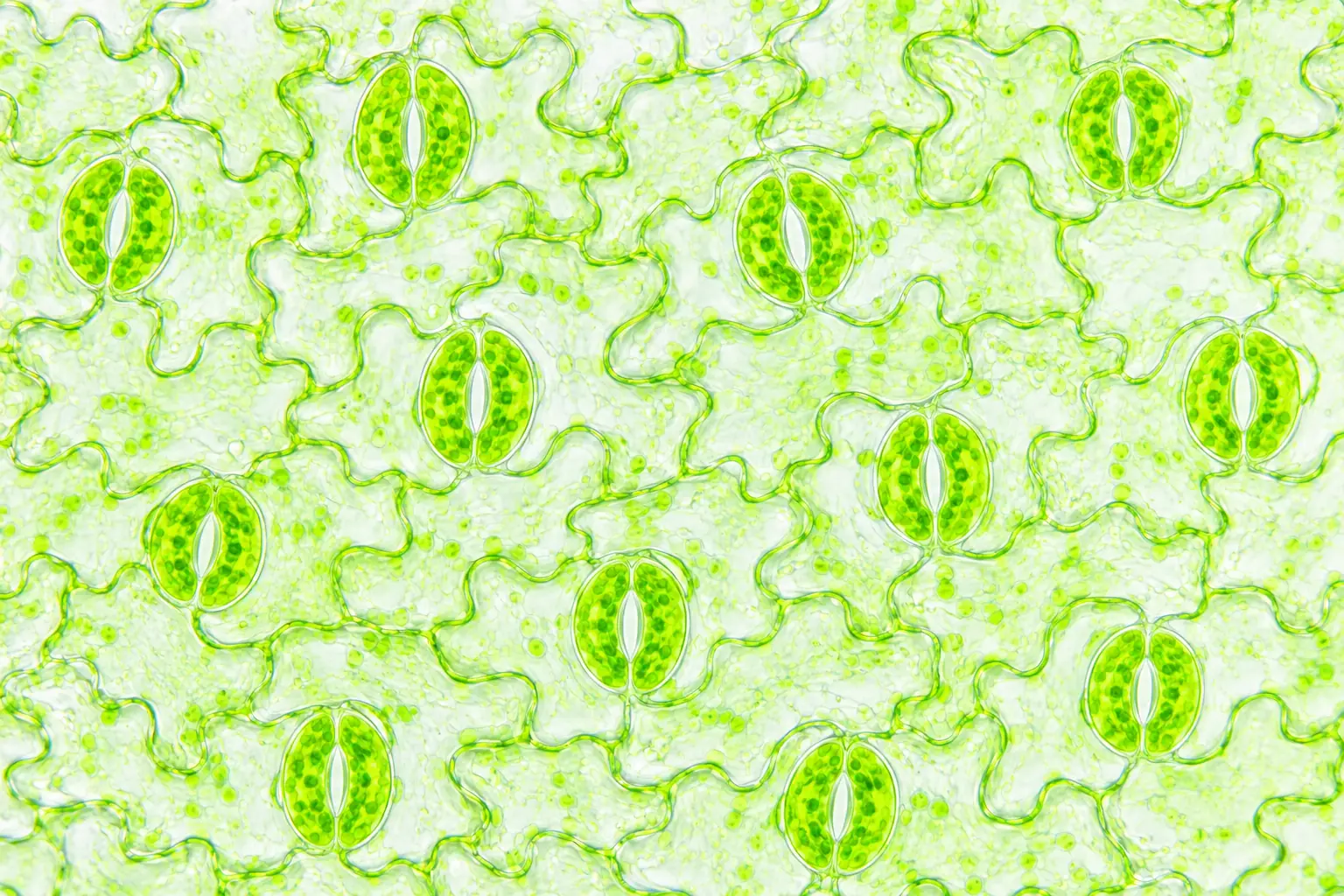
The big why
Why do leaves have tiny holes in them?
The holes, called stomata, let carbon dioxide in for photosynthesis. Guard cells close them on hot days so the plant doesn't wilt.
On this page
- Functions of stomata
- What is a stoma? The meaning of the word
- Where stomata are found
- What are guard cells?
- How guard cells open and close a stoma
- When stomata open and close
- Pictures of stomata under the microscope
- Try it: see stomata with nail varnish
- How stomata link to photosynthesis and respiration
- Key facts to remember
- Check your understanding
- Quizzes, worksheets and labs
- Frequently asked questions
Quick answer
Stomata (singular: stoma) are tiny pores, mostly on the underside of leaves, that let gases in and out of a plant. Carbon dioxide enters through them for photosynthesis, while oxygen and water vapour leave. Each pore, called a stoma, is surrounded by two that open and close it.
Functions of stomata
Stomata have three main functions, and all of them depend on gases moving through the pore.
- Let carbon dioxide in. Photosynthesis needs a steady supply of CO2 from the air. It in through open stomata to the cells inside the leaf.
- Let oxygen out. The oxygen made by photosynthesis diffuses out the same way.
- Let water vapour out. Water evaporates from cells inside the leaf and escapes through the stomata. This loss is called transpiration, and it pulls more water up from the roots through the .
What is a stoma? The meaning of the word
The word stoma comes from the Greek for "mouth", because the open pore looks like a tiny pair of lips. One pore is a stoma; two or more are stomata. You may also see them called stomates. So "what is a stomata?" is really asking about one stoma, or about the pores as a group.
Where stomata are found
Most stomata are on the lower surface of a leaf. The underside is shaded and cooler, so less water evaporates through the pores there. The upper surface is often covered by a waxy cuticle with few or no stomata.
There are exceptions. Water lilies have their stomata on the upper surface, because the underside of the leaf rests on the water. Stomata are also found on green stems.
What are guard cells?
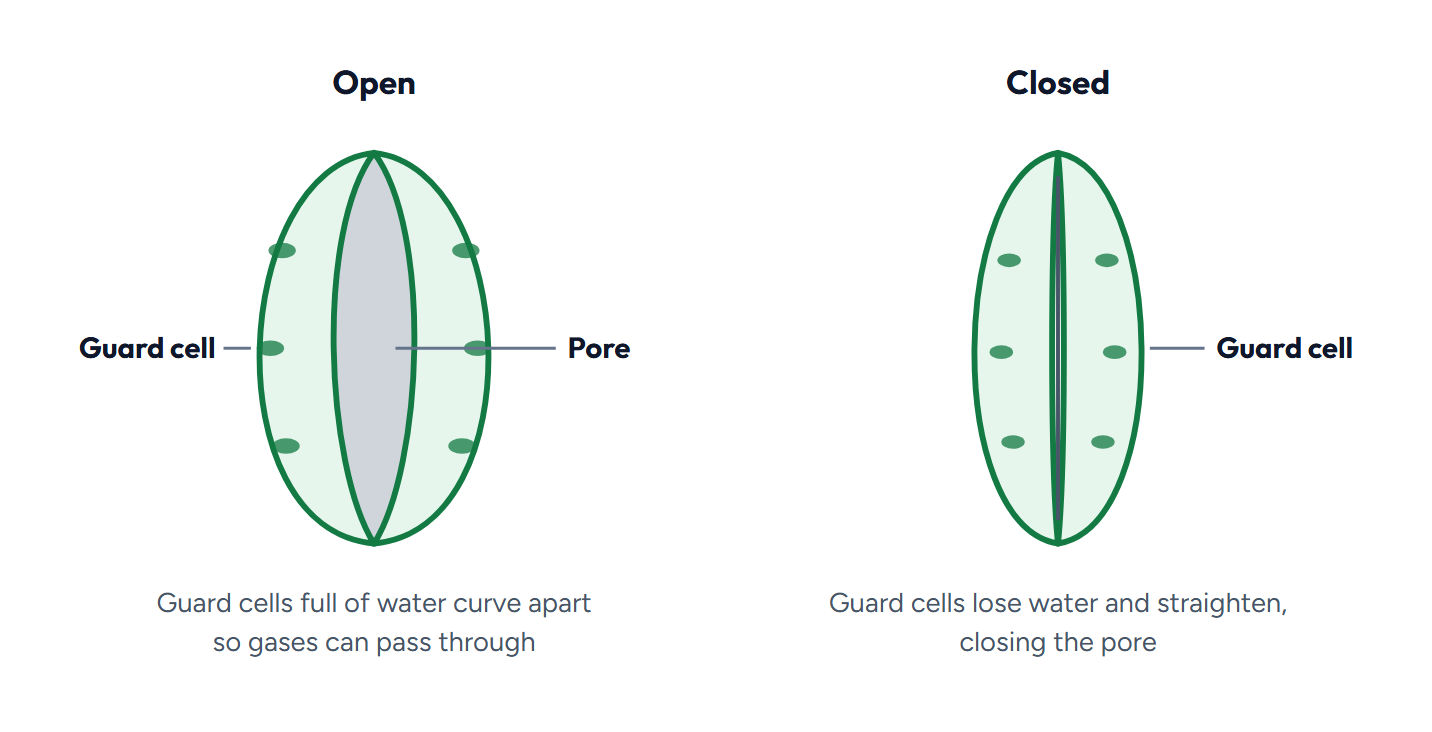
Guard cells are the two bean-shaped cells that surround every stoma. Together they act like a pair of doors: when they swell, the pore between them opens, and when they go limp, it closes.
Guard cells are different from the other cells of the leaf's surface (the epidermis) in three ways:
- They have . Most epidermis cells don't. The chloroplasts help supply the energy guard cells need to pump ions.
- Their walls are uneven. The wall next to the pore is thick and stiff, and the outer wall is thin and stretchy.
- They can change shape quickly, by taking in or losing water in minutes.
How guard cells open and close a stoma
The inner wall of each guard cell, next to the pore, is thicker and less stretchy than the outer wall. That uneven wall is what makes the opening work.
Step 1
Guard cells take in potassium ions
In light, guard cells pump potassium ions in from the cells around them. This makes the solution inside the guard cells more concentrated.
- When
- Usually in daylight
Step 2
Water follows by osmosis
Water moves into the guard cells by osmosis, from the weaker solution outside to the more concentrated solution inside.
- Result
- Guard cells become turgid (swollen)
Step 3
The guard cells curve apart
As they swell, the stretchy outer walls expand more than the thick inner walls. The cells bend outwards like two bananas, and a gap opens between them.
- Result
- The stoma opens
Step 4
Losing water closes the pore
In the dark, or when the plant is short of water, potassium ions leave and water follows them out. The guard cells go limp, straighten, and the pore closes.
- Signal
- A drought hormone called abscisic acid (ABA)
When stomata open and close
| Condition | Stomata | Why |
|---|---|---|
| Bright light | Open | Photosynthesis needs carbon dioxide |
| Darkness | Mostly closed | No photosynthesis, so the plant saves water |
| Hot, dry or windy weather | Close partly or fully | To stop the plant losing too much water |
| Drought | Closed | The hormone abscisic acid tells guard cells to close |
Plants are always balancing two needs. Open stomata let in the carbon dioxide needed for photosynthesis, but every open pore also loses water. On a hot day a plant may close its stomata to avoid wilting, even though that slows photosynthesis.
Some desert plants, such as cacti and pineapples, solve this problem a different way. They open their stomata at night, when it is cooler, take in carbon dioxide and store it, then use it for photosynthesis during the day with their stomata closed. This is called CAM photosynthesis.
Pictures of stomata under the microscope
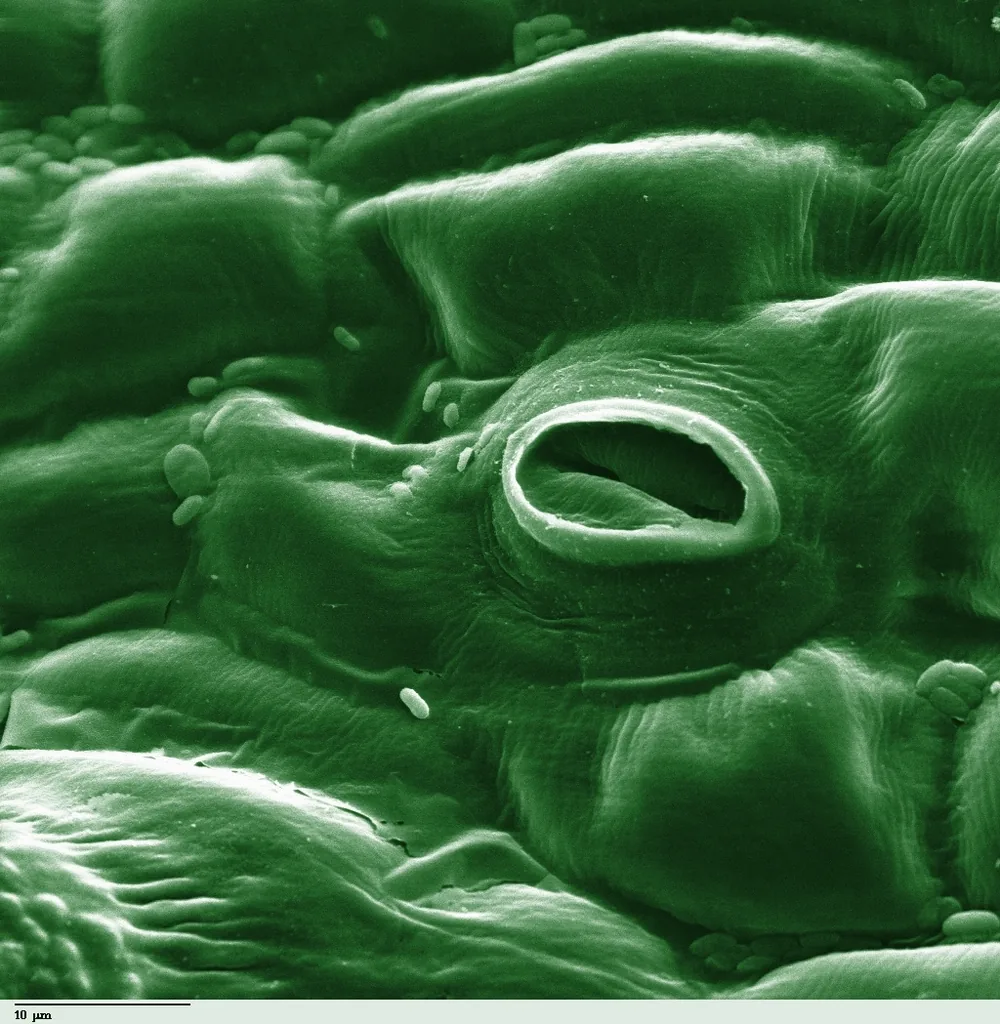
Stomata are far too small to see with the naked eye. A typical stoma is only about 20 to 50 micrometres long, so a few hundred could fit across your fingernail. Here is what they look like under two kinds of microscope.
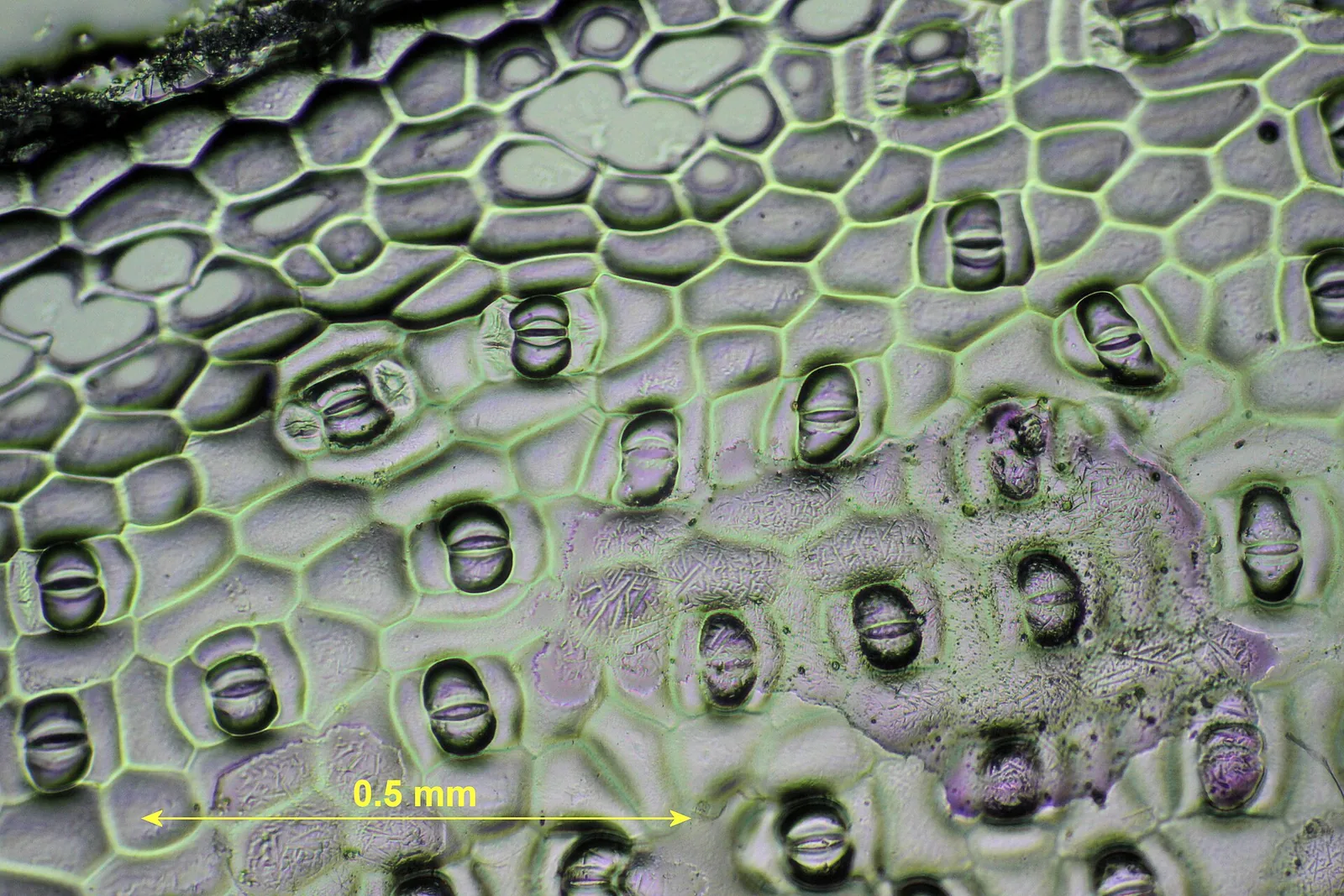

Count the stomata in the photo and you'll find over twenty in a patch only about a millimetre across. A single leaf can have many thousands per square centimetre on its underside.

Try it: see stomata with nail varnish
You can see stomata yourself with a microscope and a few household items. Ask an adult before using nail varnish.
- Paint a thin layer of clear nail varnish on the underside of a leaf, about 1 cm square. Leaves from a houseplant, spider plant or lettuce work well.
- Let it dry completely, for about 10 minutes.
- Press clear sticky tape over the dry varnish, then peel it off slowly. The varnish comes away as a copy of the leaf surface.
- Stick the tape onto a microscope slide.
- Look under a microscope at ×100 to ×400 magnification. The stomata look like tiny pairs of lips. Count how many you can see in one view.
To turn this into an experiment, compare the upper and lower surfaces of the same leaf, or count the stomata on a plant grown in shade with one grown in full sun.
How stomata link to photosynthesis and respiration
Every molecule of carbon dioxide used in the photosynthesis equation comes in through a stoma, and every molecule of oxygen made goes out the same way. You can see where stomata sit in a leaf in our photosynthesis diagram. At night, when only respiration happens, the gases flow the other way. See photosynthesis vs cellular respiration for how the balance changes between day and night.
Cheat sheet
Key facts to remember
What are stomata?
- Stomata are tiny pores, mostly on the underside of leaves.
- Carbon dioxide enters through them, and oxygen and water vapour leave.
- Each stoma is surrounded by two guard cells that open and close it.
- Guard cells take in water by osmosis and swell to open the pore. They lose water and go limp to close it.
- Stomata usually open in light and close in the dark or in hot, dry weather to save water.
From Cluecub · www.cluecub.com/what-are-stomata
Practice questions
Check your understanding
5 questions
1. What is the main job of stomata?
Stomata are pores for gas exchange. Carbon dioxide comes in, and oxygen and water vapour go out.
2. Which cells open and close a stoma?
Two guard cells surround each stoma and change shape to open or close it.
3. Why does a stoma open when its guard cells take in water?
The thick inner walls stretch less than the outer walls, so swollen guard cells bend outwards and open a gap.
4. Why are most stomata on the underside of leaves?
The underside is cooler and shaded, so less water evaporates through the open pores.
5. When do cactus stomata open?
Cacti open their stomata at night, when it is cooler, to take in carbon dioxide without losing much water. This is called CAM photosynthesis.
Frequently asked questions
What are stomata?
Stomata are tiny pores in the surface of leaves and green stems. They let carbon dioxide into the plant and let oxygen and water vapour out.
What is the function of guard cells?
Guard cells surround each stoma. By taking in or losing water, they change shape to open or close the pore, controlling gas exchange and water loss.
Why do stomata close at night?
Photosynthesis stops in the dark, so the plant doesn't need to take in carbon dioxide. Closing the stomata saves water.
What is the singular of stomata?
The singular is stoma. Stomata is the plural.
How do stomata affect transpiration?
Most water vapour leaves a plant through its stomata. When they open, transpiration increases; when they close, it slows down.