The big why
Why does one sugar molecule need six oxygen molecules?
Every carbon and hydrogen atom in glucose has to leave as carbon dioxide or water, and that takes exactly six O₂. The balanced equation shows how.
On this page
- The word equation
- What each part of the equation means
- How to balance the respiration equation
- Where cellular respiration happens
- The four stages of aerobic respiration
- How much energy does respiration release?
- Anaerobic respiration equations
- How respiration links to photosynthesis
- Key facts to remember
- Check your understanding
- Quizzes, worksheets and labs
- Frequently asked questions
Quick answer
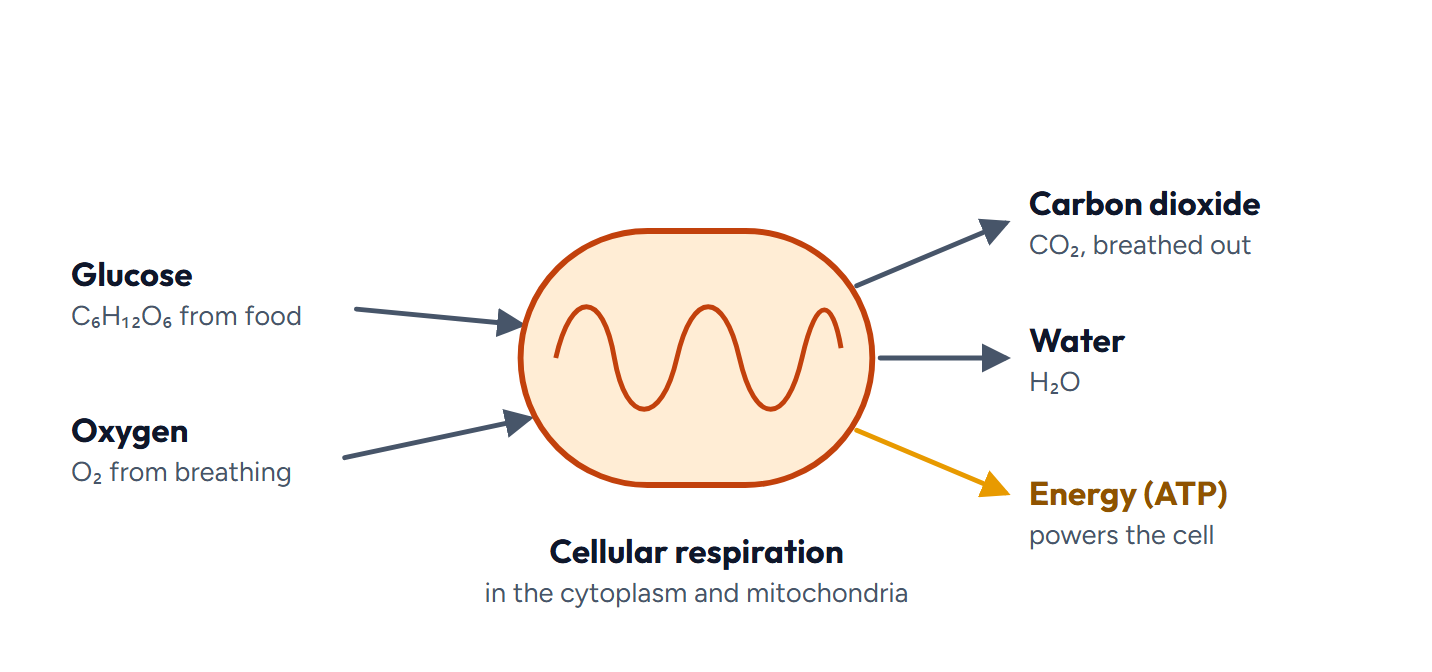
The balanced equation for cellular respiration is C6H12O6 + 6O2 → 6CO2 + 6H2O + energy. Cells break down one molecule of using six molecules of oxygen. This releases six molecules of carbon dioxide, six of water, and energy that the cell captures as .
C6H12O6 + 6O2 produces 6CO2 + 6H2O + energy (ATP)
glucose + oxygen → carbon dioxide + water (+ energy)
The word equation
glucose + oxygen → carbon dioxide + water (+ energy)
Energy is written in brackets, or after a plus sign, because it is released by the reaction rather than being a substance. In cells, part of that energy is captured in a molecule called ATP (adenosine triphosphate), which powers almost everything a cell does. The rest is given off as heat.
What each part of the equation means
| Part | Formula | Role | Where it comes from or goes |
|---|---|---|---|
| Glucose | C6H12O6 | Reactant | From digested food in animals, or made by photosynthesis in plants |
| Oxygen | O2 | Reactant | Breathed in and carried by the blood in animals; in through leaves and roots in plants |
| Carbon dioxide | CO2 | Product | A waste gas. Animals breathe it out; plants can reuse it in photosynthesis |
| Water | H2O | Product | Becomes part of the water inside the cell |
| Energy | ATP | Product | Powers muscle contraction, active transport, making new molecules and keeping warm |
How to balance the respiration equation
The steps are almost the same as for photosynthesis, because the equation is the same one written in reverse.
- Start with the unbalanced equation: C6H12O6 + O2 → CO2 + H2O.
- Balance carbon. Glucose has 6 carbon atoms, so you need 6CO2.
- Balance hydrogen. Glucose has 12 hydrogen atoms, so you need 6H2O.
- Balance oxygen last. The right side has 12 oxygen atoms in 6CO2 and 6 in 6H2O, making 18. Glucose supplies 6, so 12 must come from oxygen gas: 6O2.
Try it yourself
Balance the cellular respiration equation
Change the number in front of each molecule until every type of atom has the same count on both sides.
| Atom | Left side | Right side | Equal? |
|---|
Where cellular respiration happens
It starts in the and is completed inside the mitochondria. Cells that use a lot of energy, such as muscle cells and sperm cells, contain large numbers of mitochondria. Plant cells have mitochondria too, and they respire all the time.
The four stages of aerobic respiration
The overall equation is a summary. Inside the cell, glucose is broken down in four stages. Step through them in order.
Step 1
Glycolysis
In the cytoplasm, one glucose molecule is split into two molecules of . This stage doesn't need oxygen.
- Where
- Cytoplasm
- Net ATP
- 2
- Also makes
- 2
Step 2
Link reaction (pyruvate oxidation)
Each pyruvate moves into a mitochondrion and is converted into a molecule called . One carbon atom is removed from each pyruvate and released as carbon dioxide.
- Where
- Mitochondrial matrix
- Releases
- 2 CO2
Step 3
Krebs cycle (citric acid cycle)
Acetyl CoA is broken down in a cycle of reactions. The rest of the carbon leaves as carbon dioxide, and energy is loaded onto the carrier molecules NADH and .
- Where
- Mitochondrial matrix
- Releases
- 4 CO2
- Net ATP
- 2
Step 4
Electron transport chain
NADH and FADH₂ pass their to proteins in the inner mitochondrial membrane. The energy is used to pump hydrogen ions, which then flow back through an called to make most of the cell's ATP. At the end of the chain, oxygen accepts the electrons and joins with hydrogen ions to form water.
- Where
- Inner mitochondrial membrane
- ATP
- About 26 to 28
- Makes
- Water
Count the carbon dioxide: 2 from the link reaction and 4 from the Krebs cycle make the 6 molecules in the equation. For a closer look at the stage that makes most of the ATP, read the guide to the electron transport chain.
How much energy does respiration release?
Completely breaking down one mole of glucose (180 g) releases about 2,870 kJ of energy. Cells capture part of it as roughly 30 to 32 ATP molecules for every glucose molecule. The rest is released as heat, which is how mammals and birds keep their bodies warm.
Anaerobic respiration equations
When there isn't enough oxygen, cells can still release a small amount of energy. Only glycolysis can run, so anaerobic respiration makes just 2 ATP per glucose molecule.
| Type | Where it happens | Word equation | Symbol equation | ATP per glucose |
|---|---|---|---|---|
| Aerobic | Most cells, with oxygen | glucose + oxygen → carbon dioxide + water | C6H12O6 + 6O2 → 6CO2 + 6H2O | About 30 to 32 |
| Anaerobic in animals | Muscle cells during hard exercise | glucose → lactic acid | C6H12O6 → 2C3H6O3 | 2 |
| Anaerobic in yeast and plants | Yeast, plant roots in waterlogged soil | glucose → ethanol + carbon dioxide | C6H12O6 → 2C2H5OH + 2CO2 | 2 |
For the full story, including a yeast balloon experiment, read our guide to anaerobic respiration, or compare both types in aerobic vs anaerobic respiration.
The carbon dioxide from yeast makes bread rise, and its ethanol is the alcohol in beer and wine. In muscles, lactic acid builds up during hard exercise. Afterwards you keep breathing hard to supply the extra oxygen needed to break it down, which is often called the oxygen debt.
How respiration links to photosynthesis
Photosynthesis makes the glucose and oxygen that respiration uses, and respiration makes the carbon dioxide and water that photosynthesis uses. See the photosynthesis equation, or read photosynthesis vs cellular respiration for a side-by-side comparison.
Cheat sheet
Key facts to remember
The cellular respiration equation
- The balanced equation is C6H12O6 + 6O2 → 6CO2 + 6H2O + energy.
- Word equation: glucose + oxygen → carbon dioxide + water (+ energy).
- The energy is captured as ATP: about 30 to 32 ATP per glucose.
- There are four stages: glycolysis, the link reaction, the Krebs cycle and the electron transport chain.
- Without oxygen, animal cells make lactic acid, and yeast makes ethanol and carbon dioxide.
From Cluecub · www.cluecub.com/cellular-respiration-equation
Practice questions
Check your understanding
5 questions
1. Which is the balanced equation for aerobic respiration?
Option B is photosynthesis, option C isn't balanced, and option D is anaerobic respiration in yeast.
2. Which stage of aerobic respiration makes the most ATP?
The electron transport chain makes about 26 to 28 ATP per glucose. Glycolysis and the Krebs cycle make 2 each.
3. Where does glycolysis take place?
Glycolysis happens in the cytoplasm, before anything enters the mitochondria. That's why it can run without oxygen.
4. What job does oxygen do in aerobic respiration?
Oxygen is the final electron acceptor. Without it, the electron transport chain stops and the cell can only use glycolysis.
5. What does anaerobic respiration in human muscle cells produce?
Human muscles make lactic acid. Ethanol and carbon dioxide come from anaerobic respiration in yeast and plants.
Frequently asked questions
What is the chemical equation for cellular respiration?
The balanced equation is C6H12O6 + 6O2 → 6CO2 + 6H2O + energy, with most of the energy captured as ATP.
What are the reactants and products of cellular respiration?
The reactants are glucose and oxygen. The products are carbon dioxide, water and energy in the form of ATP.
Is cellular respiration the opposite of photosynthesis?
The overall equations are reverses of each other. The reactions inside are different, though. They use different enzymes and happen in different organelles.
Why do cells need oxygen for respiration?
Oxygen accepts electrons at the end of the electron transport chain. Without it, the chain stops, and cells can make only 2 ATP per glucose instead of about 30.
Do plants carry out cellular respiration?
Yes. Every living plant cell respires all the time, day and night, to release energy from glucose.