The big why
How does a plant build sugar out of thin air?
It grabs carbon dioxide from the air and, using energy captured from light, builds it into sugar one carbon at a time.
On this page
- Where does the Calvin cycle take place?
- The three steps of the Calvin cycle
- What goes in and what comes out
- Light-dependent vs light-independent reactions
- Does the Calvin cycle need light?
- RuBisCO: the enzyme that fixes carbon
- How the Calvin cycle fits into photosynthesis
- Key facts to remember
- Check your understanding
- Quizzes, worksheets and labs
- Frequently asked questions
Quick answer
The Calvin cycle, also called the light-independent reactions, is the second stage of photosynthesis. In the of the , it uses and from the light-dependent reactions to turn carbon dioxide into a three-carbon sugar called , which the plant uses to build . It has three steps: carbon fixation, reduction and regeneration of .
Where does the Calvin cycle take place?
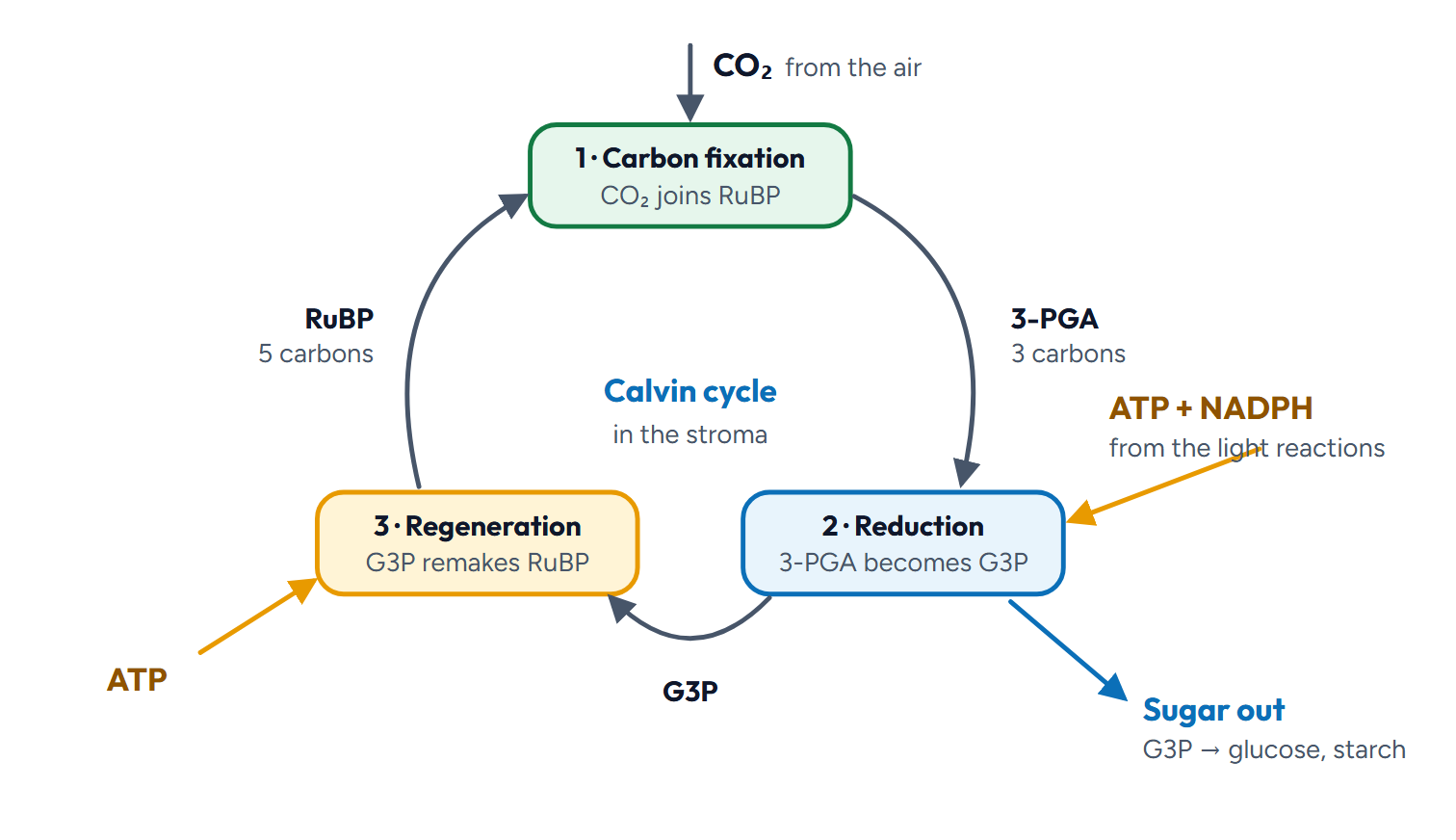
The Calvin cycle (the light-independent reactions) takes place in the stroma of the chloroplast. The stroma is the fluid that fills the chloroplast around the stacks of (see the chloroplast diagram), and in most plants these chloroplasts are packed into the leaf's palisade cells. The stroma holds the for the cycle, including . The light-dependent reactions happen right next door on the thylakoid membranes, so the ATP and NADPH they make don't have far to travel.
It is named after Melvin Calvin, who worked out the steps with Andrew Benson and James Bassham in the 1940s and 1950s using radioactive carbon. Calvin won the Nobel Prize in Chemistry for this work in 1961. You will also see it called the light-independent reactions, the dark reactions or the C3 cycle.
The three steps of the Calvin cycle
The cycle turns three times to fix three molecules of carbon dioxide. Step through what happens in one set of three turns.
Step 1
Carbon fixation
The enzyme RuBisCO attaches each carbon dioxide molecule to a five-carbon sugar called RuBP. The six-carbon molecule this makes is unstable and splits at once into two three-carbon molecules of 3-PGA.
- In
- 3 CO2 + 3 RuBP
- Out
- 6 molecules of 3-PGA
Step 2
Reduction
ATP and NADPH from the light-dependent reactions are used to convert 3-PGA into G3P (glyceraldehyde 3-phosphate). This is where the energy captured from light is stored in a sugar.
- Uses
- 6 ATP and 6 NADPH
- Out
- 6 G3P
Step 3
Sugar leaves the cycle
One of the six G3P molecules leaves the cycle. The plant uses it to make glucose, sucrose, and other molecules.
- Out
- 1 G3P
Step 4
Regeneration of RuBP
The other five G3P molecules are rearranged, using more ATP, to rebuild the three RuBP molecules the cycle started with. Now the cycle can fix more carbon dioxide.
- Uses
- 3 ATP
- Out
- 3 RuBP
What goes in and what comes out
| For every… | Carbon dioxide used | ATP used | NADPH used | Sugar made |
|---|---|---|---|---|
| 3 turns of the cycle | 3 | 9 | 6 | 1 G3P |
| 6 turns of the cycle | 6 | 18 | 12 | 2 G3P, which make 1 glucose |
So making one molecule of glucose takes six turns of the Calvin cycle. The used ATP and NADPH return to the thylakoids as ADP, phosphate and NADP⁺, ready to be recharged by the light-dependent reactions.
Light-dependent vs light-independent reactions
| Light-dependent reactions | Light-independent reactions (Calvin cycle) | |
|---|---|---|
| Where | Thylakoid membranes | Stroma |
| Needs light directly? | Yes | No |
| Uses | Light, water, ADP, NADP⁺ | Carbon dioxide, ATP, NADPH |
| Makes | ATP, NADPH, oxygen | G3P (used to make glucose), ADP, NADP⁺ |
Read more about the first stage in the light-dependent reactions.
Does the Calvin cycle need light?
Not directly. None of its reactions use light energy, which is why it is called "light-independent". But it depends on the ATP and NADPH made by the light-dependent reactions, and several of its enzymes are only switched on in the light. So in practice, the Calvin cycle runs during the day and stops soon after dark.
RuBisCO: the enzyme that fixes carbon
RuBisCO is the enzyme that grabs carbon dioxide from the air and adds it to RuBP. It is often described as the most abundant protein on Earth, because plants need so much of it.
RuBisCO is slow, and it sometimes grabs oxygen instead of carbon dioxide. This wasteful side reaction is called photorespiration, and it happens more on hot, dry days. Plants such as maize and sugar cane (called C4 plants) have extra steps that concentrate carbon dioxide around RuBisCO to avoid it.
How the Calvin cycle fits into photosynthesis
The overall photosynthesis equation summarises two linked stages, which you can see side by side in the photosynthesis diagram:
- The light-dependent reactions capture light energy as ATP and NADPH, and release oxygen.
- The Calvin cycle spends that ATP and NADPH to build sugar from carbon dioxide.
The carbon atoms in the glucose come from carbon dioxide via the Calvin cycle. The oxygen gas comes from water split in the light reactions.
Cheat sheet
Key facts to remember
The Calvin cycle (light-independent reactions)
- The Calvin cycle is the second stage of photosynthesis. It happens in the stroma.
- It uses ATP and NADPH from the light-dependent reactions.
- Its three steps are carbon fixation, reduction and regeneration of RuBP.
- The enzyme RuBisCO fixes carbon dioxide by joining it to RuBP.
- It makes a three-carbon sugar called G3P, which the plant uses to build glucose.
- It doesn't use light directly, but it stops soon after dark.
From Cluecub · www.cluecub.com/calvin-cycle
Practice questions
Check your understanding
5 questions
1. Where does the Calvin cycle take place?
The Calvin cycle happens in the stroma, the fluid around the thylakoids inside the chloroplast.
2. Which enzyme fixes carbon dioxide in the Calvin cycle?
RuBisCO attaches carbon dioxide to RuBP in the carbon fixation step.
3. Which two molecules from the light-dependent reactions does the Calvin cycle use?
ATP provides energy and NADPH provides the needed to turn 3-PGA into G3P.
4. How many turns of the Calvin cycle are needed to make one glucose molecule?
Each turn fixes one carbon dioxide. Glucose has six carbon atoms, so it takes six turns.
5. What happens in the regeneration step?
Five of every six G3P molecules are used, with ATP, to rebuild RuBP. Without this step the cycle would run out of RuBP.
Frequently asked questions
What is the Calvin cycle?
It is the second stage of photosynthesis, in which carbon dioxide is turned into sugar using ATP and NADPH from the light-dependent reactions.
Where do the light-independent reactions take place?
In the stroma of the chloroplast, the fluid around the thylakoids. The light-independent reactions are another name for the Calvin cycle.
What are the products of the Calvin cycle?
The useful product is G3P, a three-carbon sugar used to make glucose and other molecules. It also returns ADP, phosphate and NADP⁺ to the light-dependent reactions.
What are the three steps of the Calvin cycle?
Carbon fixation, reduction, and regeneration of RuBP.
Why is the Calvin cycle called light-independent?
None of its reactions use light directly. It still relies on ATP and NADPH from the light-dependent reactions, so it mainly runs in daylight.
How many ATP and NADPH does the Calvin cycle use?
For every three carbon dioxide molecules fixed, it uses 9 ATP and 6 NADPH. Making one glucose takes 18 ATP and 12 NADPH.