The big why
Where does the oxygen we breathe come from?
Plants make it by splitting water with the energy of light. Every oxygen molecule they release started out as part of a water molecule.
On this page
- What goes in and what comes out
- Where the light-dependent reactions take place
- The steps, one at a time
- Where the oxygen comes from
- Cyclic and non-cyclic photophosphorylation
- Light-dependent reactions vs the Calvin cycle
- A similar chain in your own cells
- Key facts to remember
- Check your understanding
- Quizzes, worksheets and labs
- Frequently asked questions
Quick answer
The light-dependent reactions are the first stage of photosynthesis. They take place on the membranes inside . Light energy is used to split water, which releases oxygen, and the energy is captured in two carrier molecules, and . The Calvin cycle then uses ATP and NADPH to make sugar.
What goes in and what comes out
| Goes in | Comes out |
|---|---|
| Light energy | ATP (to the Calvin cycle) |
| Water (H2O) | NADPH (to the Calvin cycle) |
| ADP and phosphate | Oxygen (O2), released as a by-product |
| NADP⁺ | Hydrogen ions, which build up in the thylakoid space |
Notice that no sugar is made here and no carbon dioxide is used. Those both belong to the Calvin cycle.
Where the light-dependent reactions take place
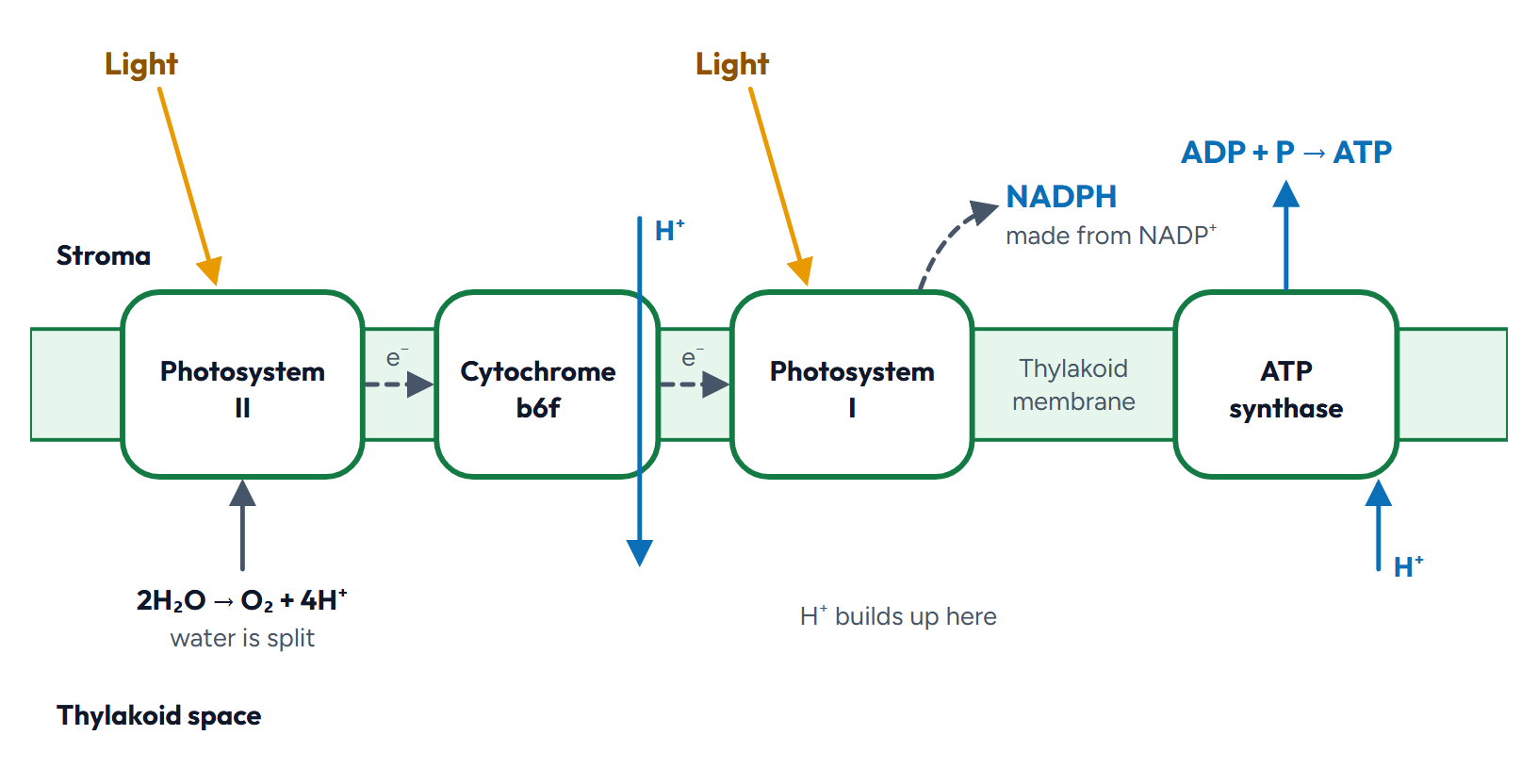
They happen in and across the thylakoid membranes. Thylakoids are flattened sacs stacked into piles called . Their membranes hold chlorophyll, the photosystems and the other proteins in the diagram. Stacking many thylakoids together gives a huge membrane area to catch light.
The space inside each thylakoid is called the thylakoid space (or lumen). The fluid outside, in the rest of the chloroplast, is the . Every part is labelled in our chloroplast diagram, and the photosynthesis diagram shows how both stages fit together.
The steps, one at a time
Step 1
Light hits photosystem II
molecules in photosystem II absorb light. The energy is passed to a special pair of chlorophyll molecules, which lose two high-energy electrons.
- Where
- Thylakoid membrane
Step 2
Water is split
To replace the lost electrons, photosystem II splits water molecules. This is called photolysis. It releases oxygen gas and hydrogen ions into the thylakoid space.
- Reaction
- 2H2O → O2 + 4H⁺ + 4 electrons
Step 3
Electrons pass along a transport chain
The electrons move through a chain of carriers, including the cytochrome b6f complex. Energy released along the way pumps more hydrogen ions into the thylakoid space.
- Result
- Hydrogen ions build up inside the thylakoid
Step 4
Photosystem I re-energises the electrons
Light hits photosystem I and boosts the electrons to a high energy level again. They are passed to NADP⁺, which picks up a hydrogen ion to become NADPH.
- Makes
- NADPH
Step 5
ATP synthase makes ATP
Hydrogen ions are now much more concentrated inside the thylakoid. They flow back out to the stroma through an called ATP synthase, which uses their movement to join ADP and phosphate into ATP. This process is called chemiosmosis.
- Makes
- ATP
Where the oxygen comes from
All the oxygen gas released by photosynthesis comes from the water split by photosystem II, not from carbon dioxide. This is the oxygen that fills our atmosphere. You can read how scientists proved this in the photosynthesis equation guide.
Cyclic and non-cyclic photophosphorylation
Making ATP using light is called photophosphorylation. It can happen in two ways.
| Non-cyclic | Cyclic | |
|---|---|---|
| Photosystems used | II and I | I only |
| Electrons end up in | NADPH | Back at photosystem I |
| Products | ATP, NADPH and oxygen | ATP only |
| Why it matters | The main pathway | Tops up extra ATP, because the Calvin cycle needs more ATP than NADPH |
Light-dependent reactions vs the Calvin cycle
| Light-dependent reactions | Calvin cycle | |
|---|---|---|
| Where | Thylakoid membranes | Stroma |
| Needs light directly? | Yes | No, but needs their ATP and NADPH |
| Uses | Light, water, ADP, NADP⁺ | Carbon dioxide, ATP, NADPH |
| Makes | ATP, NADPH, oxygen | sugar (for glucose) |
The two stages depend on each other. The light reactions make the ATP and NADPH, and the Calvin cycle sends back ADP, phosphate and NADP⁺ to be recharged.
A similar chain in your own cells
Your mitochondria use almost the same trick. The electron transport chain in cellular respiration also passes electrons along membrane proteins, pumps hydrogen ions, and lets them flow back through ATP synthase to make ATP.
Cheat sheet
Key facts to remember
The light-dependent reactions
- The light-dependent reactions are the first stage of photosynthesis.
- They happen on the thylakoid membranes inside chloroplasts.
- Chlorophyll in the photosystems absorbs light energy.
- Water is split, releasing oxygen, hydrogen ions and electrons.
- The energy is stored in ATP and NADPH, which go to the Calvin cycle.
From Cluecub · www.cluecub.com/light-dependent-reactions
Practice questions
Check your understanding
5 questions
1. Where do the light-dependent reactions take place?
The photosystems and electron carriers sit in the thylakoid membranes.
2. What are the products of the light-dependent reactions?
The light reactions make ATP and NADPH for the Calvin cycle, and release oxygen.
3. Where does the oxygen released in photosynthesis come from?
Photosystem II splits water to replace its lost electrons, and this releases oxygen gas.
4. What drives ATP synthase to make ATP?
Hydrogen ions build up inside the thylakoid and flow back to the stroma through ATP synthase. This is chemiosmosis.
5. Which happens in cyclic photophosphorylation?
Cyclic photophosphorylation uses only photosystem I. The electrons loop back, so it makes ATP but no NADPH or oxygen.
Frequently asked questions
What happens in the light-dependent reactions?
Light energy is absorbed by chlorophyll, water is split to release oxygen, and the energy is stored in ATP and NADPH for the Calvin cycle.
What are the reactants and products of the light-dependent reactions?
The reactants are water, light, ADP, phosphate and NADP⁺. The products are ATP, NADPH and oxygen.
Where do the light-dependent reactions occur?
On the thylakoid membranes inside chloroplasts.
What is the difference between the light-dependent and light-independent reactions?
The light-dependent reactions use light to make ATP, NADPH and oxygen. The light-independent reactions (the Calvin cycle) use that ATP and NADPH to turn carbon dioxide into sugar.