The big why
Why are plants green?
Chlorophyll soaks up red and blue light for photosynthesis but reflects most of the green, so green is the colour that reaches your eyes.
On this page
- What does chlorophyll do?
- Why is chlorophyll green?
- Where is chlorophyll found?
- Types of chlorophyll
- Other leaf pigments
- The structure of chlorophyll
- Try it: separate leaf pigments with chromatography
- Chlorophyll and photosynthesis at a glance
- Key facts to remember
- Check your understanding
- Quizzes, worksheets and labs
- Frequently asked questions
Quick answer
Chlorophyll is the green pigment in plants, algae and cyanobacteria that absorbs light energy for photosynthesis. It is found in the membranes of . Chlorophyll absorbs mostly blue and red light and reflects green light, which is why plants look green. The energy it captures is used to split water and make the and that turn carbon dioxide into sugar.
What does chlorophyll do?
Chlorophyll's job is to catch light energy and pass it into photosynthesis. It is the first step in turning sunlight into food.
Step 1
It absorbs light
When light hits a leaf, chlorophyll molecules absorb blue and red light. The energy of the light excites in the chlorophyll, raising them to a higher energy level.
- Absorbs
- Mostly blue and red light
Step 2
It passes the energy along
Hundreds of chlorophyll molecules are grouped together with proteins in a . Like a satellite dish, they collect light over a wide area and pass the energy from molecule to molecule towards the centre.
- Where
- Thylakoid membranes
Step 3
It gives away an electron
At the reaction centre, a special pair of chlorophyll a molecules uses the energy to give away an energised electron. That electron starts the electron transport chain of the light-dependent reactions.
- Starts
- The light-dependent reactions
Step 4
Water fills the gap
The chlorophyll that lost an electron takes a replacement from water. Splitting water this way releases oxygen, which is where the oxygen in the air comes from.
- Releases
- O2
The energy chlorophyll captures ends up in two carrier molecules, ATP and NADPH. The Calvin cycle then uses them to build sugar from carbon dioxide. Without chlorophyll, there would be no way to get the Sun's energy into the food chain. Read the full story in the light-dependent reactions.
Why is chlorophyll green?
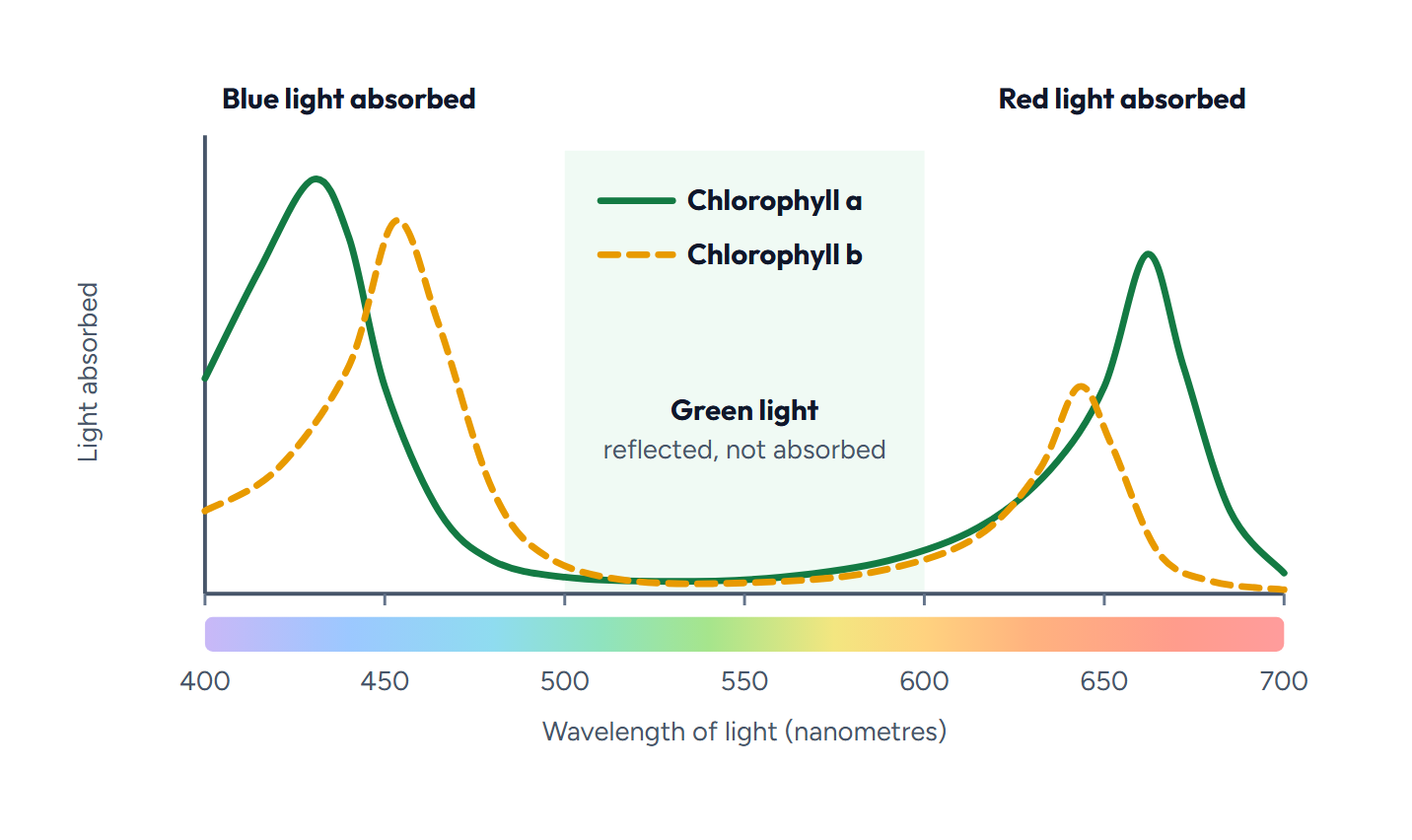
White sunlight is a mix of all the colours of the rainbow. Chlorophyll absorbs blue and red light strongly, but absorbs very little green light. The green light is reflected or passes through the leaf, so that is the colour your eyes see.
| Colour of light | Wavelength (roughly) | What chlorophyll does |
|---|---|---|
| Blue and violet | 400 to 500 nm | Absorbs it strongly |
| Green and yellow | 500 to 600 nm | Absorbs very little; most is reflected |
| Orange and red | 600 to 700 nm | Absorbs it strongly, especially red |
A graph of how much light a pigment absorbs at each colour is called its absorption spectrum, like the diagram above.
Where is chlorophyll found?
Chlorophyll is found in the chloroplasts of plant and algae cells, built into the thylakoid membranes. Most of it is in the leaves, especially the palisade cells near the top, where the light is strongest. See every part in the chloroplast diagram, or follow it from the whole plant down in where does photosynthesis take place?
Roots, wood and petals don't have chlorophyll, which is why they aren't green. Cyanobacteria have chlorophyll too, but no chloroplasts: their thylakoid membranes sit loose inside the cell.
Types of chlorophyll
There are several types of chlorophyll. Plants use two of them.
| Type | Colour | Found in | Role |
|---|---|---|---|
| Chlorophyll a | Blue-green | All plants, algae and cyanobacteria | The main pigment. It sits at the reaction centres and starts the light reactions |
| Chlorophyll b | Yellow-green | Plants and green algae | An accessory pigment. It catches light at slightly different colours and passes the energy to chlorophyll a |
| Chlorophyll c | Green | Brown algae such as kelp, and diatoms | Accessory pigment in these algae |
| Chlorophyll d and f | Green | Some cyanobacteria | Absorb far-red light, so these bacteria can live in very shady places |
In a typical leaf there is about three times as much chlorophyll a as chlorophyll b. Having two types widens the range of light a plant can use.
Other leaf pigments
Chlorophyll isn't the only pigment in a leaf. Carotenoids are yellow and orange pigments, the same kind that make carrots orange. They absorb blue-green light that chlorophyll misses and pass the energy on. They also protect the leaf by soaking up extra energy on very bright days.
This explains autumn colours. Before trees drop their leaves, they break down the chlorophyll and take back its useful parts. The yellow and orange carotenoids, which were there all along, finally show through. Red autumn colours come from different pigments, called anthocyanins, that some trees make at this time.
The structure of chlorophyll
A chlorophyll molecule has two parts.
- A flat ring of carbon and nitrogen atoms, with a magnesium ion at the centre. This ring is the part that absorbs light.
- A long tail made of carbon and hydrogen. It anchors the molecule into the thylakoid membrane.
The chemical formula of chlorophyll a is C₅₅H₇₂O₅N₄Mg. Chlorophyll b differs by only one small group of atoms (C₅₅H₇₀O₆N₄Mg), but that is enough to shift the colours it absorbs.
The ring looks a lot like haem, the part of haemoglobin that carries oxygen in your blood. The big difference is the metal in the middle: magnesium in chlorophyll, iron in haem.
Try it: separate leaf pigments with chromatography
You can see that a leaf contains more than one pigment using paper chromatography. Ask an adult to help, as rubbing alcohol is flammable.
You need: fresh spinach leaves, a strip of white coffee filter paper about 2 cm wide, a coin, a pencil, a tall glass, and isopropyl rubbing alcohol (nail varnish remover with acetone also works).
- Draw a pencil line across the paper strip, about 2 cm from the bottom.
- Lay a spinach leaf over the line and roll the edge of the coin firmly along it, pressing a green line of pigment into the paper. Repeat a few times with fresh parts of the leaf to make it dark.
- Pour about 1 cm of alcohol into the glass. Stand the strip in it so the green line is above the liquid. Cover the glass with foil to stop it evaporating.
- Wait 30 to 60 minutes as the alcohol climbs the paper, then take the strip out and let it dry.
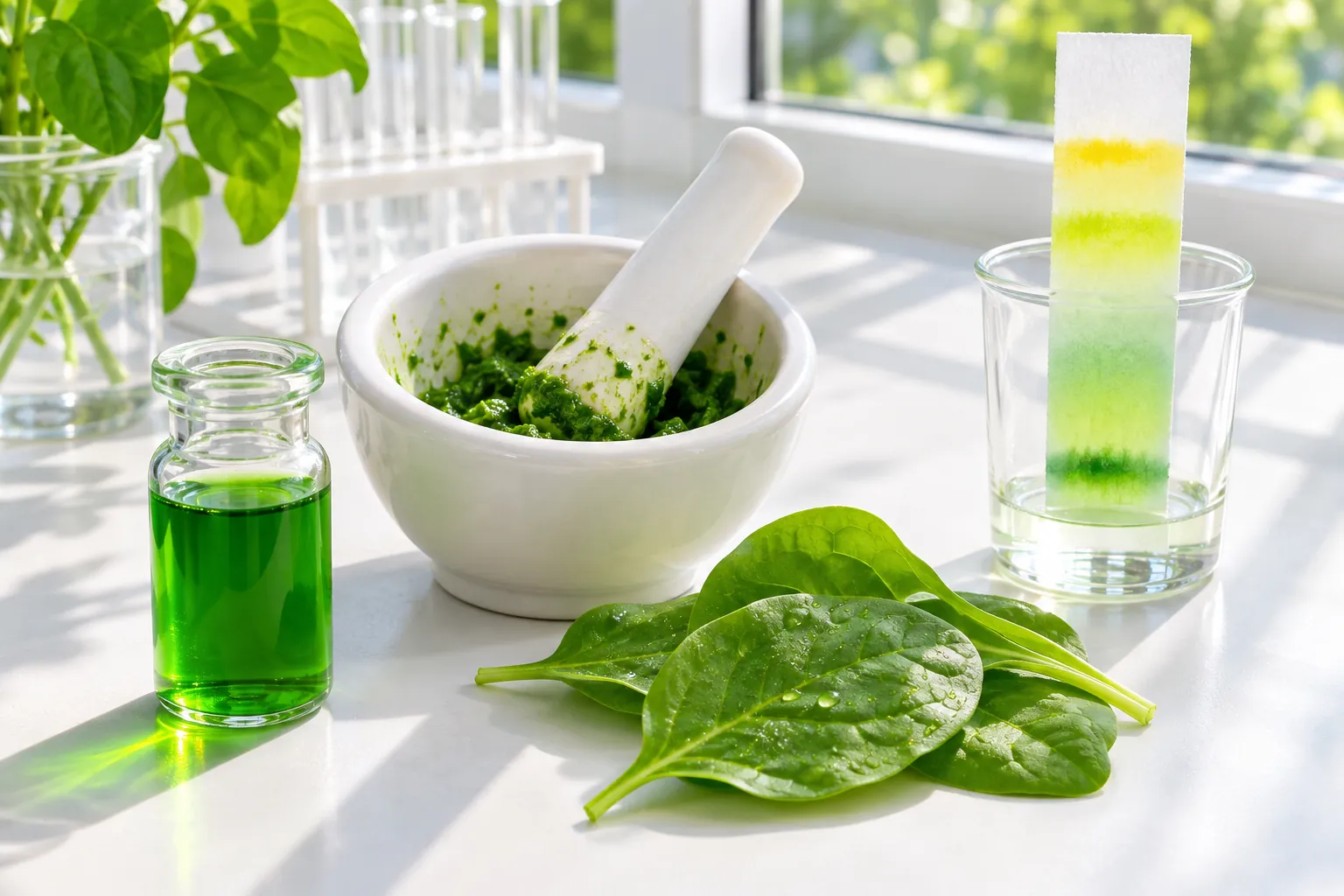
You should see the green line split into separate bands: yellow and orange carotenoids travel furthest, then blue-green chlorophyll a, with yellow-green chlorophyll b usually lowest. Each pigment dissolves and sticks to the paper differently, so each travels a different distance.
Chlorophyll and photosynthesis at a glance
| Question | Answer |
|---|---|
| What is it? | A green pigment |
| Where is it? | Thylakoid membranes in chloroplasts |
| What does it absorb? | Mostly blue and red light |
| What does it reflect? | Green light |
| Main types in plants | Chlorophyll a and chlorophyll b |
| Metal at its centre | Magnesium |
| What it makes possible | The light-dependent reactions of photosynthesis |
In the photosynthesis equation, chlorophyll is written above the arrow. It is needed for the reaction, but it isn't used up, so it isn't a reactant. Explaining it to a younger child? See photosynthesis for kids.
Cheat sheet
Key facts to remember
What is chlorophyll?
- Chlorophyll is the green pigment that absorbs light energy for photosynthesis.
- It is found in the thylakoid membranes of chloroplasts.
- It absorbs mostly blue and red light, and reflects green light.
- Plants have two main types: chlorophyll a and chlorophyll b.
- Each chlorophyll molecule has a magnesium ion at the centre of a ring.
- Plants need magnesium and nitrogen from the soil to make chlorophyll.
From Cluecub · www.cluecub.com/what-is-chlorophyll
Practice questions
Check your understanding
5 questions
1. Where in the cell is chlorophyll found?
Chlorophyll is built into the thylakoid membranes inside chloroplasts, where the light-dependent reactions happen.
2. Which colours of light does chlorophyll absorb most?
Chlorophyll absorbs blue and red light strongly and reflects most green light.
3. Why do leaves look green?
Chlorophyll absorbs little green light. The green is reflected, so that's the colour we see.
4. Which metal ion is at the centre of a chlorophyll molecule?
Chlorophyll has magnesium at its centre. Haem, in your blood, has iron.
5. Why do many leaves turn yellow in autumn?
Trees break down chlorophyll before dropping their leaves. The carotenoids were there all along, hidden by the green.
Frequently asked questions
What is chlorophyll in simple terms?
Chlorophyll is the green substance in plants that catches sunlight. Plants use the energy it catches to make their food by photosynthesis.
What does chlorophyll do?
It absorbs light energy, mostly blue and red light, and uses it to start photosynthesis. The energy is used to split water, releasing oxygen, and to make ATP and NADPH for building sugar.
Why is chlorophyll important?
Without chlorophyll, plants couldn't capture the Sun's energy. Almost all food chains, and almost all the oxygen in the air, depend on it.
What is the difference between chlorophyll and chloroplasts?
Chlorophyll is a pigment molecule. Chloroplasts are the in plant cells that contain chlorophyll and carry out photosynthesis.
Do all plants have chlorophyll?
Almost all do. A few parasitic plants, such as dodder, have little or no chlorophyll and take their food from other plants instead.