The big why
Why do you need food even when you're asleep?
Every one of your cells is releasing energy from food all day and all night, just to stay alive.
On this page
- Why cells need respiration
- Where cellular respiration happens
- The 4 steps of cellular respiration
- Aerobic and anaerobic respiration
- Cellular respiration is not breathing
- How respiration links to photosynthesis
- What happens to the energy?
- Key facts to remember
- Check your understanding
- Quizzes, worksheets and labs
- Frequently asked questions
Quick answer
Cellular respiration is the process cells use to release energy from food. reacts with oxygen to make carbon dioxide and water, and the energy released is stored in a molecule called , which powers everything the cell does. It happens in every living cell, mostly inside the , all day and all night.
C6H12O6 + 6O2 produces 6CO2 + 6H2O + energy (ATP)
glucose + oxygen → carbon dioxide + water (+ energy)
Why cells need respiration
Every living thing needs energy. You use it to move, grow, think, keep warm and repair damage. Plants use it to build new leaves and roots. But cells can't use the energy in food directly. They first have to move it into ATP (adenosine triphosphate), a small molecule that works like a rechargeable battery. Cellular respiration is how they do it.
Food contains energy because plants captured it from sunlight during photosynthesis and stored it in glucose. When you eat, you take in that stored energy. Respiration releases it again.
Where cellular respiration happens
It starts in the and finishes inside the mitochondria, the small often called the "powerhouses" of the cell. Cells that use a lot of energy, such as muscle, heart and brain cells, have large numbers of mitochondria.
Plant cells have mitochondria too. Plants respire all the time, day and night, just like animals.
The 4 steps of cellular respiration
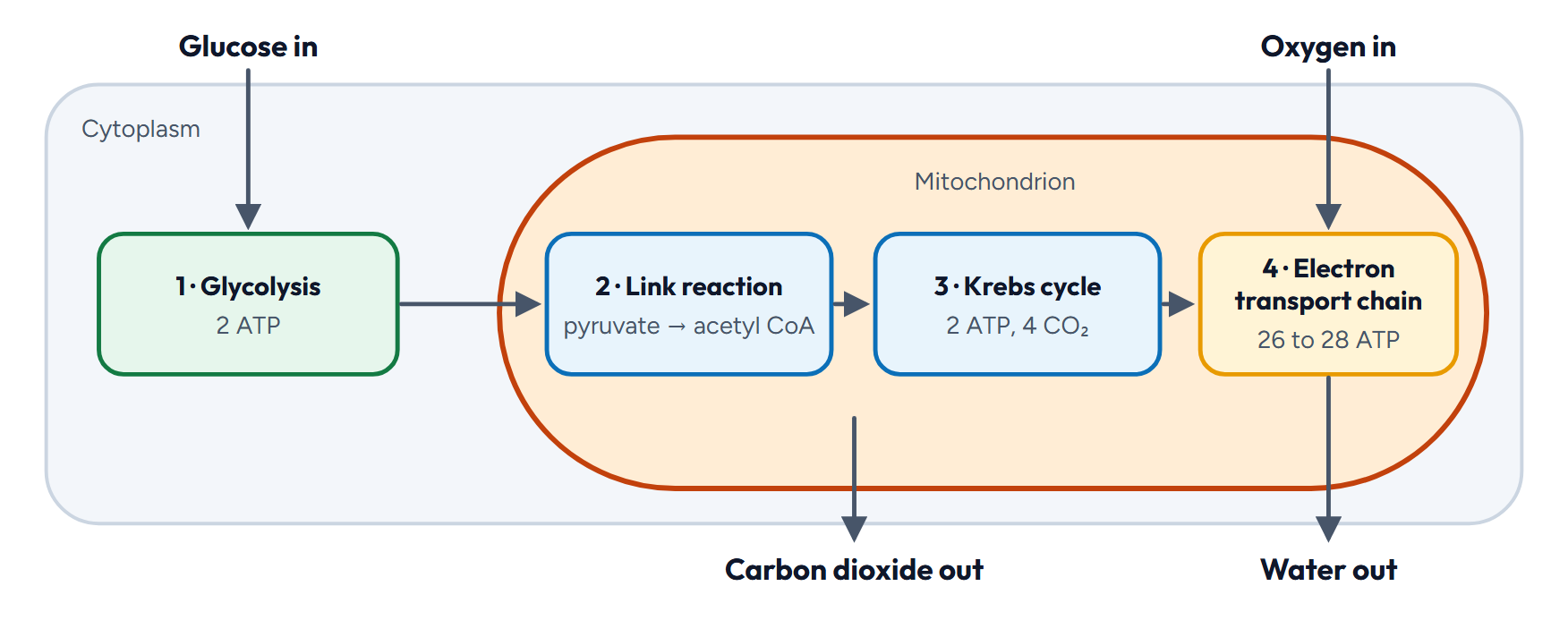
The equation above is a summary. In the cell, happens in four steps, or stages: glycolysis, the link reaction, the Krebs cycle and the transport chain. Glucose is broken down a little at a time, so its energy is released gradually and not all at once as heat.
| Stage | Where | What happens | ATP per glucose |
|---|---|---|---|
| 1. Glycolysis | Cytoplasm | Glucose is split into 2 | 2 |
| 2. Link reaction | Mitochondrial matrix | Pyruvate becomes , releasing carbon dioxide | 0 |
| 3. Krebs cycle | Mitochondrial matrix | Acetyl CoA is broken down to carbon dioxide; energy is loaded onto and | 2 |
| 4. Electron transport chain | Inner mitochondrial membrane | NADH and FADH₂ power ; oxygen accepts electrons and forms water | About 26 to 28 |
| Total | About 30 to 32 |
For the balanced equation in detail, including how to balance it yourself, see the cellular respiration equation.
Aerobic and anaerobic respiration
What we have described so far is aerobic respiration, which uses oxygen. When oxygen runs short, cells can switch to anaerobic respiration. It only uses glycolysis, so it makes just 2 ATP per glucose.
- In animal muscle cells, it makes lactic acid.
- In yeast and plants, it makes ethanol and carbon dioxide.
Read anaerobic respiration for the equations and a yeast balloon experiment, or aerobic vs anaerobic respiration for a side-by-side comparison.
Cellular respiration is not breathing
This is the most common mix-up in the whole topic.
| Breathing | Cellular respiration | |
|---|---|---|
| What it is | Moving air in and out of the lungs | A chemical reaction that releases energy from glucose |
| Where | Lungs and airways | Inside every living cell |
| Who does it | Animals with lungs or gills | Every living thing, including plants and bacteria |
| Job | Brings in oxygen and removes carbon dioxide | Uses oxygen and makes carbon dioxide |
Breathing supports respiration by supplying the oxygen it needs and getting rid of the carbon dioxide it makes.
How respiration links to photosynthesis
Respiration and photosynthesis are like two halves of a loop. Photosynthesis uses carbon dioxide and water to make glucose and oxygen. Respiration uses glucose and oxygen to make carbon dioxide and water, releasing the energy for life. See photosynthesis vs cellular respiration for a full comparison, or the whole photosynthesis and cellular respiration learning path.
What happens to the energy?
About a third of the energy in glucose ends up in ATP. The rest is released as heat. That isn't wasted for mammals and birds: it is how they keep their bodies warm. Your cells use ATP to:
- make muscles contract
- send nerve signals
- move substances in and out of cells (active transport)
- build proteins, DNA and other large molecules
- divide and grow
Cheat sheet
Key facts to remember
What is cellular respiration?
- Cellular respiration releases energy from food in every living cell, day and night.
- Glucose + oxygen → carbon dioxide + water, with the energy stored as ATP.
- Most of it happens in the mitochondria. Glycolysis happens in the cytoplasm.
- The four stages are glycolysis, the link reaction, the Krebs cycle and the electron transport chain.
- Respiration is not breathing. Breathing moves gases in and out; respiration is a chemical reaction in cells.
From Cluecub · www.cluecub.com/cellular-respiration
Practice questions
Check your understanding
5 questions
1. What is the main purpose of cellular respiration?
Respiration releases the energy stored in glucose and captures it as ATP, which the cell can use.
2. In which organelle does most of cellular respiration happen?
Glycolysis happens in the cytoplasm, but the other three stages, which make most of the ATP, happen in the mitochondria.
3. What are the products of aerobic respiration?
Glucose and oxygen are the reactants. Carbon dioxide, water and energy as ATP are the products.
4. Which stage of respiration makes the most ATP?
The electron transport chain makes about 26 to 28 of the roughly 30 to 32 ATP per glucose.
5. Which statement about plants is correct?
Plant cells respire day and night. They photosynthesise only when there is light.
Frequently asked questions
What is cellular respiration in simple terms?
It is how cells release energy from food. Glucose and oxygen react to make carbon dioxide and water, and the energy is stored as ATP.
What is the equation for cellular respiration?
glucose + oxygen → carbon dioxide + water (+ energy), or C6H12O6 + 6O2 → 6CO2 + 6H2O + energy.
What are the 4 stages of cellular respiration?
Glycolysis, the link reaction, the Krebs cycle and the electron transport chain.
Where does cellular respiration take place?
It starts in the cytoplasm with glycolysis and finishes in the mitochondria.
Is cellular respiration the same as breathing?
No. Breathing moves air in and out of the lungs. Cellular respiration is a chemical reaction inside cells. Breathing supplies the oxygen that respiration uses.