The big why
How do red blood cells get energy with no mitochondria?
They rely entirely on glycolysis, a quick chain of 10 reactions that splits sugar in the cytoplasm without needing oxygen.
On this page
Quick answer
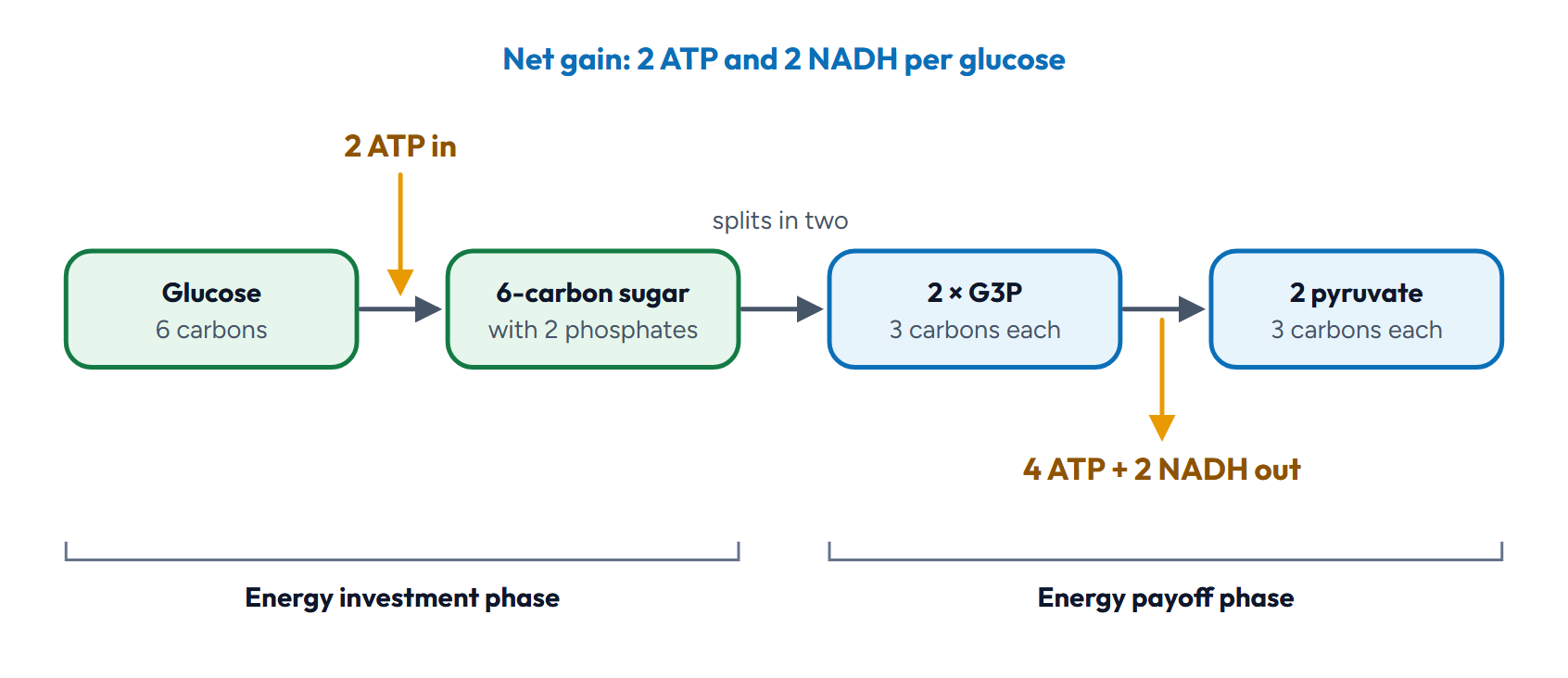
Glycolysis is the first stage of cellular respiration. It happens in the and doesn't need oxygen. It splits one molecule (6 carbons) into two molecules of (3 carbons each). Along the way, it uses 2 and makes 4, for a net gain of 2 ATP, and it also makes 2 .
What glycolysis means
The name comes from two Greek words: glyco, meaning sugar, and lysis, meaning splitting. So glycolysis literally means "sugar splitting". It is a chain of 10 reactions, each controlled by its own .
Glycolysis is found in almost every living thing, from bacteria to people. That suggests it evolved very early in the history of life, before there was much oxygen in the air.
Where does glycolysis take place?
Glycolysis takes place in the cytoplasm of the cell, the jelly-like fluid outside the nucleus and the . It happens in the cytoplasm of almost every cell, in plants, animals, fungi and bacteria. Its enzymes are dissolved in the cytoplasm, so it needs no at all.
That is why it is the one stage of respiration that bacteria and red blood cells can still carry out, even though they have no mitochondria. Only after glycolysis does pyruvate move into the mitochondria, and only if oxygen is available.
Products of glycolysis
For each glucose molecule, the products of glycolysis are 2 pyruvate, a net gain of 2 ATP and 2 NADH. Here is everything that goes in and comes out.
| Goes in | Comes out |
|---|---|
| 1 glucose | 2 pyruvate |
| 2 ATP (spent in phase 1) | 4 ATP (made in phase 2), so a net gain of 2 ATP |
| 2 NAD⁺ | 2 NADH |
| 4 ADP and 4 phosphate | 2 water |
The 10 steps of glycolysis
The 10 steps fall into two phases: an energy investment phase (steps 1 to 5) and an energy payoff phase (steps 6 to 10). Step through the key moments first.
Step 1
Energy investment: glucose is trapped
An enzyme called hexokinase adds a phosphate group from ATP to glucose. This traps glucose inside the cell, because the phosphate group stops it passing back out through the membrane.
- Uses
- 1 ATP
Step 2
Energy investment: a second phosphate
The molecule is rearranged, then the enzyme phosphofructokinase adds a second phosphate from another ATP. This makes a six-carbon sugar with a phosphate at each end. Phosphofructokinase is the main control point, speeding glycolysis up or slowing it down to match the cell's need for energy.
- Uses
- 1 ATP
Step 3
Splitting: two 3-carbon halves
The six-carbon sugar is split into two three-carbon molecules. One of them is rearranged so both become (glyceraldehyde 3-phosphate). From here on, everything happens twice for each glucose.
- Makes
- 2 G3P
Step 4
Energy payoff: NADH is made
Each G3P gives up hydrogen and to NAD⁺, making NADH. Each G3P also gains another phosphate group from the cytoplasm.
- Makes
- 2 NADH
Step 5
Energy payoff: ATP is made
Phosphate groups are passed from the sugar molecules straight onto ADP, making ATP. This happens twice for each G3P. The final product of each half is pyruvate.
- Makes
- 4 ATP and 2 pyruvate
Making ATP by moving a phosphate group straight from a sugar molecule onto ADP is called substrate-level phosphorylation. It is different from the way most ATP is made later, in the electron transport chain.
Here are all 10 steps, with the enzyme that controls each one. Steps 6 to 10 happen twice for every glucose, once for each G3P.
| Step | What happens | Enzyme | Energy |
|---|---|---|---|
| 1 | Glucose → glucose 6-phosphate | Hexokinase | Uses 1 ATP |
| 2 | Glucose 6-phosphate → fructose 6-phosphate | Phosphoglucose isomerase | None |
| 3 | Fructose 6-phosphate → fructose 1,6-bisphosphate | Phosphofructokinase | Uses 1 ATP |
| 4 | Fructose 1,6-bisphosphate splits into G3P and DHAP | Aldolase | None |
| 5 | DHAP → G3P, so there are now 2 G3P | Triose phosphate isomerase | None |
| 6 | G3P → 1,3-bisphosphoglycerate | G3P dehydrogenase | Makes 1 NADH (×2) |
| 7 | 1,3-bisphosphoglycerate → 3-phosphoglycerate | Phosphoglycerate kinase | Makes 1 ATP (×2) |
| 8 | 3-phosphoglycerate → 2-phosphoglycerate | Phosphoglycerate mutase | None |
| 9 | 2-phosphoglycerate → phosphoenolpyruvate, releasing water | Enolase | None |
| 10 | Phosphoenolpyruvate → pyruvate | Pyruvate kinase | Makes 1 ATP (×2) |
Does glycolysis need oxygen?
No. None of its reactions use oxygen, so glycolysis is anaerobic. But it does need a steady supply of NAD⁺. Each glucose turns 2 NAD⁺ into 2 NADH, and if all the NAD⁺ runs out, glycolysis stops.
- With oxygen, NADH passes its electrons to the electron transport chain in the mitochondria, which turns it back into NAD⁺.
- Without oxygen, the cell turns pyruvate into or , which also turns NADH back into NAD⁺. This is anaerobic respiration, also called fermentation.
What happens to pyruvate next?
| Conditions | What happens to pyruvate | Total ATP per glucose |
|---|---|---|
| Oxygen available | Moves into the mitochondria, becomes acetyl CoA, and enters the Krebs cycle | About 30 to 32 |
| No oxygen, in animals | Turned into lactic acid | 2 |
| No oxygen, in yeast and plants | Turned into ethanol and carbon dioxide | 2 |
See aerobic vs anaerobic respiration for the full comparison, or the cellular respiration equation for how glycolysis fits into the whole process.
Why glycolysis matters
Although it makes only 2 ATP per glucose, glycolysis is the only way some cells can make ATP. Red blood cells have no mitochondria, so they rely on glycolysis entirely. Fast-working muscle cells also use it heavily during short bursts of activity, because it is quick.
Cheat sheet
Key facts to remember
Glycolysis
- Glycolysis is the first stage of cellular respiration.
- It happens in the cytoplasm and doesn't need oxygen.
- It splits one glucose (6 carbons) into two pyruvate (3 carbons each).
- It uses 2 ATP and makes 4, a net gain of 2 ATP, plus 2 NADH.
- Its 10 reactions form two phases: energy investment and energy payoff.
From Cluecub · www.cluecub.com/glycolysis
Practice questions
Check your understanding
5 questions
1. Where in the cell does glycolysis take place?
Glycolysis happens in the cytoplasm. Its product, pyruvate, can then move into the mitochondria.
2. What is the net ATP gain from glycolysis per glucose?
Glycolysis makes 4 ATP but uses 2 at the start, giving a net gain of 2.
3. What are the end products of glycolysis?
One glucose becomes 2 pyruvate, with a net gain of 2 ATP and 2 NADH.
4. Does glycolysis need oxygen?
Glycolysis is anaerobic. It does need NAD⁺, which is recycled either by the electron transport chain or by fermentation.
5. Why is ATP used at the start of glycolysis?
The two ATP add phosphate groups. This traps glucose in the cell and makes the molecule ready to split.
Frequently asked questions
Where does glycolysis take place?
In the cytoplasm of the cell, not in the mitochondria. It happens in almost all living cells, including bacteria and red blood cells.
What is glycolysis in simple terms?
It is the first stage of respiration, where a glucose molecule is split into two smaller pyruvate molecules, releasing a small amount of energy as ATP.
What are the products of glycolysis?
2 pyruvate, a net gain of 2 ATP, and 2 NADH for each glucose molecule.
How many steps are in glycolysis?
Ten steps, each controlled by a different enzyme. Steps 1 to 5 are the energy investment phase and steps 6 to 10 are the energy payoff phase.
Is glycolysis aerobic or anaerobic?
Anaerobic. It doesn't use oxygen, so it can happen whether or not oxygen is available.
What happens after glycolysis?
With oxygen, pyruvate enters the mitochondria for the link reaction and the Krebs cycle. Without oxygen, it is turned into lactic acid or ethanol.