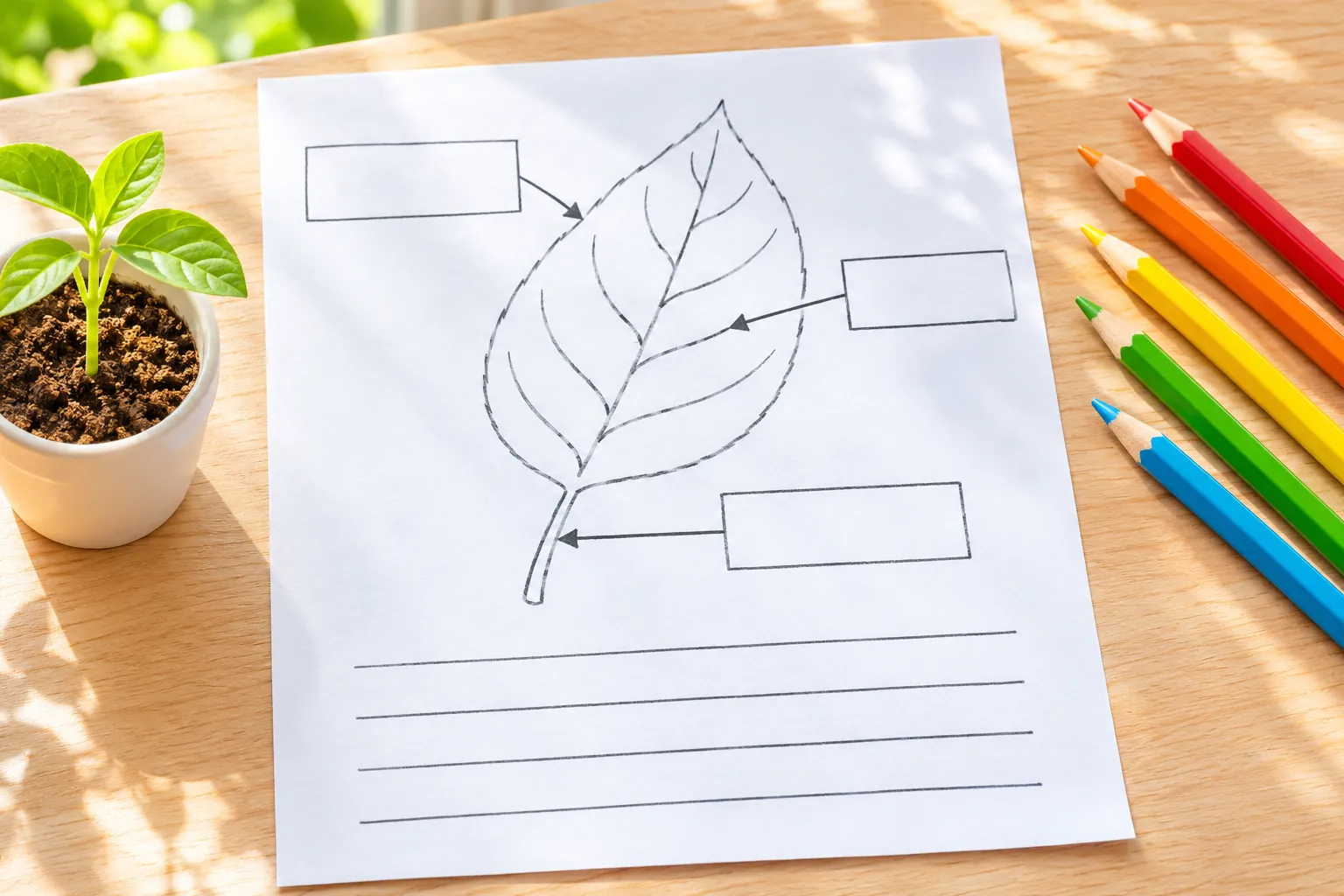
What's on this worksheet
This free photosynthesis worksheet has four parts: label a leaf diagram, fill in the blanks, complete the photosynthesis equation and answer six short questions. It fits on two printed pages, and the answer key is a separate PDF, so you can hand out the worksheet without the answers. Everything is also shown below, so students can work through it on screen.
Who it's for
The worksheet is written for grades 6 to 10, at about the level of a middle school life science or GCSE biology course. It takes about 25 to 35 minutes. It works well as:
- a homework task after a first lesson on photosynthesis
- a starter or plenary activity in class
- revision before a test, alongside the photosynthesis quiz
Cluecub · Free worksheet
Photosynthesis worksheet
NameClassDate
Part A: Label the diagram
This is a cross-section of a leaf. Write the name of each numbered part on the diagram. Use the word bank.
- Air space
- CO₂ in
- Light
- Lower epidermis
- O₂ and water vapour out
- Upper epidermis
- Vein
- Waxy cuticle
Part B: Fill in the blanks
- carbon dioxide
- chloroplasts
- light
- oxygen
- stomata
- water
- Photosynthesis takes place in called .
- The green pigment absorbs light energy.
- Plants take in from the air for photosynthesis.
- The gas given off as a waste product of photosynthesis is .
- The sugar made in photosynthesis is called .
- Gases move in and out of a leaf through tiny pores called .
- The light-dependent reactions happen on the membranes.
- The Calvin cycle happens in the , the fluid inside the chloroplast.
Part C: Complete the equations
Complete the word equation: carbon dioxide + → + oxygen
Balance the symbol equation: CO₂ + H₂O → C₆H₁₂O₆ + O₂
Part D: Answer the questions
Why are most chloroplasts found in the palisade mesophyll?
Explain why stomata often close on hot, dry days.
Name the two stages of photosynthesis and say where in the chloroplast each one happens.
Where does the oxygen released by photosynthesis come from?
Give two ways a plant uses the glucose it makes.
A plant is moved from bright light into dim light. What happens to its rate of photosynthesis, and why?
Free from www.cluecub.com/photosynthesis-worksheet
Show the answer key
Cluecub · Answer key
Photosynthesis worksheet: answers
Part A: Label the diagram
- Light
- CO₂ in
- O₂ and water vapour out
- Waxy cuticle
- Upper epidermis
- Palisade mesophyll
- Spongy mesophyll
- Lower epidermis
- Stoma
- Chloroplasts
- Air space
- Vein
Part B: Fill in the blanks
- chloroplasts
- chlorophyll
- carbon dioxide
- oxygen
- glucose
- stomata
- thylakoid
- stroma
Part C: Complete the equations
- carbon dioxide + water → glucose + oxygen (using light energy)
- 6CO₂ + 6H₂O → C₆H₁₂O₆ + 6O₂
Part D: Answer the questions
- The palisade layer is just below the top of the leaf, where light is strongest, so packing chloroplasts there lets the leaf capture the most light.
- Closing the stomata cuts down water loss, so the plant doesn't wilt. The trade-off is that less carbon dioxide gets in, so photosynthesis slows down.
- The light-dependent reactions happen on the thylakoid membranes. The Calvin cycle happens in the stroma.
- From water. Water is split in the light-dependent reactions, and the oxygen is released as a waste gas.
- Any two of: respiration to release energy; stored as ; built into for cell walls; turned into sucrose to move around the plant; used to make proteins, fats and oils.
- It goes down. Light supplies the energy for the light-dependent reactions, so in dim light less and NADPH are made for the Calvin cycle.
Free from www.cluecub.com/photosynthesis-worksheet
How to use the answer key
The answer key gives the label for every number on the diagram, the missing word for each blank, both completed equations and a model answer for each question. For the questions, accept any answer that makes the same scientific point in the student's own words.
If a student struggles with Part A, the labelled photosynthesis diagram guide walks through every layer of the leaf. For Part C, the photosynthesis equation guide has an interactive equation balancer.
Frequently asked questions
Is this photosynthesis worksheet free?
Yes. You can download, print and copy it for your class for free. Please don't sell it or upload it to another website.
Is there an answer key?
Yes. The answer key is a separate PDF, so you can print the worksheet without the answers. It's also on this page under Show the answer key.
What grade is this worksheet for?
Grades 6 to 10. Older students can use it as quick revision before moving on to the light-dependent reactions and the Calvin cycle.
Is there a worksheet on cellular respiration too?
Yes. Try the cellular respiration worksheet, which follows the same layout.