The big why
Why doesn't the air run out of oxygen?
Every living thing uses oxygen for respiration, but plants keep putting it back through photosynthesis. Each process feeds the other.
On this page
- Photosynthesis and cellular respiration diagram
- Side-by-side comparison
- How the two processes are connected
- What they have in common
- Do plants carry out cellular respiration?
- Photosynthesis and cellular respiration equations
- Learn each process in detail
- Key facts to remember
- Check your understanding
- Quizzes, worksheets and labs
- Frequently asked questions
Quick answer
Photosynthesis uses light energy to make and oxygen from carbon dioxide and water. Cellular respiration does the reverse overall: it breaks glucose down with oxygen to release energy as , giving off carbon dioxide and water. The products of each process are the reactants of the other.
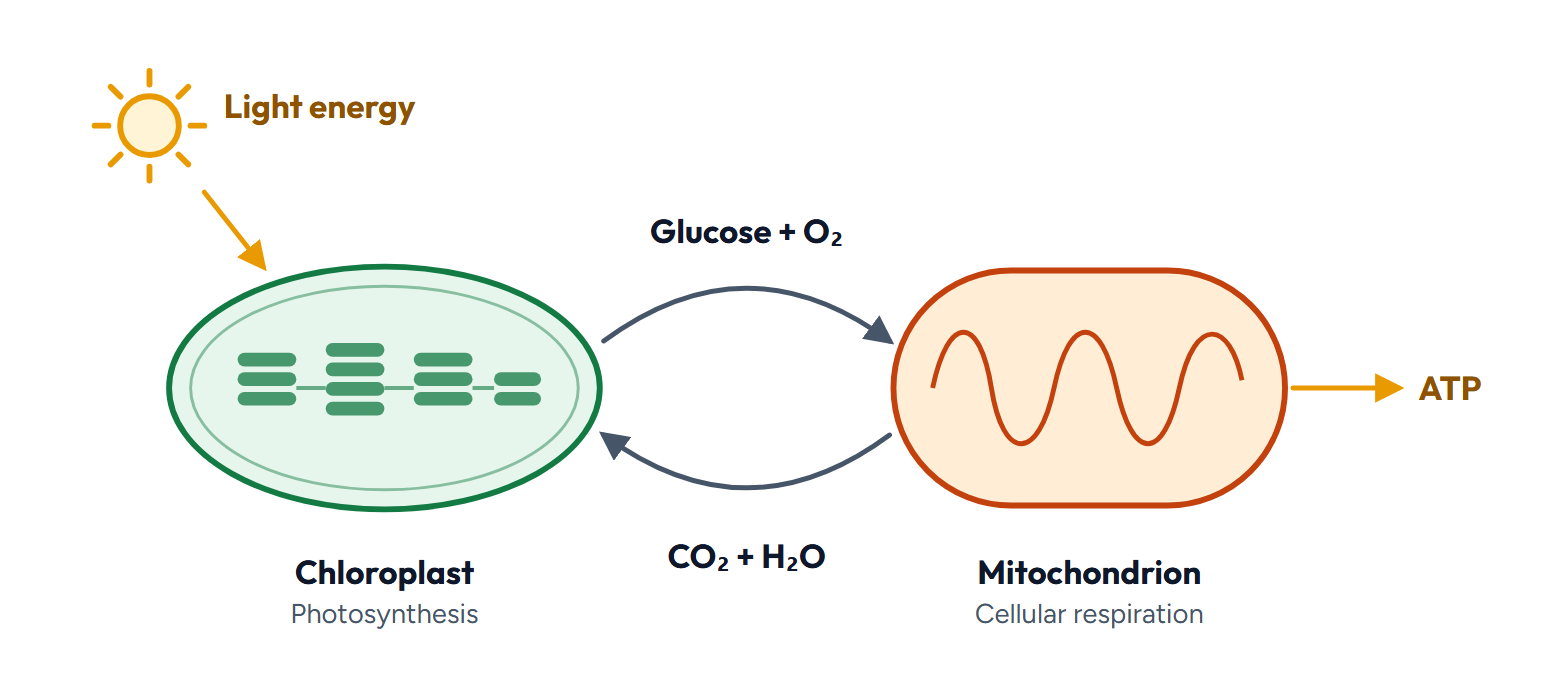
Photosynthesis and cellular respiration diagram
This diagram shows how the two processes connect in one cycle, with the on one side and the on the other.
Side-by-side comparison
| Feature | Photosynthesis | Cellular respiration |
|---|---|---|
| Equation | 6CO2 + 6H2O → C6H12O6 + 6O2 | C6H12O6 + 6O2 → 6CO2 + 6H2O + energy |
| What happens to energy | Light energy is stored in glucose | Energy in glucose is released as ATP and heat |
| Where it happens | Chloroplasts | , then mitochondria |
| Which organisms | Plants, algae and some bacteria | Nearly all living things, including plants |
| When it happens | Only when there is light | All the time, day and night |
| Reactants | Carbon dioxide and water | Glucose and oxygen |
| Products | Glucose and oxygen | Carbon dioxide, water and ATP |
| Gas taken in | Carbon dioxide | Oxygen |
| Gas given out | Oxygen | Carbon dioxide |
| Energy change | Endothermic (takes in energy) | Exothermic (releases energy) |
How the two processes are connected
Put the two equations next to each other and you can see they form a loop:
- Photosynthesis turns CO2 and H2O into glucose and O2.
- Respiration turns glucose and O2 back into CO2 and H2O.
The atoms go round and round. The carbon in the carbon dioxide you breathe out today may be in a leaf next week, and later in an animal that eats it. This is a large part of the carbon cycle.
Energy doesn't cycle in the same way. It enters as sunlight, is stored in glucose, is released as ATP and is finally lost as heat. New energy from the Sun is needed all the time to keep the loop going.
What they have in common
- Both are chains of enzyme-controlled reactions, so temperature affects the rate of both.
- Both make ATP using an transport chain and an called , built into a folded inner membrane: the in chloroplasts and the cristae in mitochondria.
- Both happen inside with a double membrane. Chloroplasts and mitochondria both have their own DNA, a clue that they evolved from bacteria that lived inside other cells.
- Both happen in plant cells. A leaf cell contains chloroplasts and mitochondria at the same time.
Do plants carry out cellular respiration?
Yes. This is one of the most common misunderstandings in biology.
What changes between day and night is the balance between the two:
- In bright light, photosynthesis runs faster than respiration. Overall, the plant takes in carbon dioxide and gives out oxygen.
- In the dark, only respiration happens. The plant takes in oxygen and gives out carbon dioxide, just like an animal.
- At dawn and dusk, there is a light level where the two rates are exactly equal and there is no overall gas exchange. This is called the compensation point.
Photosynthesis and cellular respiration equations
| Process | Word equation | Balanced equation |
|---|---|---|
| Photosynthesis | carbon dioxide + water → glucose + oxygen | 6CO2 + 6H2O → C6H12O6 + 6O2 |
| Cellular respiration | glucose + oxygen → carbon dioxide + water (+ energy) | C6H12O6 + 6O2 → 6CO2 + 6H2O + energy |
The two equations are mirror images, but respiration is not photosynthesis running backwards. They use different enzymes, go through different in-between molecules (the Calvin cycle in photosynthesis, glycolysis and the Krebs cycle in respiration) and happen in different organelles. The equations only summarise where each process starts and finishes. See the photosynthesis equation and the cellular respiration equation for how to balance each one.
Learn each process in detail
- The photosynthesis equation: how to write, read and balance it, plus the two stages of photosynthesis.
- The cellular respiration equation: the four stages, how much ATP is made, and .
- What are stomata?: the pores where both processes exchange gases with the air.
- The light-dependent reactions and the Calvin cycle: the two stages of photosynthesis.
- What is cellular respiration?: the big picture of how cells release energy from food.
- Glycolysis, the Krebs cycle and the electron transport chain: the stages of respiration, one at a time.
- Aerobic vs anaerobic respiration: what changes when there is no oxygen.
- Chloroplast diagram: every part of the organelle where photosynthesis happens.
Cheat sheet
Key facts to remember
Photosynthesis vs cellular respiration
- Photosynthesis: carbon dioxide + water → glucose + oxygen, using light energy.
- Cellular respiration: glucose + oxygen → carbon dioxide + water, releasing energy as ATP.
- Photosynthesis happens in chloroplasts. Respiration happens mostly in mitochondria.
- Plants do both. Animals only respire.
- The products of each process are the reactants of the other.
From Cluecub · www.cluecub.com/photosynthesis-vs-cellular-respiration
Practice questions
Check your understanding
5 questions
1. Which organelle carries out photosynthesis?
Photosynthesis happens in chloroplasts. Mitochondria carry out most of cellular respiration.
2. What happens in a plant leaf cell at night?
Photosynthesis needs light, so it stops at night. Respiration carries on all the time.
3. Which products of photosynthesis are the reactants of respiration?
Photosynthesis makes glucose and oxygen, and respiration uses exactly those two.
4. Which statement about energy is correct?
Atoms cycle between the two processes, but energy flows through. It arrives as sunlight and ends up as heat, so the Sun has to keep supplying it.
5. What is happening at a plant's compensation point?
At the compensation point, the plant uses carbon dioxide as fast as it makes it, so there is no overall exchange of gases.
Frequently asked questions
What is the main difference between photosynthesis and cellular respiration?
Photosynthesis stores energy by making glucose from carbon dioxide and water. Cellular respiration releases that energy by breaking glucose down into carbon dioxide and water.
How are photosynthesis and cellular respiration related?
The products of photosynthesis (glucose and oxygen) are the reactants of respiration, and the products of respiration (carbon dioxide and water) are the reactants of photosynthesis.
Are photosynthesis and cellular respiration opposites?
Their overall equations are reverses of each other, but the reactions inside are different and happen in different organelles.
Do animals carry out photosynthesis?
No. Animals can't make their own glucose. They get it by eating plants, or by eating other animals that ate plants.