Photosynthesis & cellular respiration
How living things capture energy from light and release it from food. Work through the guides in order, or jump to the one you need.
Two reactions that power almost all life
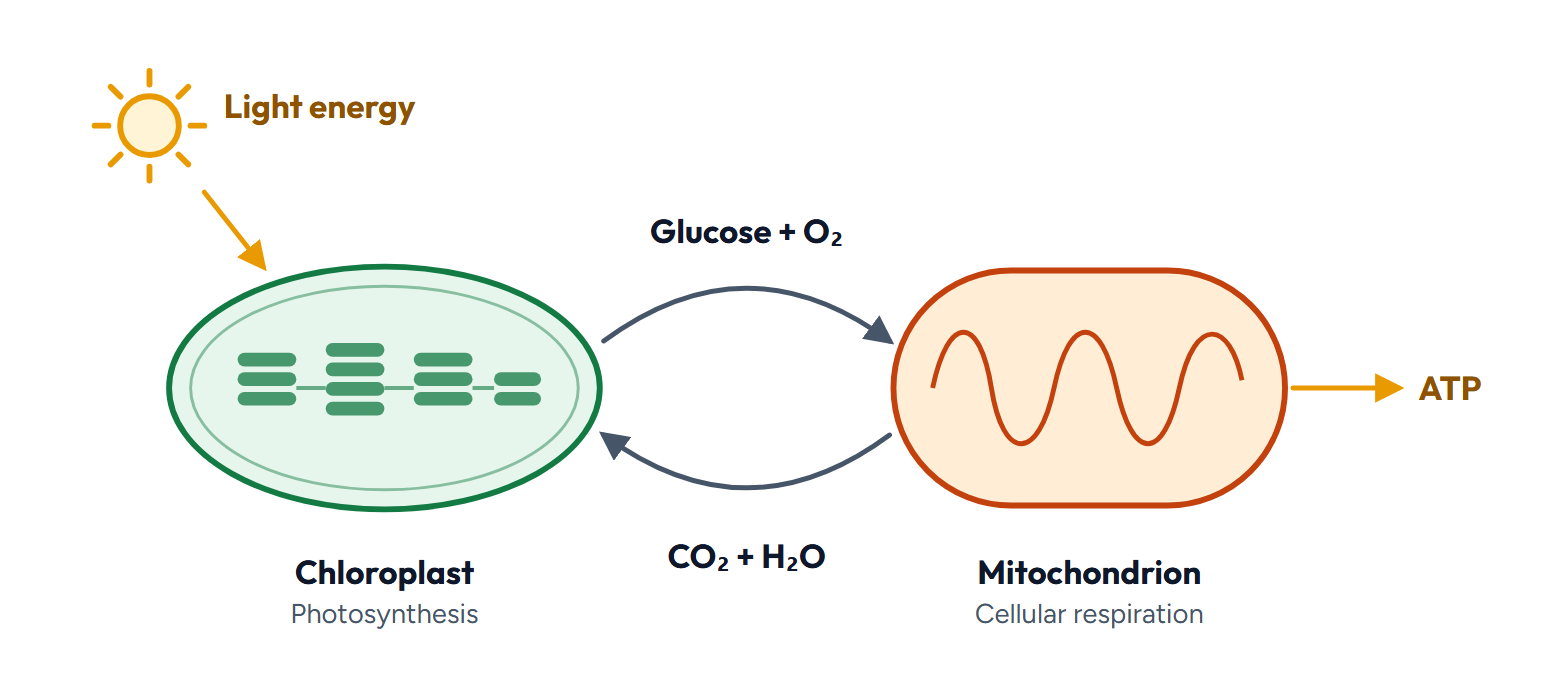
Nearly every living thing depends on two chemical reactions. Photosynthesis captures energy from sunlight and stores it in glucose. Cellular respiration releases that energy so cells can use it. One process makes what the other needs, so the two form a loop.
The two key equations
6CO2 + 6H2O light, chlorophyllproduces C6H12O6 + 6O2
carbon dioxide + water → glucose + oxygen
C6H12O6 + 6O2 produces 6CO2 + 6H2O + energy
glucose + oxygen → carbon dioxide + water (+ energy)
Learning path
All 19 guides are ready. Start with guide 1 and work down, or jump straight to the one you need. Each guide links to the next.
- 1
What is photosynthesis?
Where does the wood in a tree come from?
The simple definition, what goes in and comes out, how the process works step by step, and why every living thing depends on it.
- 2
The photosynthesis equation
Why do plants need sunlight to grow?
The balanced symbol equation, the word equation, what every part means and how to balance it yourself.
- 3
The cellular respiration equation
Why does one sugar molecule need six oxygen molecules?
The balanced equation, what each part means, the four stages that release the energy, and the equations for anaerobic respiration.
- 4
Photosynthesis diagram
How does a plant make food from light, air and water?
Four labelled diagrams that show photosynthesis from the whole leaf down to the chloroplast, and how to draw one for your notes.
- 5
What are stomata?
Why do leaves have tiny holes in them?
The tiny pores that let a leaf breathe, how guard cells open and close them, and how to see them for yourself.
- 6
Where does photosynthesis take place?
Why are most chloroplasts near the top of a leaf?
Zoom in from a whole plant to a single chloroplast, and find out where each stage of photosynthesis happens.
- 7
Chloroplast diagram
Why does a chloroplast have its own DNA?
What chloroplasts do, every part labelled, what each one does, and how the structure helps it carry out photosynthesis.
- 8
What is chlorophyll?
Why are plants green?
The green pigment that catches sunlight, what it does in photosynthesis, why it makes plants green, and how to see it for yourself.
- 9
The Calvin cycle
How does a plant build sugar out of thin air?
How plants turn carbon dioxide into sugar, step by step, and how much ATP and NADPH it takes.
- 10
The light-dependent reactions
Where does the oxygen we breathe come from?
How chloroplasts turn light into chemical energy, from splitting water to making ATP and NADPH.
- 11
Photosynthesis vs cellular respiration
Why doesn't the air run out of oxygen?
How the two processes differ, what they have in common, and how each one supplies the other.
- 12
The electron transport chain
Why do you need to breathe oxygen at all?
The last stage of aerobic respiration, where most of a cell's ATP is made and the oxygen you breathe finally gets used.
- 13
Anaerobic respiration
Why do your legs burn when you sprint?
How cells release energy when there isn't enough oxygen, from tired muscles to rising bread.
- 14
Fermentation
Why does yoghurt taste sour?
How cells keep making energy without oxygen, the two types of fermentation step by step, and the foods that depend on them.
- 15
Aerobic vs anaerobic respiration
Why can you walk for hours but sprint for only a few seconds?
The key differences between respiration with and without oxygen, side by side, with the equations you need for exams.
- 16
Glycolysis
How do red blood cells get energy with no mitochondria?
The first stage of respiration, where one glucose molecule is split in two and a cell earns its first ATP.
- 17
The Krebs cycle
Where does the carbon dioxide you breathe out come from?
The cycle in the mitochondria that strips the last carbon from your food and loads its energy onto carrier molecules.
- 18
What is cellular respiration?
Why do you need food even when you're asleep?
How every living cell turns the food you eat into energy it can use, explained from the very beginning.
- 19
Photosynthesis for kids
Why don't plants need to eat?
How plants make their own food from sunlight, water and air, explained simply, with experiments to try at home and a quiz to finish.
What you'll be able to do
By the end of this topic you will be able to:
- write and balance the equations for photosynthesis and for aerobic and anaerobic respiration
- explain where each process happens inside a cell and label the organelles involved
- describe the stages of photosynthesis and of cellular respiration, and what each stage makes
- explain how the two processes cycle carbon and oxygen, and why energy has to keep arriving from the Sun
Practice and activities
Quizzes, worksheets and a virtual lab
Check what you know, print a worksheet for class, or run the experiment yourself.
- Virtual labVirtual photosynthesis labMove the lamp, change the carbon dioxide and the temperature, watch pondweed give off oxygen, and graph your own results.
- QuizPhotosynthesis quiz45 multiple-choice questions, from the basics to the Calvin cycle, with an explanation for every answer.
- QuizCellular respiration quiz45 multiple-choice questions on how cells release energy, from the basics to the electron transport chain, with every answer explained.
- WorksheetPhotosynthesis worksheetA ready-to-print worksheet with a leaf diagram to label, the equation, fill-in-the-blanks and short questions, plus a full answer key.
- WorksheetCellular respiration worksheetA ready-to-print worksheet on how cells release energy, with a diagram to label, the equations, fill-in-the-blanks and questions, plus an answer key.