
The big why
Why can you walk for hours but sprint for only a few seconds?
Walking runs on oxygen, which gets about 15 times more energy out of each sugar molecule. Sprinting leans on a fast back-up that makes only 2 ATP.
On this page
Quick answer
The main difference is oxygen. Aerobic respiration uses oxygen, breaks down completely into carbon dioxide and water, and makes about 30 to 32 per glucose. Anaerobic respiration works without oxygen, breaks glucose down only partly into (in animals) or and carbon dioxide (in yeast and plants), and makes just 2 ATP.
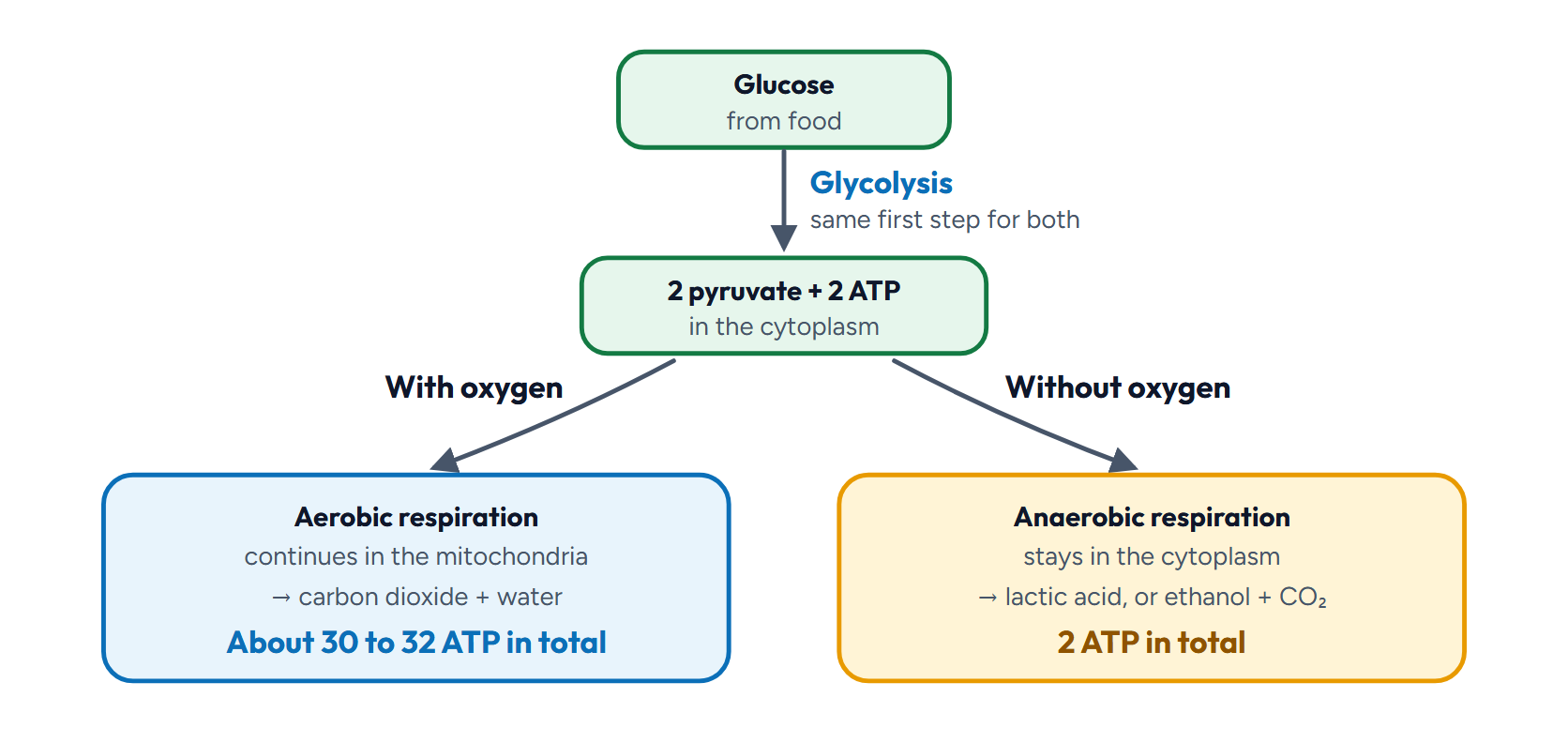
Comparison table
| Aerobic respiration | Anaerobic respiration | |
|---|---|---|
| Oxygen | Needed | Not needed |
| Where in the cell | Starts in the , finishes in the | Cytoplasm only |
| Glucose broken down | Completely | Partly |
| Products | Carbon dioxide and water | Lactic acid (animals), or ethanol and carbon dioxide (yeast and plants) |
| ATP per glucose | About 30 to 32 | 2 |
| Speed | Slower, but steady for a long time | Faster, but only for short bursts |
| Stages | Glycolysis, link reaction, Krebs cycle, transport chain | Glycolysis, then fermentation |
| Examples | Resting muscles, brain cells, plant cells in daylight and dark | A sprint, yeast in bread dough, roots in waterlogged soil |
The equations side by side
C6H12O6 + 6O2 produces 6CO2 + 6H2O
glucose + oxygen → carbon dioxide + water (+ lots of energy)
C6H12O6 produces 2C3H6O3
glucose → lactic acid (+ a little energy)
C6H12O6 produces 2C2H5OH + 2CO2
glucose → ethanol + carbon dioxide (+ a little energy)
What they have in common
- Both release energy from glucose and capture some of it as ATP.
- Both start with glycolysis in the cytoplasm, which splits glucose into two pyruvate and makes 2 ATP.
- Both are controlled by and happen inside living cells, all the time.
- Both happen in plants, animals, fungi and many bacteria.
Why aerobic respiration makes so much more ATP
In aerobic respiration, pyruvate goes into the mitochondria. The Krebs cycle strips out the rest of its energy as and , and the electron transport chain uses them to make most of the ATP. Oxygen is needed at the very end of the chain to accept the used electrons.
In anaerobic respiration, there is no oxygen to accept electrons, so the mitochondria can't do this. The cell only gets the 2 ATP from glycolysis. Much of the energy is still stored in the lactic acid or ethanol.
When your body uses each type
Your muscle cells switch between the two depending on how hard you are working:
- At rest or walking: your heart and lungs supply enough oxygen, so muscles respire aerobically.
- Sprinting or lifting something heavy: muscles need energy faster than oxygen can arrive. They top up with anaerobic respiration, and lactic acid builds up.
- After exercise: you keep breathing fast. The extra oxygen is used to break down the lactic acid, mostly in the liver. This is often called the oxygen debt.
For more on the "without oxygen" side, including yeast, bread and a balloon experiment, read our full guide to anaerobic respiration.
Cheat sheet
Key facts to remember
Aerobic vs anaerobic respiration
- Aerobic respiration uses oxygen. Anaerobic respiration doesn't.
- Aerobic makes about 30 to 32 ATP per glucose. Anaerobic makes just 2.
- Aerobic products: carbon dioxide and water.
- Anaerobic products: lactic acid in animals, or ethanol and carbon dioxide in yeast and plants.
- Both start with glycolysis in the cytoplasm. Aerobic respiration then carries on in the mitochondria.
From Cluecub · www.cluecub.com/aerobic-vs-anaerobic-respiration
Practice questions
Check your understanding
5 questions
1. Which type of respiration needs oxygen?
Aerobic means 'with air'. Anaerobic respiration works without oxygen.
2. How many ATP does aerobic respiration make compared with anaerobic?
Aerobic respiration breaks glucose down completely, so it makes about 30 to 32 ATP. Anaerobic makes only 2.
3. Which stage is shared by both aerobic and anaerobic respiration?
Glycolysis happens in the cytoplasm and doesn't need oxygen, so both types start with it.
4. What are the products of anaerobic respiration in yeast?
Yeast turns glucose into ethanol and carbon dioxide. Lactic acid is made in animal cells.
5. Why do you keep breathing hard after a sprint?
The extra oxygen is used to break down lactic acid made during anaerobic respiration.
Frequently asked questions
What is the main difference between aerobic and anaerobic respiration?
Aerobic respiration uses oxygen and makes about 30 to 32 ATP per glucose. Anaerobic respiration doesn't use oxygen and makes only 2 ATP.
Which is more efficient, aerobic or anaerobic respiration?
Aerobic respiration. It releases around 15 times more ATP from each glucose molecule.
Where does each type of respiration take place?
Aerobic respiration starts in the cytoplasm and finishes in the mitochondria. Anaerobic respiration happens only in the cytoplasm.
What are the similarities between aerobic and anaerobic respiration?
Both release energy from glucose, both make ATP, both start with glycolysis, and both are controlled by enzymes.