The big why
Why don't plants fall over without a skeleton?
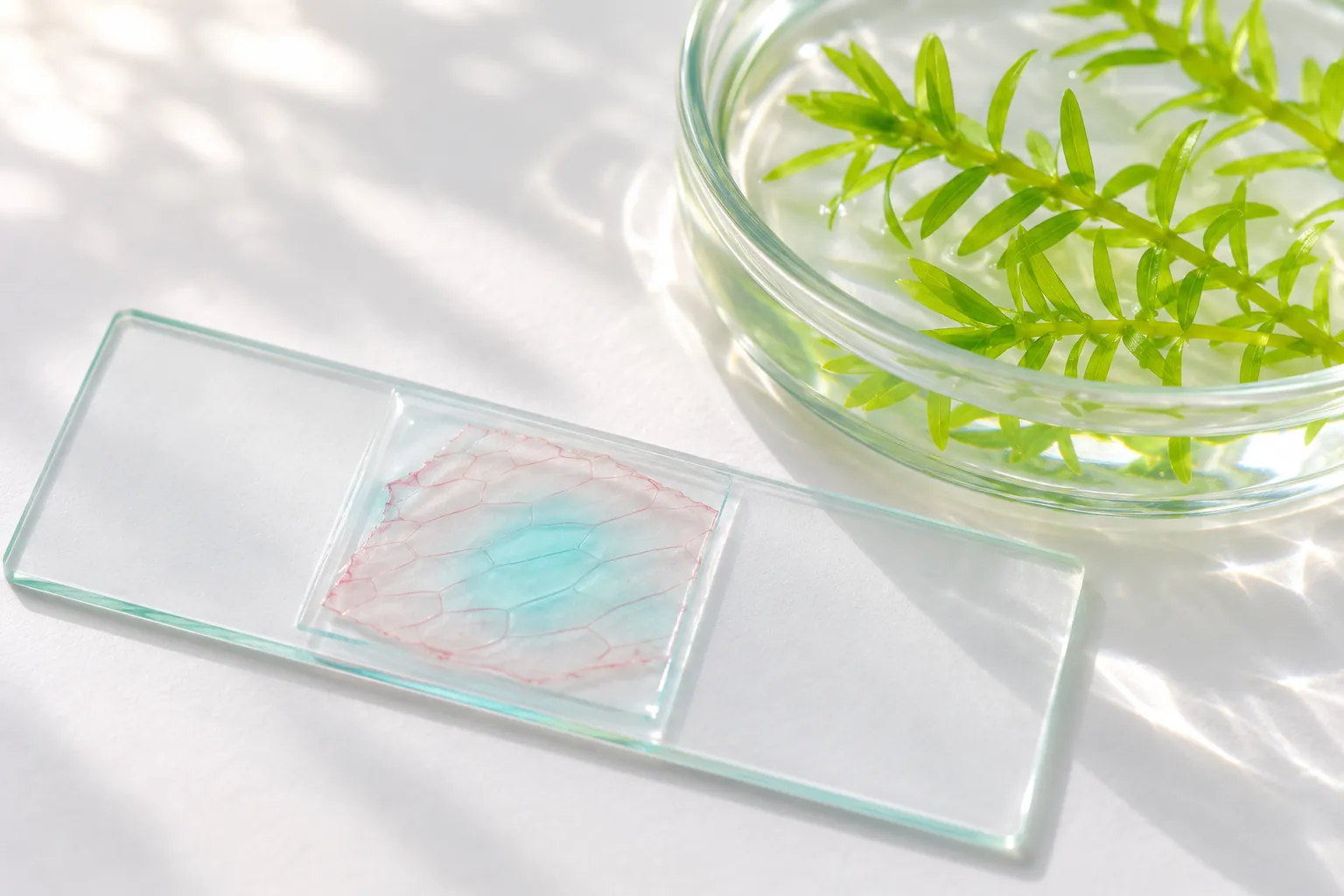
Each plant cell is pumped full of water and pressed against a stiff cell wall, like millions of tiny inflated balloons packed into boxes.
On this page
Quick answer
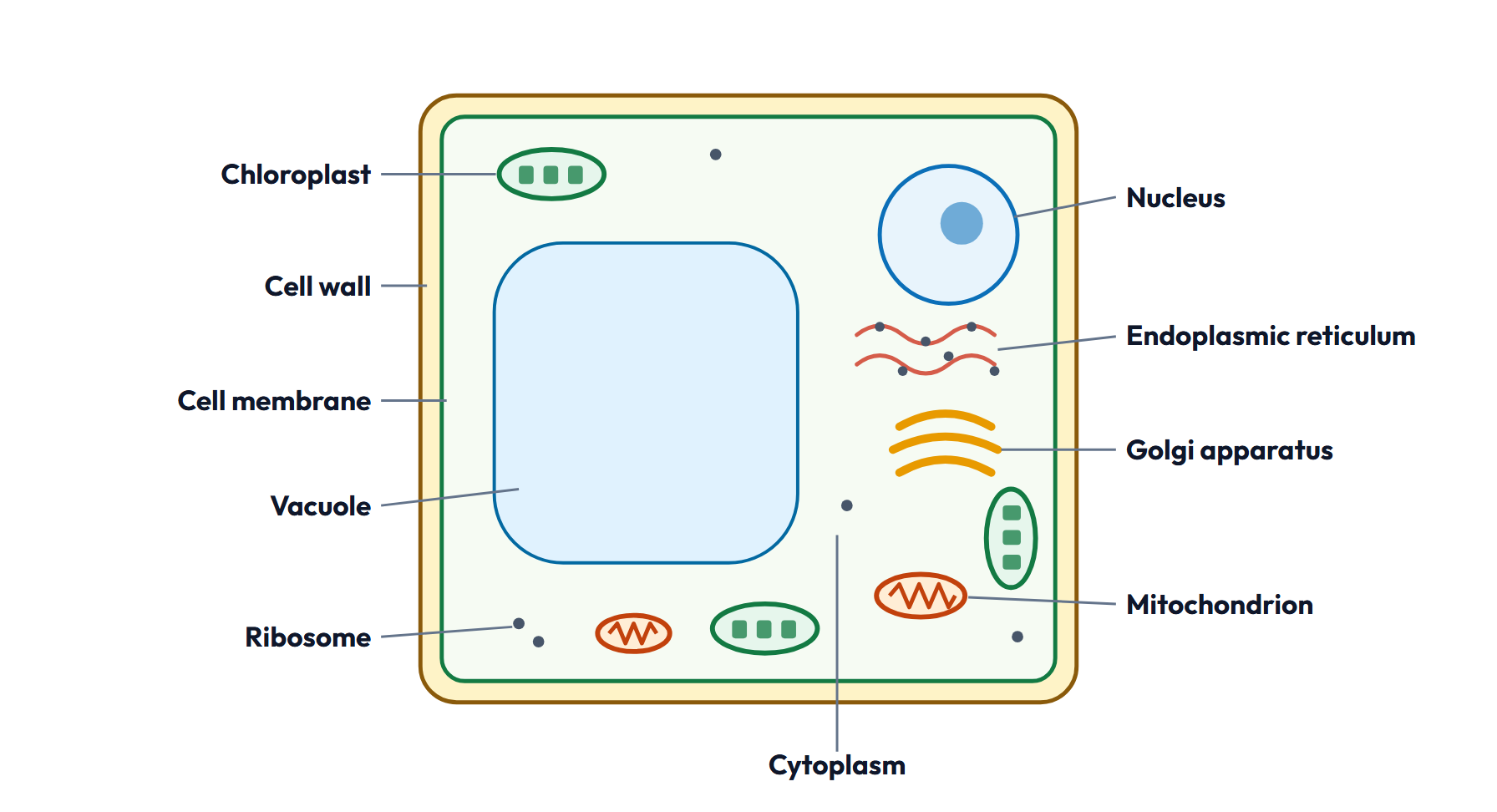
A plant cell diagram shows a box-shaped cell surrounded by a rigid cell wall. Just inside the wall is the thin cell membrane. The jelly-like inside holds a large central vacuole, a nucleus, green , , ribosomes, the endoplasmic reticulum and the Golgi apparatus. The cell wall, chloroplasts and large vacuole are the three parts that animal cells don't have.
The parts of a plant cell and their functions
| Part | What it is | What it does |
|---|---|---|
| Cell wall | A stiff outer layer made of | Supports the cell, gives it a fixed shape and stops it bursting when it takes in water |
| Cell membrane | A thin, flexible layer just inside the wall | Controls what enters and leaves the cell |
| Cytoplasm | A jelly-like fluid that fills the cell | Where many chemical reactions happen; holds the in place |
| Nucleus | A round organelle holding the cell's DNA | Controls the cell's activities and carries the instructions for making proteins |
| Vacuole | A large sac filled with cell sap | Stores water, sugars and salts, and keeps the cell firm |
| Chloroplast | A green, oval organelle | Carries out photosynthesis, making from light, water and carbon dioxide |
| Mitochondrion | A small, sausage-shaped organelle | Releases energy from glucose by cellular respiration |
| Ribosome | A tiny dot, free in the cytoplasm or on the ER | Makes proteins |
| Endoplasmic reticulum (ER) | A network of folded membranes | Makes and carries proteins (rough ER) and fats (smooth ER) around the cell |
| Golgi apparatus | A stack of flattened sacs | Packages and sends proteins to where they're needed |
Most school courses expect you to label at least the first eight. Higher courses add the ER and Golgi apparatus. Use the Label it yourself button under the diagram to test yourself.
Parts found only in plant cells
Three parts on a plant cell diagram are missing from an animal cell. Each one suits the way a plant lives.
- Cell wall. Plants can't move to find shelter, and most have no skeleton. The stiff cellulose wall supports each cell and, together, all the walls hold the plant up.
- Chloroplasts. Plants make their own food by photosynthesis, so the cells in leaves and green stems are packed with chloroplasts. Animals eat their food, so they don't need them.
- Large permanent vacuole. It can fill up to 90% of a mature plant cell. It stores water and pushes the cytoplasm out against the wall, keeping the cell firm.
For a full side-by-side comparison, read plant vs animal cells.
The vacuole: why plants wilt
The vacuole is filled with cell sap, a solution of water, sugars and salts. When a plant has plenty of water, the vacuoles swell and push the cytoplasm and membrane against the cell wall. The cell becomes firm, or turgid, like a pumped-up tyre.
When a plant is short of water, the vacuoles shrink. The cells go soft, or flaccid, and the leaves and stems droop. That is wilting. Water the plant and the vacuoles fill again, so it stands back up within hours.
Cell wall vs cell membrane
The two layers sit right next to each other, so they're easy to mix up.
| Cell wall | Cell membrane | |
|---|---|---|
| Found in | Plant cells (and fungi and bacteria) | All cells |
| Made of | Cellulose | Fats (lipids) and proteins |
| Stiff or flexible? | Stiff | Flexible |
| What passes through? | Almost everything (fully permeable) | Only some substances (partially permeable) |
| Main job | Support and shape | Control what enters and leaves |
How to draw a plant cell diagram
You only need a sharp pencil and a ruler. Follow these steps.
Step 1
Draw the cell wall
Draw a large rectangle with slightly rounded corners. Then draw a second rectangle just outside it, so the wall looks thick.
Step 2
Add the cell membrane
Draw a thin line just inside the wall, following its shape all the way round.
Step 3
Draw the vacuole and nucleus
Draw a large rounded shape in the middle for the vacuole, taking up about half the cell. Push the nucleus, a circle with a small dot in it, to one side.
Step 4
Add the small organelles
Draw three or four green ovals for chloroplasts around the edge, two small sausage shapes for mitochondria, and a few dots for ribosomes.
Step 5
Label every part
Draw straight label lines with a ruler, without arrowheads, and write each label neatly to the side. Don't let the lines cross. Add a title, such as "A plant cell".
See real plant cells
You can see plant cells with a school light microscope at ×100 to ×400 magnification.
- Onion skin. Peel a thin, see-through layer from inside an onion, lay it flat on a slide, and add a drop of iodine solution to stain it. You'll see rows of brick-shaped cells, each with a cell wall and a dark nucleus.
- Pondweed or moss leaf. A single leaf of pondweed (Elodea) is thin enough to see through. Its cells are packed with green chloroplasts, and you may even see them moving around the cell.
Different types of plant cell
A plant is made of many kinds of cell. Each has the same basic parts, but its shape and organelles suit its job.
| Cell type | Where it is | How it is adapted |
|---|---|---|
| Palisade cell | Near the top of a leaf | Tall and packed with chloroplasts to absorb lots of light |
| Root hair cell | On the outside of young roots | A long thin hair gives a big surface for taking in water; no chloroplasts |
| Around the stomata of a leaf | Changes shape to open and close the pore | |
| cell | In the veins | Dead, hollow tubes with strong walls that carry water |
See where palisade cells sit in the leaf in where does photosynthesis take place?, and look inside a chloroplast in the chloroplast diagram.
Cheat sheet
Key facts to remember
Plant cell diagram
- Plant cells have a cell wall, cell membrane, cytoplasm, nucleus, vacuole, chloroplasts, mitochondria and ribosomes.
- The cell wall is made of cellulose. It supports the cell and gives it a fixed shape.
- The large permanent vacuole holds cell sap and keeps the cell firm.
- Chloroplasts carry out photosynthesis. They are only in the green parts of a plant.
- The nucleus holds the DNA and controls the cell.
- Cell wall, chloroplasts and a large vacuole are found in plant cells but not animal cells.
From Cluecub · www.cluecub.com/plant-cell-diagram
Practice questions
Check your understanding
5 questions
1. Which part of a plant cell is made of cellulose?
The cell wall is made of cellulose, a tough carbohydrate. The membrane is made of lipids and proteins.
2. What is the main job of the large vacuole in a plant cell?
The vacuole stores water, sugars and salts. When it is full, it presses the cell against the wall and keeps it turgid.
3. Which three parts are found in plant cells but not animal cells?
Both kinds of cell have a nucleus, cytoplasm, membrane, mitochondria and ribosomes. Only plant cells have a cell wall, chloroplasts and a large permanent vacuole.
4. Why are there no chloroplasts in root cells?
Chloroplasts are only useful where there is light. Roots grow in dark soil and get sugar from the leaves instead.
5. What happens to plant cells when a plant wilts?
Without enough water, the vacuoles shrink. The cells become flaccid and the plant droops.
Frequently asked questions
What are the parts of a plant cell?
Cell wall, cell membrane, cytoplasm, nucleus, a large vacuole, chloroplasts, mitochondria and ribosomes. More detailed diagrams also show the endoplasmic reticulum and Golgi apparatus.
What are the 3 main parts of a plant cell?
At the simplest level: the cell wall and membrane around the outside, the cytoplasm inside, and the nucleus. The three parts unique to plant cells are the cell wall, chloroplasts and a large permanent vacuole.
What does a plant cell look like?
It is usually box-shaped, with a thick cell wall, a large vacuole filling much of the middle, a nucleus pushed to one side and, in green parts, many small green chloroplasts.
Do all plant cells have chloroplasts?
No. Only cells in the green parts of a plant, such as leaves and young stems, have them. Root cells and onion bulb cells don't.
What is the function of the cell wall in a plant cell?
It supports the cell, gives it a fixed shape, and stops it bursting when the vacuole fills with water.