The big why
Why do plants need sunlight to grow?
Light supplies the energy that turns carbon dioxide and water into glucose, the sugar plants use for food and for building new cells.
On this page
- The photosynthesis formula
- The word equation
- What each part of the equation means
- How to balance the photosynthesis equation
- Reactants and products
- Where photosynthesis happens
- The two stages of photosynthesis
- What plants do with the glucose
- What affects the rate of photosynthesis
- Photosynthesis and cellular respiration
- Key facts to remember
- Check your understanding
- Quizzes, worksheets and labs
- Frequently asked questions
Quick answer
The balanced equation for photosynthesis is 6CO2 + 6H2O → C6H12O6 + 6O2. In photosynthesis, plants use light energy, absorbed by , to turn six molecules of carbon dioxide and six molecules of water into one molecule of and six molecules of oxygen.
6CO2 + 6H2O light, chlorophyllproduces C6H12O6 + 6O2
carbon dioxide + water → glucose + oxygen
The photosynthesis formula
The chemical formula for photosynthesis, often just called the photosynthesis formula, is the balanced symbol equation:
6CO2 + 6H2O → C6H12O6 + 6O2
It is the same equation you need for GCSE, KS3, AP Biology and most school courses. Some textbooks add "light energy" to the left-hand side, or write it as 6CO₂ + 6H₂O + light → C₆H₁₂O₆ + 6O₂. Both mean the same thing: light is the energy that drives the reaction, not a chemical in it.
The word equation
The word equation says the same thing without chemical formulas:
carbon dioxide + water → glucose + oxygen
Write "light" and "chlorophyll" above the arrow. Both are needed for the reaction, but neither is used up as a reactant. Light is energy, not a substance, and chlorophyll is the green pigment that absorbs it.
What each part of the equation means
| Part | Formula | Role | Where it comes from or goes |
|---|---|---|---|
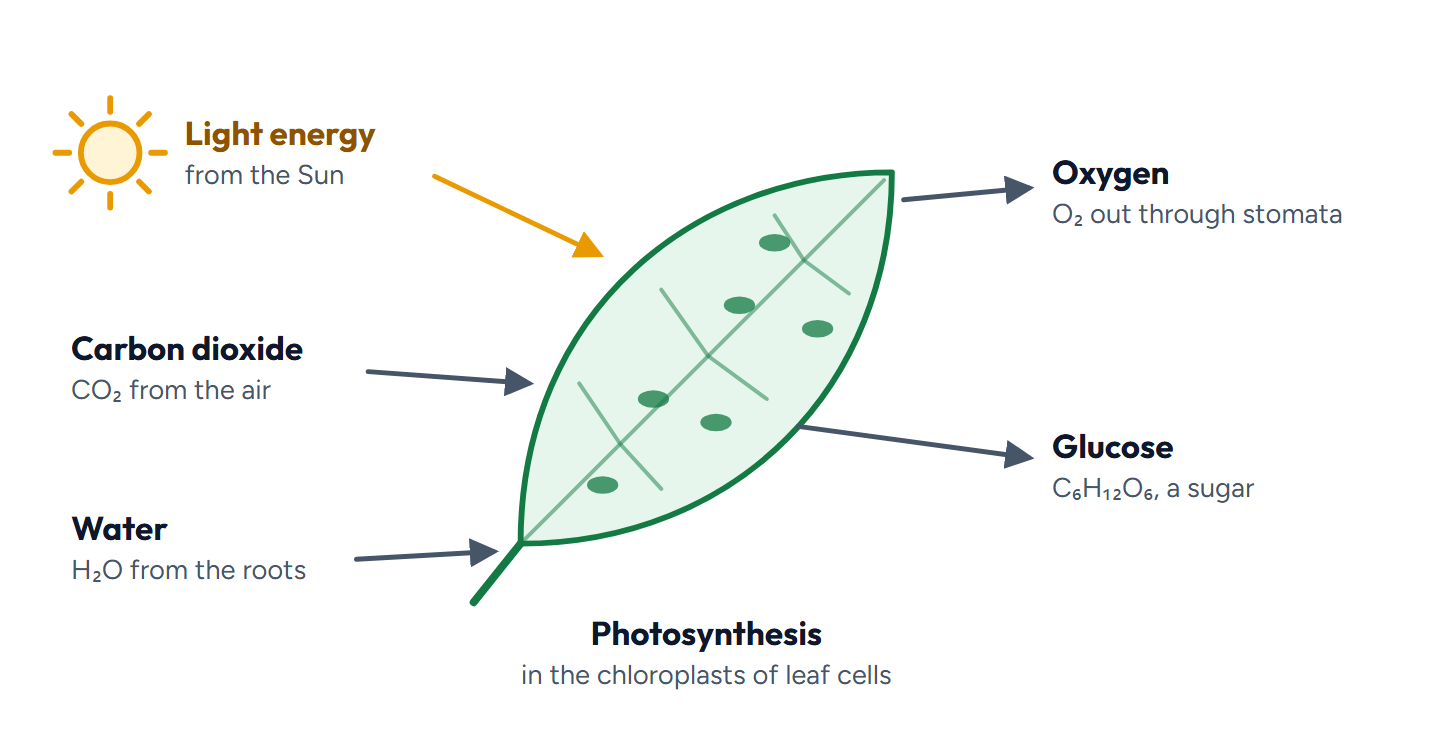
| Carbon dioxide | CO2 | Reactant | Enters the leaf from the air through tiny pores called stomata |
| Water | H2O | Reactant | Absorbed by the roots and carried up to the leaves in the |
| Light energy | none | Energy input | Absorbed by chlorophyll in the chloroplasts |
| Glucose | C6H12O6 | Product | Used for energy, stored as , or built into other molecules |
| Oxygen | O2 | Product | Released into the air through the |
The large numbers in front of the formulas are coefficients. They tell you how many molecules take part, so 6CO2 means six molecules of carbon dioxide. The small numbers are subscripts. They tell you how many atoms of each element are in one molecule. One glucose molecule, C6H12O6, contains 6 carbon atoms, 12 hydrogen atoms and 6 oxygen atoms.
How to balance the photosynthesis equation
Atoms are never created or destroyed in a chemical reaction, so each type of atom must appear the same number of times on both sides. Here is how to get from the unbalanced equation to the balanced one.
- Start with the unbalanced equation: CO2 + H2O → C6H12O6 + O2.
- Balance carbon. Glucose has 6 carbon atoms, so you need 6 carbon dioxide molecules: 6CO2.
- Balance hydrogen. Glucose has 12 hydrogen atoms. Each water molecule has 2, so you need 6 water molecules: 6H2O.
- Balance oxygen last. The left side now has 12 oxygen atoms in 6CO2 and 6 in 6H2O, making 18. Glucose holds 6 of them, so the other 12 must be in oxygen gas. That gives 6O2.
- Check your answer. There are 6 carbon, 12 hydrogen and 18 oxygen atoms on each side.
Oxygen goes last because it appears in every molecule in the equation. Its count changes every time you change another number.
Try it yourself
Balance the photosynthesis equation
Change the number in front of each molecule until every type of atom has the same count on both sides.
| Atom | Left side | Right side | Equal? |
|---|
Reactants and products
The reactants are carbon dioxide and water. The products are glucose and oxygen. Light energy is sometimes listed with the reactants, but strictly it is an energy input rather than a substance.
Because of this, you will sometimes see a fuller version of the equation: 6CO2 + 12H2O → C6H12O6 + 6O2 + 6H2O. It shows that 12 water molecules are split and 6 new ones are made. Most courses use the simpler version.
Where photosynthesis happens
Photosynthesis takes place in chloroplasts. Most are in the palisade cells just below the upper surface of the leaf, where the light is strongest. Each chloroplast contains stacks of flattened membranes called , surrounded by a fluid called the . See the labelled chloroplast diagram, or follow it all the way from leaf to chloroplast in where does photosynthesis take place? To see the whole process drawn out, use our labelled photosynthesis diagram
- The light-dependent reactions happen on the thylakoid membranes.
- The Calvin cycle, also called the light-independent reactions, happens in the stroma.
The two stages of photosynthesis
The overall equation hides two linked stages. Step through what happens in each one.
Step 1
Light is absorbed
Chlorophyll and other pigments in the thylakoid membranes absorb light, mostly red and blue wavelengths. Green light is reflected, which is why leaves look green.
- Where
- Thylakoid membranes
- Uses
- Light energy
Step 2
Water is split
The absorbed energy is used to split water molecules. This releases oxygen as a by-product and frees and hydrogen ions.
- Where
- Thylakoid membranes
- Makes
- O2, electrons, hydrogen ions
Step 3
Energy carriers are made
The electrons pass along a chain of proteins called an electron transport chain. Their energy is used to make and , which carry energy to the next stage.
- Where
- Thylakoid membranes
- Makes
- ATP and NADPH
Step 4
Carbon dioxide is turned into sugar
In the Calvin cycle, the RuBisCO attaches carbon dioxide to a five-carbon molecule. ATP and NADPH then power the reactions that turn it into a three-carbon sugar, which the plant uses to build glucose.
- Where
- Stroma
- Uses
- CO2, ATP and NADPH
- Makes
- Sugar for glucose
What plants do with the glucose
- Respiration: cells break glucose down to release energy, day and night.
- Starch: extra glucose is joined into starch and stored in leaves, roots, seeds and tubers.
- Cellulose: glucose is built into cellulose, which makes up cell walls.
- Sucrose: glucose is turned into sucrose to be carried around the plant in the phloem.
- Proteins, fats and oils: combined with nitrogen from nitrates in the soil, glucose is used to make amino acids. It is also used to make fats and oils.
What affects the rate of photosynthesis
Three main factors control how fast photosynthesis happens. Whichever one is in shortest supply holds the rate back, and it is called the limiting factor.
- Light intensity. More light means faster photosynthesis, until another factor becomes limiting.
- Carbon dioxide concentration. More CO2 speeds it up, again until something else limits it. Some greenhouse growers add carbon dioxide for this reason.
- Temperature. Photosynthesis is controlled by enzymes. It speeds up as it gets warmer, then drops sharply once it is hot enough to damage them.
The amount of chlorophyll and the water supply matter too, but these three are the ones exam questions focus on.
Photosynthesis and cellular respiration
Cellular respiration is close to the reverse of photosynthesis. It uses glucose and oxygen and releases carbon dioxide, water and energy:
C6H12O6 + 6O2 → 6CO2 + 6H2O + energy
Read the full guide to the cellular respiration equation, or see how photosynthesis and cellular respiration compare.
Cheat sheet
Key facts to remember
The photosynthesis equation
- The balanced equation is 6CO2 + 6H2O → C6H12O6 + 6O2.
- Word equation: carbon dioxide + water → glucose + oxygen, using light energy.
- Reactants: carbon dioxide from the air (through the stomata) and water from the roots.
- Products: glucose, the plant's food, and oxygen, released into the air.
- It happens in chloroplasts, using light absorbed by chlorophyll.
- It has two stages: the light-dependent reactions and the Calvin cycle.
From Cluecub · www.cluecub.com/photosynthesis-equation
Practice questions
Check your understanding
5 questions
1. What is the balanced symbol equation for photosynthesis?
Six carbon dioxide and six water molecules make one glucose and six oxygen molecules. Option C is the cellular respiration equation.
2. Where does the oxygen released by photosynthesis come from?
Water molecules are split in the light-dependent reactions, and their oxygen atoms are released as O2 gas.
3. In which part of the chloroplast does the Calvin cycle take place?
The Calvin cycle happens in the stroma, the fluid that surrounds the thylakoids.
4. How many oxygen atoms are on each side of the balanced equation?
Left side: 12 in 6CO2 plus 6 in 6H2O. Right side: 6 in glucose plus 12 in 6O2. That makes 18 on each side.
5. Why is light written above the arrow instead of as a reactant?
Light provides the energy for the reaction, but it isn't made of atoms, so it isn't counted as a reactant.
Frequently asked questions
What is the chemical equation for photosynthesis?
The balanced chemical equation is 6CO2 + 6H2O → C6H12O6 + 6O2, with light energy and chlorophyll written above the arrow.
What is the word equation for photosynthesis?
Carbon dioxide + water → glucose + oxygen, using light energy absorbed by chlorophyll.
What are the reactants and products of photosynthesis?
The reactants are carbon dioxide and water. The products are glucose and oxygen.
Is photosynthesis endothermic or exothermic?
It is endothermic. It takes in energy from light and stores it in the chemical bonds of glucose. Cellular respiration releases that energy again.
Why does the equation make glucose if plants store starch?
Glucose is the sugar that the overall equation describes. Plants then join many glucose molecules together to make starch for storage and cellulose for their cell walls.