On this page
What's on this worksheet
This free cellular respiration worksheet has four parts: label a diagram of respiration, fill in the blanks, complete three equations and answer six short questions. It prints on two pages, and the answer key is a separate PDF. Everything is shown below too, so students can work through it on screen.
Who it's for
The worksheet is written for grades 6 to 10, at about the level of a middle school life science or GCSE biology course. It takes about 25 to 35 minutes. Use it:
- as homework after a first lesson on respiration
- as a starter or plenary in class
- for revision, alongside the cellular respiration quiz
Cluecub · Free worksheet
Cellular respiration worksheet
NameClassDate
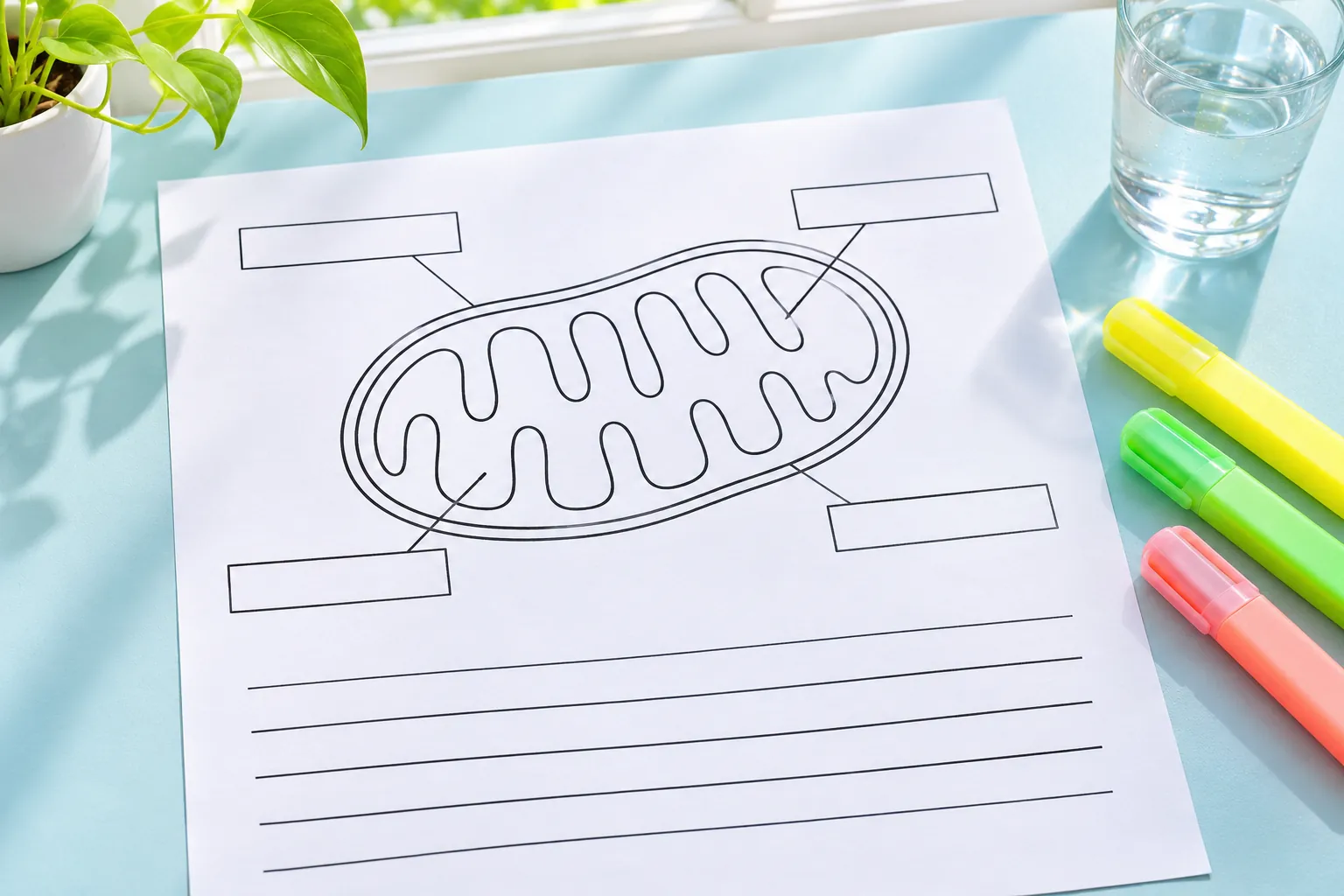
Part A: Label the diagram
This diagram shows what goes into and comes out of cellular respiration. Write the name of each numbered part on the diagram. Use the word bank.
- Carbon dioxide
- Cellular respiration
- Energy ()
- Oxygen
- Water
Part B: Fill in the blanks
- ATP
- carbon dioxide
- glucose
- glycolysis
- oxygen
- water
- Cellular respiration releases energy from , a sugar.
- Most of cellular respiration happens inside the .
- Glycolysis happens in the of the cell.
- The energy released is stored in a molecule called .
- uses and gives off carbon dioxide and water.
- During hard exercise, muscle cells make by .
- When there is no oxygen, yeast makes and carbon dioxide.
- The first stage of respiration, which splits glucose in two, is called .
Part C: Complete the equations
Complete the word equation for aerobic respiration: glucose + → carbon dioxide + (+ energy)
Balance the symbol equation: C₆H₁₂O₆ + O₂ → CO₂ + H₂O
Complete the word equation for anaerobic respiration in muscles: glucose →
Part D: Answer the questions
What is the difference between breathing and cellular respiration?
Name the four stages of aerobic respiration in order.
Why does aerobic respiration release much more energy than anaerobic respiration?
What job does oxygen do in the transport chain?
Why do you keep breathing hard for a while after a sprint?
Explain how photosynthesis and cellular respiration are linked.
Free from www.cluecub.com/cellular-respiration-worksheet
Show the answer key
Cluecub · Answer key
Cellular respiration worksheet: answers
Part A: Label the diagram
- Glucose
- Oxygen
- Cellular respiration
- Carbon dioxide
- Water
- Energy (ATP)
Part B: Fill in the blanks
- glucose
- mitochondria
- cytoplasm
- ATP
- oxygen
- lactic acid
- ethanol
- glycolysis
Part C: Complete the equations
- glucose + oxygen → carbon dioxide + water (+ energy)
- C₆H₁₂O₆ + 6O₂ → 6CO₂ + 6H₂O
- glucose → lactic acid
Part D: Answer the questions
- Breathing moves air in and out of the lungs. Cellular respiration is a chemical reaction inside cells that releases energy from glucose.
- Glycolysis, the link reaction, the Krebs cycle and the electron transport chain.
- Aerobic respiration breaks glucose down completely to carbon dioxide and water, making about 30 to 32 ATP. Anaerobic respiration only breaks it down partly, leaving energy locked in lactic acid or ethanol, and makes just 2 ATP.
- Oxygen is the final electron acceptor. It collects the electrons at the end of the chain and forms water. Without it, the chain stops.
- To take in extra oxygen, which is used to break down the lactic acid that built up in the muscles during anaerobic respiration.
- The products of photosynthesis, glucose and oxygen, are the reactants of respiration. The products of respiration, carbon dioxide and water, are the reactants of photosynthesis.
Free from www.cluecub.com/cellular-respiration-worksheet
How to use the answer key
The answer key gives every label, the missing word for each blank, the completed equations and a model answer for each question. Accept any answer to the questions that makes the same scientific point in the student's own words.
If a student finds Part B hard, the what is cellular respiration? guide covers each idea from the beginning. For the equations in Part C, see the cellular respiration equation guide.
Frequently asked questions
Is this cellular respiration worksheet free?
Yes. You can download, print and copy it for your class for free. Please don't sell it or upload it to another website.
Is there an answer key?
Yes. The answer key is a separate PDF. It's also on this page under Show the answer key.
What grade is this worksheet for?
Grades 6 to 10. Students in grades 9 to 12 can use it for quick revision before moving on to glycolysis and the Krebs cycle.
Is there a photosynthesis worksheet too?
Yes. The photosynthesis worksheet follows the same layout, with a leaf diagram to label.