The big why
Why don't plants need to eat?
Because they make their own food! Leaves catch sunlight and use it to turn water and air into sugar.
On this page
- Photosynthesis for little kids (ages 5 to 7)
- Photosynthesis for ages 8 to 10 (grades 3 to 5)
- Photosynthesis words for kids
- 3 easy photosynthesis experiments for kids
- Fun facts about photosynthesis
- How to explain photosynthesis to a child
- Key facts to remember
- Photosynthesis quiz for kids
- Frequently asked questions
Quick answer
Photosynthesis is how plants make their own food. A plant's leaves catch sunlight. The plant uses that energy to turn water from the soil and carbon dioxide from the air into sugar, which is its food. While it does this, it gives off oxygen, the gas we breathe.
Photosynthesis for little kids (ages 5 to 7)
You eat food to grow. Plants need food too, but they don't eat. They make their own food!
Every leaf is like a tiny kitchen. To cook up its food, a plant needs three things:
- Sunlight from the sky
- Water, which it sucks up through its roots
- Air, which goes in through tiny holes in its leaves
The plant mixes the water and air together, and the sunlight gives it the power to do it. It makes sugar, which is food for the plant. That is photosynthesis!
There is one more thing the plant makes: oxygen. The plant lets it out into the air. You breathe that oxygen in. So every time you take a breath, you can thank a plant.
A short photosynthesis rhyme
Sun up high and water low, air comes in to help me grow. I make my food, I make it sweet, and give you oxygen. Isn't that neat?
Photosynthesis for ages 8 to 10 (grades 3 to 5)
Now let's add the science words.
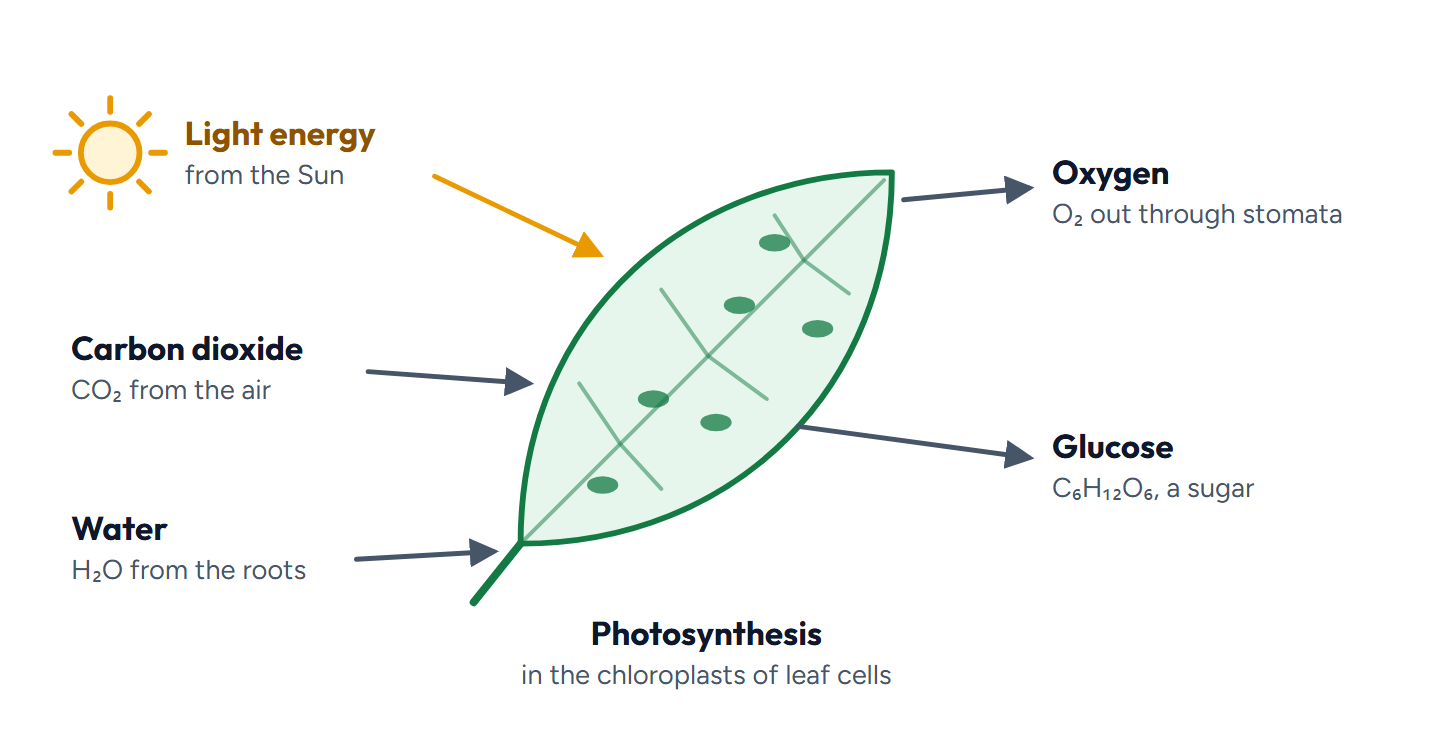
Photosynthesis happens mostly in a plant's leaves. Leaf cells are full of tiny green parts called . Chloroplasts contain , a green substance that catches sunlight. Chlorophyll is what makes leaves green.
Here is what goes in and what comes out.
| Goes in | Comes out |
|---|---|
| Water, from the roots | , a kind of sugar the plant uses as food |
| Carbon dioxide, a gas from the air | Oxygen, a gas the plant lets out into the air |
| Light energy, from the Sun |
Carbon dioxide gets into the leaf through tiny holes called . Most are on the underside of the leaf. They are far too small to see without a microscope. Find out more in what are stomata?
Scientists write photosynthesis as a word equation:
carbon dioxide + water → glucose + oxygen
The arrow means "turns into". Sunlight gives the energy to make it happen.
What does the plant do with the glucose? It uses some for energy, some to grow new leaves, stems and roots, and stores some as for later. When you eat a potato, rice or bread, you are eating starch that a plant made by photosynthesis.
Photosynthesis words for kids
| Word | What it means |
|---|---|
| Photosynthesis | How plants make food using light. "Photo" means light and "synthesis" means putting together |
| Chlorophyll | The green stuff in leaves that catches sunlight |
| Chloroplast | A tiny green part inside a leaf cell where food is made |
| Carbon dioxide | A gas in the air. Plants take it in, and we breathe it out |
| Oxygen | A gas in the air. Plants give it out, and we breathe it in |
| Glucose | A sugar. It is the plant's food |
| Stomata | Tiny holes in a leaf that let gases in and out |
| Roots | The part of a plant that holds it in the soil and takes in water |
3 easy photosynthesis experiments for kids
Ask an adult to help with each one.
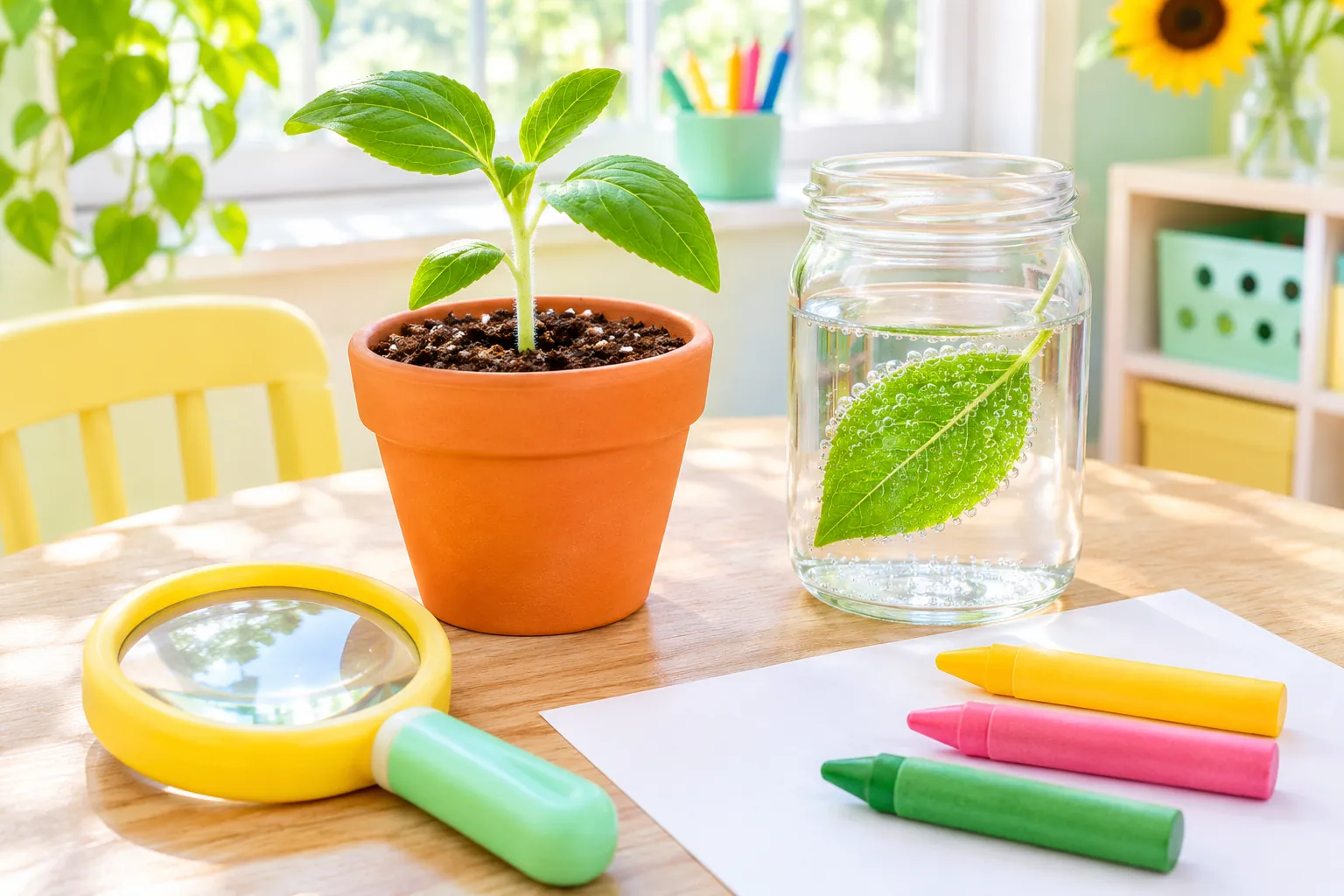
1. Watch a leaf make oxygen bubbles
You need: a clear glass or jar, water, a fresh green leaf (spinach or a leaf from a garden plant works well), a sunny window.
- Fill the glass with water.
- Put the leaf in the water and push it under with a spoon so it is covered.
- Leave it in a sunny spot for an hour or two.
- Look closely with a magnifying glass. Tiny bubbles appear on the leaf.
What's happening? The leaf is still doing photosynthesis, and some of the bubbles are oxygen it has made. (A few are just air that was already in the water.) Put a second glass in a dark cupboard and compare. Fewer bubbles in the dark show that photosynthesis needs light.
2. The light and dark cress test
You need: cress or grass seeds, two small pots or yoghurt pots with soil or damp cotton wool, a sunny windowsill and a dark cupboard.
- Sprinkle the same number of seeds in each pot and water them.
- Put one pot on the windowsill and one in the cupboard.
- Water both a little each day. After a week, compare them.
What's happening? The cress on the windowsill is green and strong. The cress in the cupboard is tall, thin and yellow, because without light it can't make its food or its green chlorophyll.
3. Cover part of a leaf
You need: a plant growing outside or in a pot, a small piece of kitchen foil, a paper clip.
- Fold the foil over part of one leaf and clip it in place. Don't pull the leaf off the plant.
- Leave it for about a week.
- Take the foil off and compare the covered part with the rest of the leaf.
What's happening? The covered part is paler. It had no light, so it couldn't do photosynthesis or keep making chlorophyll.
Fun facts about photosynthesis
- Leaves look green because chlorophyll soaks up red and blue light and bounces green light back to your eyes.
- Leaves change colour in autumn. The plant breaks down its chlorophyll, and yellow and orange colours that were hidden underneath show through.
- Not just plants! Tiny living things in the ocean, such as algae, do photosynthesis too. They make about half of the oxygen made on Earth each year.
- A tree is mostly made from air. The wood in a tree trunk is built mainly from carbon dioxide taken from the air.
- Cactuses do it in their stems. Their spines are special leaves that don't do photosynthesis, so the green stem does the work instead.
- Almost all food comes from photosynthesis. Even a burger: the cow ate grass, and the grass made its food from sunlight.
How to explain photosynthesis to a child
For parents and teachers, a few tips that work well:
- Start with a question. Ask "How do you think plants eat?" Children often guess "from the soil". Then show them how plants make food from light and air instead.
- Use the kitchen idea. Leaves are kitchens, sunlight is the cooker, and water and air are the ingredients.
- Do it, don't just say it. The leaf-bubble experiment above shows photosynthesis happening in about an hour.
- Add words slowly. Five-year-olds only need sunlight, water, air, food and oxygen. Add chlorophyll and carbon dioxide from about age 8.
- Link it to them. The oxygen they breathe and the food they eat both start with photosynthesis.
When your child is ready for more, the full guide what is photosynthesis? explains every step, and the photosynthesis diagram guide shows how to draw it.
Cheat sheet
Key facts to remember
Photosynthesis for kids
- Photosynthesis is how plants make their own food.
- Plants need sunlight, water and carbon dioxide from the air.
- They make sugar (food) and give off oxygen, the gas we breathe.
- It happens in the leaves, inside tiny green parts called chloroplasts.
- Chlorophyll is the green stuff that catches sunlight.
From Cluecub · www.cluecub.com/photosynthesis-for-kids
Practice questions
Photosynthesis quiz for kids
5 questions
1. What is photosynthesis?
Photosynthesis is how plants make their own food using sunlight, water and air.
2. Which part of the plant does most of the photosynthesis?
Leaves are flat and wide to catch lots of sunlight, and they are full of green chlorophyll.
3. What is the green stuff in leaves that catches sunlight?
Chlorophyll is green and catches the sunlight that plants need.
4. Which gas do plants take in from the air?
Plants take in carbon dioxide and give out oxygen.
5. What would happen to a plant kept in the dark for a long time?
Without light, a plant can't do photosynthesis, so it can't make food and stops making green chlorophyll.
Frequently asked questions
How do you explain photosynthesis to a child?
Say that plants make their own food. Their leaves catch sunlight and use its energy to turn water and air into sugar. They give off oxygen, which we breathe.
What is photosynthesis for kids in one sentence?
Photosynthesis is how green plants use sunlight, water and carbon dioxide from the air to make their own food and give off oxygen.
What age do kids learn about photosynthesis?
Young children learn that plants need light and water from about age 5. The word photosynthesis and the gases involved usually come in around grades 3 to 5 (ages 8 to 11), with the full equation later.
What are the 3 things plants need for photosynthesis?
Sunlight, water and carbon dioxide. Plants also need chlorophyll, the green substance in their leaves that catches the light.
Why is photosynthesis important for kids to learn?
Because all of us depend on it. Photosynthesis makes the oxygen we breathe and starts almost every food chain, including the food we eat.