The big why
Why does a chloroplast have its own DNA?
It's a clue that chloroplasts were once free-living bacteria that moved into a larger cell long ago and never left.
On this page
- What does a chloroplast do?
- Chloroplast structure: the parts and what they do
- The double membrane (envelope)
- Thylakoids and grana: where light is captured
- The stroma: where sugar is made
- DNA and ribosomes: a clue to the past
- How a chloroplast is adapted for photosynthesis
- Chloroplast vs mitochondrion
- How to draw a chloroplast diagram
- Key facts to remember
- Check your understanding
- Quizzes, worksheets and labs
- Frequently asked questions
Quick answer
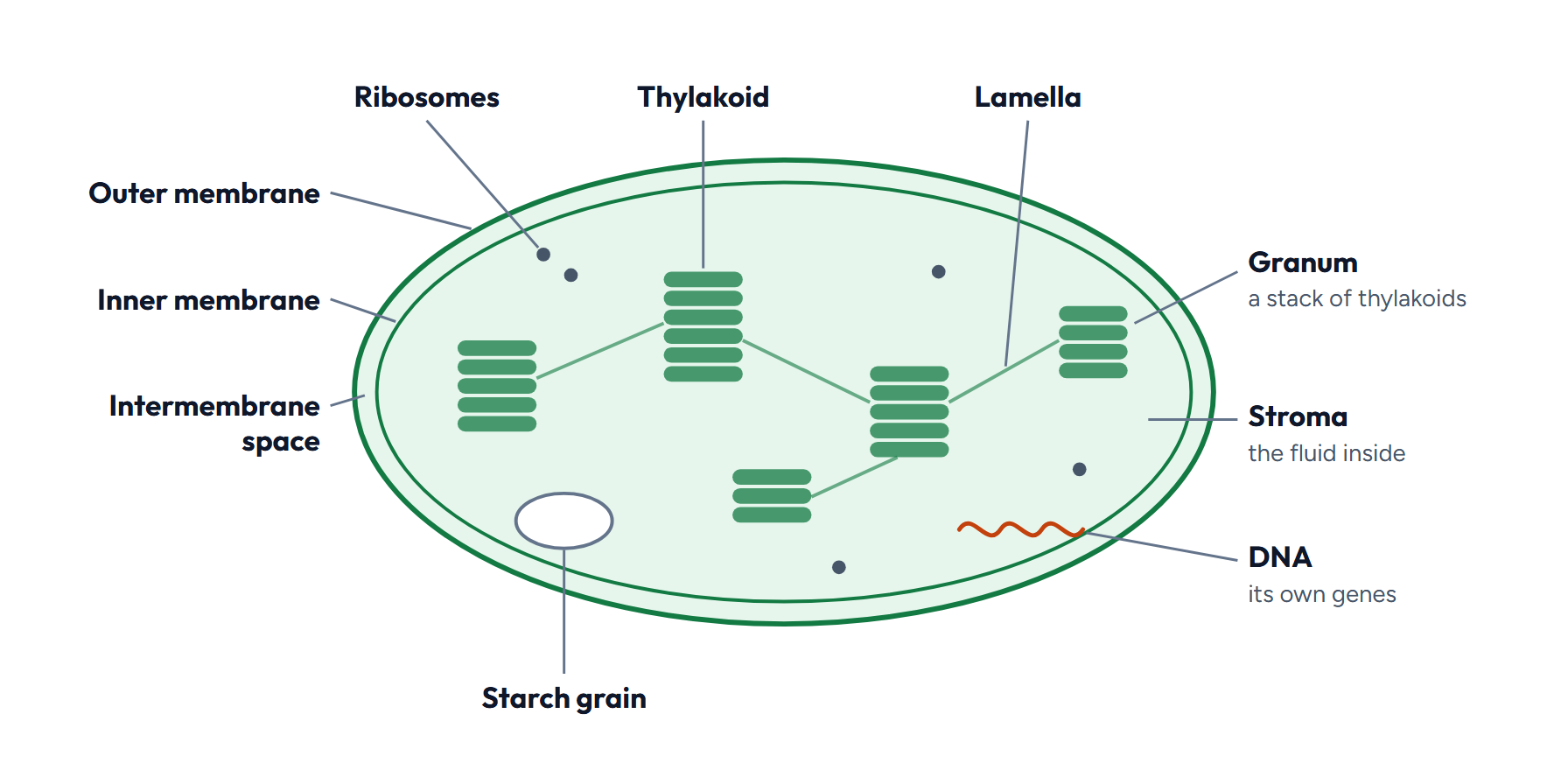
A chloroplast is the in plant and algae cells where photosynthesis happens. Its function is to capture light energy and use it to turn carbon dioxide and water into and oxygen. A labelled chloroplast diagram shows a double membrane (outer and inner) around a fluid called the . Inside the stroma are stacks of flat discs called . Each stack is a , and stacks are joined by lamellae. The stroma also holds grains, ribosomes and the chloroplast's own DNA.
What does a chloroplast do?
The main function of a chloroplast is photosynthesis. It is where light energy is turned into chemical energy, stored in sugar. Almost all the food on Earth, and the oxygen in the air, starts in chloroplasts.
Inside one chloroplast, photosynthesis has two stages that happen in two different places:
- Capturing light. in the thylakoid membranes absorbs light. The energy splits water, releases oxygen, and makes the energy carriers and . These are the light-dependent reactions.
- Making sugar. In the stroma, the Calvin cycle uses that ATP and NADPH to turn carbon dioxide into sugar.
Chloroplasts have a few other jobs too.
| Role of chloroplasts | How they do it |
|---|---|
| Make food for the plant | Turn carbon dioxide and water into glucose by photosynthesis |
| Release oxygen | Split water molecules in the thylakoids and give off the oxygen |
| Store energy | Keep some of the sugar as starch grains for use at night |
| Build other molecules | Make fatty acids and some amino acids that the cell needs |
| Make some of their own proteins | Use their own DNA and ribosomes |
| Avoid damage | Move to the sides of the cell in very bright light, and spread out in dim light |
A typical leaf cell holds about 10 to 100 chloroplasts. The palisade cells near the top of a leaf have the most, because they get the most light. You can see how they fit into the leaf in where does photosynthesis take place?
Chloroplast structure: the parts and what they do
A chloroplast is usually lens-shaped (like a flattened oval), about 5 to 10 micrometres long. Its structure has three layers of organisation: a double membrane on the outside, the stroma fluid inside, and the thylakoid membranes inside the stroma. Each part has its own function.
| Part | What it is | What it does |
|---|---|---|
| Outer membrane | The outside layer of the envelope | Lets small molecules in and out of the chloroplast |
| Inner membrane | The second layer, just inside the outer one | Controls which substances enter and leave the stroma |
| Intermembrane space | The thin gap between the two membranes | Separates the two membranes |
| Thylakoid | A flat, disc-shaped sac made of membrane | Holds chlorophyll and runs the light-dependent reactions |
| Granum (plural: grana) | A stack of thylakoids | Packs a large membrane area into a small space to catch more light |
| Lamella (plural: lamellae) | A thylakoid that links one granum to another | Connects the grana and spreads the light-catching system out |
| Stroma | The thick fluid around the thylakoids | Holds the for the Calvin cycle, where sugar is made |
| Starch grain | A store of starch in the stroma | Stores the glucose made in photosynthesis until it is needed |
| Ribosomes | Tiny protein-making structures | Make some of the chloroplast's own proteins |
| DNA | A small loop of genetic material | Carries the genes for some chloroplast proteins |
The double membrane (envelope)
A chloroplast is wrapped in two membranes, together called the chloroplast envelope. The outer membrane lets many small molecules pass through. The inner membrane is more selective, with transport proteins that control what goes in and out. Mitochondria have a double membrane too.
Thylakoids and grana: where light is captured
The thylakoids are where light energy is trapped. Their membranes contain chlorophyll and other pigments, built into large protein groups called . Here the light-dependent reactions split water, release oxygen and make ATP and NADPH.
The space inside each thylakoid is called the thylakoid space or lumen. Hydrogen ions build up there during the light reactions, and their flow back out powers ATP synthase.
Stacking the thylakoids into grana packs a huge area of membrane into a tiny organelle. More membrane means more chlorophyll, and more chlorophyll means more light can be captured.
The stroma: where sugar is made
The stroma is the thick fluid that fills the chloroplast around the thylakoids. It contains the enzymes for the Calvin cycle, including RuBisCO, which fixes carbon dioxide. Here the ATP and NADPH from the thylakoids are used to turn carbon dioxide into sugar.
Some of that sugar is stored right there as starch grains. Starch doesn't dissolve, so it is a compact way to store glucose for later, such as at night when photosynthesis stops.
DNA and ribosomes: a clue to the past
Chloroplasts contain their own circular DNA and small ribosomes, similar to those in bacteria. They can also divide on their own inside the cell. This is strong evidence for the endosymbiotic theory: chloroplasts came from photosynthetic bacteria (cyanobacteria) that were taken in by a larger cell long ago and lived on inside it.
How a chloroplast is adapted for photosynthesis
- Lots of thylakoid membrane in grana gives a large surface for chlorophyll to absorb light.
- Two separate places for the two stages: the thylakoids for the light reactions and the stroma for the Calvin cycle. Each place can hold just the enzymes it needs.
- Short distances. The stroma surrounds the thylakoids, so the ATP and NADPH they make reach the Calvin cycle enzymes quickly.
- Its own DNA and ribosomes let it make some of its own proteins quickly.
Chloroplast vs mitochondrion
Chloroplasts and mitochondria are often compared because both convert energy, and both have a double membrane, their own DNA and ribosomes.
| Chloroplast | Mitochondrion | |
|---|---|---|
| Process | Photosynthesis | Cellular respiration |
| Energy change | Light energy → chemical energy in glucose | Chemical energy in glucose → ATP |
| Found in | Plant and algae cells | Almost all plant, animal and fungus cells |
| Inner folds | Thylakoids stacked into grana | Cristae |
| Fluid | Stroma | Matrix |
See photosynthesis vs cellular respiration for how the two processes link, and where does photosynthesis take place? to see how chloroplasts fit inside the leaf. For the whole process on one page, see the labelled photosynthesis diagram.
How to draw a chloroplast diagram
- Draw a large oval with a second oval just inside it. Label them outer membrane and inner membrane.
- Inside, draw four or five stacks of thin flat discs. Label one disc thylakoid and one stack granum.
- Join a few stacks with single lines and label one lamella.
- Label the space around the stacks stroma.
- Add a small oval labelled starch grain, a few dots labelled ribosomes, and a small loop labelled DNA.
Cheat sheet
Key facts to remember
Chloroplast: function, structure and diagram
- The function of a chloroplast is photosynthesis: turning light energy into chemical energy stored in glucose.
- A chloroplast is wrapped in a double membrane: an outer and an inner membrane.
- Thylakoids are flat discs that hold chlorophyll. The light-dependent reactions happen on their membranes.
- A stack of thylakoids is a granum. Stacks are joined by lamellae.
- The stroma is the fluid inside, where the Calvin cycle happens.
- Chloroplasts also hold starch grains, ribosomes and their own circular DNA.
From Cluecub · www.cluecub.com/chloroplast-diagram
Practice questions
Check your understanding
5 questions
1. What is a stack of thylakoids called?
A granum is a stack of thylakoids. Cristae are the folds inside a mitochondrion.
2. Where do the light-dependent reactions take place?
Chlorophyll is in the thylakoid membranes, which is where light is absorbed and ATP and NADPH are made.
3. Which part of the chloroplast contains the enzymes for the Calvin cycle?
The stroma contains RuBisCO and the other Calvin cycle enzymes that turn carbon dioxide into sugar.
4. Why are thylakoids stacked into grana?
Stacking packs a lot of membrane, and so a lot of chlorophyll, into a small space.
5. Which feature supports the idea that chloroplasts came from bacteria?
Circular DNA and small ribosomes are like those of bacteria, which supports the endosymbiotic theory.
Frequently asked questions
What are the parts of a chloroplast?
Outer membrane, inner membrane, intermembrane space, thylakoids, grana, lamellae, stroma, starch grains, ribosomes and DNA.
What is the function of a chloroplast?
To carry out photosynthesis: capturing light energy and using it to turn carbon dioxide and water into glucose and oxygen.
What do chloroplasts do in a plant cell?
They make the plant's food. Chloroplasts trap light energy and use it to build sugar from carbon dioxide and water, releasing oxygen. They also store starch and make some fatty acids and amino acids.
How many chloroplasts are in a plant cell?
A typical leaf cell has about 10 to 100. Palisade cells near the top of the leaf have the most.
What is the difference between the thylakoid and the stroma?
Thylakoids are membrane discs where light is absorbed and the light-dependent reactions happen. The stroma is the fluid around them, where the Calvin cycle makes sugar.
Do animal cells have chloroplasts?
No. Chloroplasts are found in plant cells and algae. Animal cells have mitochondria but not chloroplasts.
Why are chloroplasts green?
They contain chlorophyll, which absorbs mostly red and blue light and reflects green light.