The big why
Why does yoghurt taste sour?
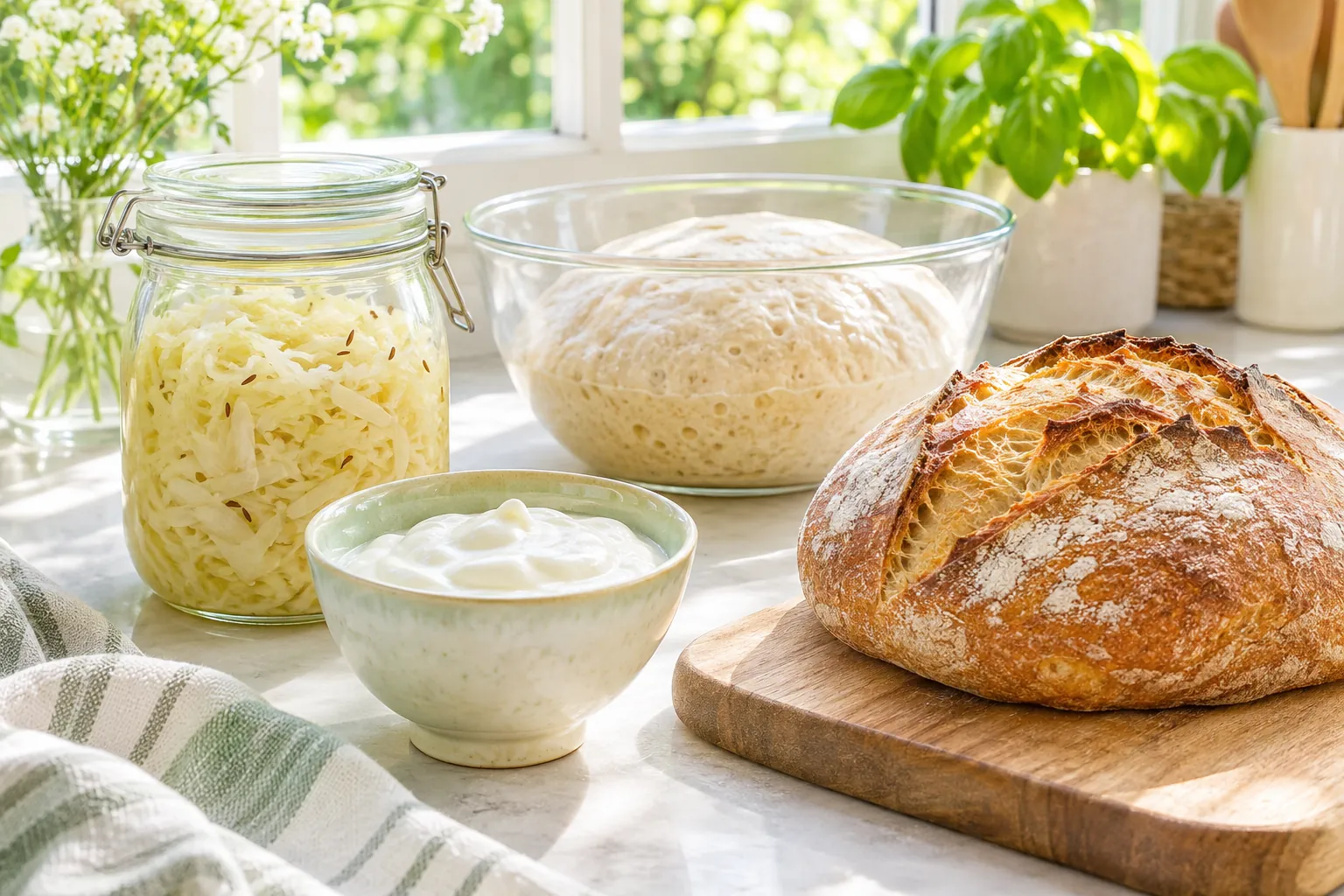
Bacteria in the milk ferment its sugar into lactic acid. The acid makes it sour and makes the milk proteins set thick.
On this page
- What is fermentation?
- Lactic acid fermentation
- Alcoholic fermentation
- Lactic acid vs alcoholic fermentation
- Fermentation in food
- Fermentation vs anaerobic respiration
- Who discovered fermentation?
- Try it: which temperature do yeast like best?
- Key facts to remember
- Check your understanding
- Quizzes, worksheets and labs
- Frequently asked questions
Quick answer
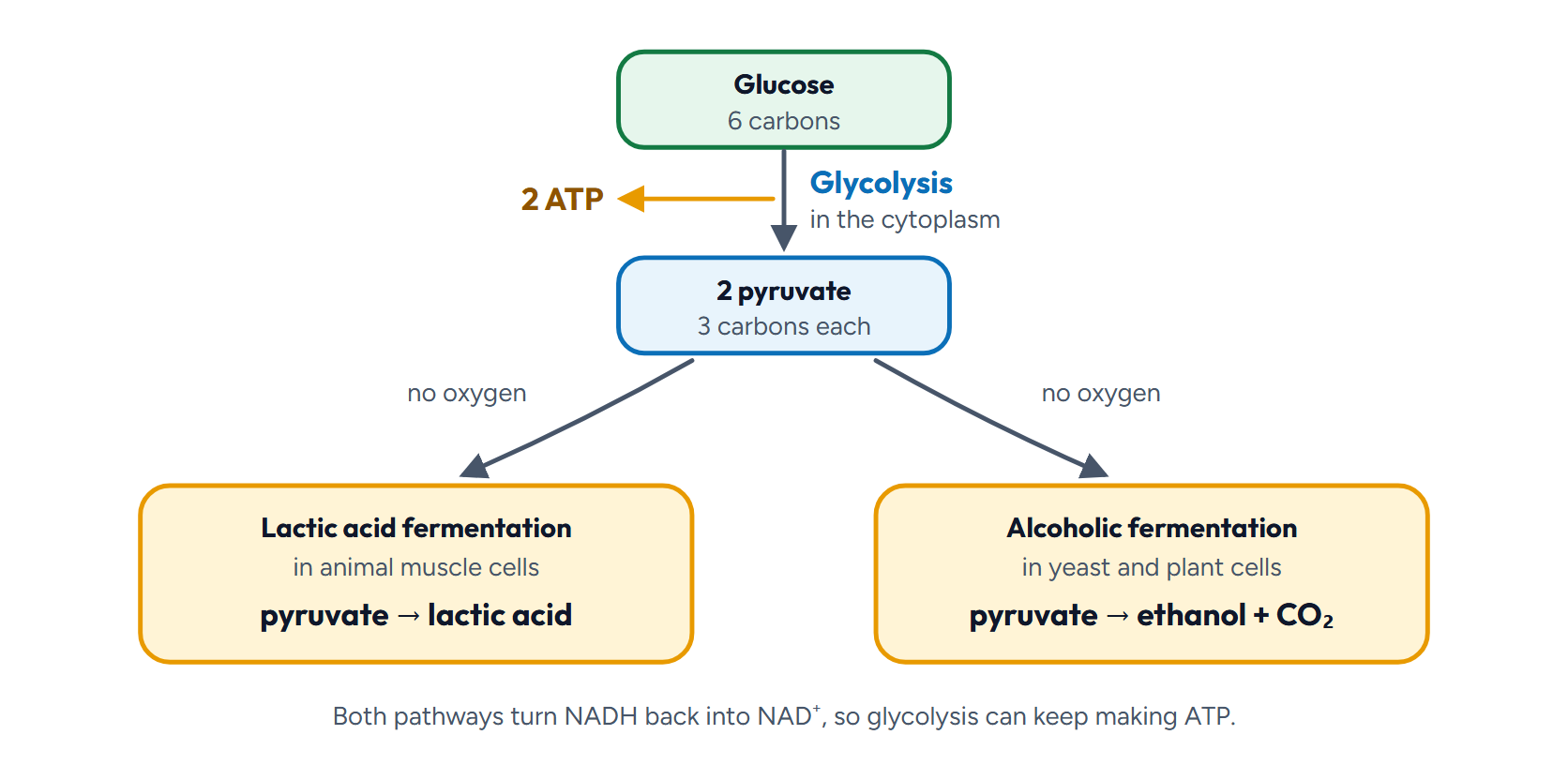
Fermentation is how cells release energy from sugar without oxygen. It is glycolysis followed by an extra step that turns into a waste product and recycles NAD⁺, so glycolysis can keep going. There are two main types. Lactic acid fermentation turns into lactic acid, in muscle cells and many bacteria. Alcoholic fermentation turns glucose into and carbon dioxide, in yeast and plant cells. Both make only 2 per glucose.
What is fermentation?
Fermentation is one way to get energy from food when there is no oxygen. In school biology it is the same thing as anaerobic respiration, and the two names are often used for each other.
Every cell's first step in using glucose is glycolysis, which splits glucose into two pyruvate and makes a net 2 ATP. Glycolysis also turns 2 NAD⁺ into 2 . A cell has only a small store of NAD⁺, so it must keep turning NADH back into NAD⁺, or glycolysis stops.
- With oxygen, NADH hands its to the electron transport chain, which recycles NAD⁺ and makes lots more ATP.
- Without oxygen, the chain stops. Fermentation is the cell's back-up plan: it hands the electrons from NADH to pyruvate instead. That recycles NAD⁺, and the pyruvate becomes lactic acid or ethanol.
Lactic acid fermentation
In lactic acid fermentation, each pyruvate is turned straight into lactic acid (lactate) in a single step.
C6H12O6 no oxygenproduces 2C3H6O3
glucose → lactic acid (+ 2 ATP)
Step 1
Glycolysis
In the , one glucose is split into two pyruvate. This makes a net 2 ATP and turns 2 NAD⁺ into 2 NADH.
- Makes
- 2 ATP, 2 NADH, 2 pyruvate
Step 2
Pyruvate is reduced to lactate
An called lactate dehydrogenase moves hydrogen from NADH onto pyruvate. Pyruvate becomes lactate, and NADH becomes NAD⁺ again.
- Reaction
- pyruvate + NADH → lactate + NAD⁺
Step 3
NAD⁺ goes back to glycolysis
The recycled NAD⁺ is used again in glycolysis, so the cell can keep making 2 ATP per glucose for as long as it has sugar.
- Net result
- 2 ATP per glucose
Where it happens:
- Muscle cells during hard exercise, when the blood can't bring oxygen fast enough. Later, the liver turns the lactate back into glucose.
- Red blood cells, all the time. They have no , so this is their only way to make ATP.
- Lactic acid bacteria, such as Lactobacillus and Streptococcus thermophilus. They turn the sugar in milk (lactose) into lactic acid.
Lactic acid fermentation releases no carbon dioxide. No carbon is lost: the six carbons of glucose end up in two lactic acid molecules of three carbons each.
Alcoholic fermentation
In alcoholic fermentation (also called alcohol fermentation or ethanol fermentation), each pyruvate is turned into ethanol and carbon dioxide in two steps.
C6H12O6 no oxygenproduces 2C2H5OH + 2CO2
glucose → ethanol + carbon dioxide (+ 2 ATP)
Step 1
Glycolysis
Exactly as before. One glucose becomes two pyruvate, with a net gain of 2 ATP and 2 NADH.
- Makes
- 2 ATP, 2 NADH, 2 pyruvate
Step 2
Carbon dioxide is removed
The enzyme pyruvate decarboxylase removes one carbon from each pyruvate as carbon dioxide. This leaves a two-carbon molecule called acetaldehyde.
- Releases
- 2 CO2
Step 3
Acetaldehyde is reduced to ethanol
The enzyme alcohol dehydrogenase moves hydrogen from NADH onto acetaldehyde, making ethanol and turning NADH back into NAD⁺.
- Reaction
- acetaldehyde + NADH → ethanol + NAD⁺
Where it happens:
- Yeast, a single-celled fungus. Bakers' and brewers' yeast is Saccharomyces cerevisiae.
- Plant cells short of oxygen, such as roots in waterlogged soil. Ethanol is toxic, so plants can only do this for a short time.
- Some bacteria, such as Zymomonas, which is used to make some traditional drinks and biofuel.
Lactic acid vs alcoholic fermentation
| Lactic acid fermentation | Alcoholic fermentation | |
|---|---|---|
| Word equation | glucose → lactic acid | glucose → ethanol + carbon dioxide |
| Symbol equation | C6H12O6 → 2C3H6O3 | C6H12O6 → 2C2H5OH + 2CO2 |
| Steps after glycolysis | 1 (pyruvate → lactate) | 2 (pyruvate → acetaldehyde → ethanol) |
| Carbon dioxide released? | No | Yes, 2 per glucose |
| Key enzyme | Lactate dehydrogenase | Pyruvate decarboxylase, then alcohol dehydrogenase |
| Found in | Animal muscle cells, red blood cells, lactic acid bacteria | Yeast, plant cells, some bacteria |
| Used to make | Yoghurt, cheese, sauerkraut, kimchi, sourdough's sour taste | Bread, beer, wine, biofuel |
| ATP per glucose | 2 | 2 |
| Where in the cell | Cytoplasm | Cytoplasm |
What they have in common: both start with glycolysis, both happen in the cytoplasm, both need no oxygen, both recycle NAD⁺, and both make just 2 ATP per glucose.
Fermentation in food
People have used fermentation for thousands of years, long before anyone knew microbes existed. It preserves food, because the acid or alcohol stops harmful microbes growing, and it creates new flavours.
| Food or drink | Microbe | Type of fermentation | What it does |
|---|---|---|---|
| Yoghurt | Lactic acid bacteria | Lactic acid | Acid sours the milk and makes its proteins set thick |
| Cheese | Lactic acid bacteria | Lactic acid | Acid helps the milk curdle and adds flavour |
| Sauerkraut and kimchi | Lactic acid bacteria on the cabbage | Lactic acid | Acid preserves the cabbage and makes it sour |
| Bread | Yeast | Alcoholic | Carbon dioxide bubbles make the dough rise; the ethanol bakes off |
| Sourdough | Yeast and lactic acid bacteria | Both | Yeast makes it rise, bacteria make it sour |
| Beer and wine | Yeast | Alcoholic | Yeast turns the sugar in grain or grapes into ethanol |
Fermentation vs anaerobic respiration
In most school courses, fermentation and mean the same thing. University biology draws a finer line:
- Fermentation uses no electron transport chain at all. All its ATP comes from glycolysis.
- Anaerobic respiration, in the strict sense, is done by some bacteria that still run an electron transport chain, but pass the electrons to a substance other than oxygen, such as nitrate or sulfate. This makes more ATP than fermentation.
Use whichever meaning your course uses. For the school version, see anaerobic respiration, and for how both compare with breathing oxygen, see aerobic vs anaerobic respiration.
Who discovered fermentation?
In the 1850s and 1860s, the French scientist Louis Pasteur showed that fermentation is carried out by living microbes, such as yeast, and that it happens when they have no oxygen. In 1897, Eduard Buchner showed that juice squeezed from yeast cells could still ferment sugar with no living cells present. That proved enzymes do the work, and Buchner won the Nobel Prize in Chemistry in 1907.
Try it: which temperature do yeast like best?
You need three clear jugs or glasses, warm and cold water, sugar, dried yeast and a ruler. Ask an adult to help with the hot water.
- Into each glass, mix 1 teaspoon of yeast, 1 teaspoon of sugar and 100 ml of water: one ice-cold, one warm (about 35 °C), one hot (about 60 °C).
- Mark the level of the liquid with a pen or a piece of tape.
- After 15 minutes, measure how high the foam has risen in each glass.
The warm glass foams most, because yeast's enzymes work fastest at warm temperatures. The cold glass foams slowly, and the hot glass hardly at all, because heat damages the enzymes and kills the yeast. The foam is carbon dioxide from alcoholic fermentation. For a similar test with a balloon, see anaerobic respiration.
Cheat sheet
Key facts to remember
Fermentation: lactic acid and alcoholic
- Fermentation releases energy from glucose without oxygen, making only 2 ATP per glucose.
- It is glycolysis followed by one or two extra steps that recycle NAD⁺.
- Lactic acid fermentation: glucose → lactic acid. Happens in muscle cells and many bacteria.
- Alcoholic fermentation: glucose → ethanol + carbon dioxide. Happens in yeast and plant cells.
- It all happens in the cytoplasm.
- Fermentation makes yoghurt, cheese, sauerkraut, bread, beer and wine.
From Cluecub · www.cluecub.com/fermentation
Practice questions
Check your understanding
5 questions
1. What is the main purpose of fermentation?
The fermentation steps make no ATP. They turn NADH back into NAD⁺, which glycolysis needs to keep running.
2. What are the products of alcoholic fermentation?
Yeast turns each pyruvate into carbon dioxide and acetaldehyde, then acetaldehyde into ethanol.
3. Which type of fermentation releases carbon dioxide?
Only alcoholic fermentation releases CO₂, when pyruvate decarboxylase removes a carbon from pyruvate.
4. How many ATP does fermentation make per glucose?
All of it comes from glycolysis, which gives a net gain of 2 ATP per glucose.
5. Which food is made using lactic acid fermentation?
Lactic acid bacteria turn the lactose in milk into lactic acid, which makes yoghurt sour and thick.
Frequently asked questions
What is lactic acid fermentation?
It is the process in which cells turn glucose into lactic acid without oxygen. It happens in muscle cells during hard exercise and in bacteria used to make yoghurt and cheese. It makes 2 ATP per glucose.
What is alcohol fermentation?
Alcohol (alcoholic) fermentation is the process in which yeast and some plant cells turn glucose into ethanol and carbon dioxide without oxygen. It is used to make bread, beer and wine.
What is the difference between lactic acid and alcoholic fermentation?
Lactic acid fermentation makes lactic acid and no carbon dioxide, in one step after glycolysis. Alcoholic fermentation makes ethanol and carbon dioxide, in two steps. Both make 2 ATP per glucose.
Where does fermentation take place in the cell?
In the cytoplasm. Glycolysis and the fermentation steps all happen there, so no mitochondria are needed.
Does fermentation need oxygen?
No. Fermentation happens without oxygen. Yeast and some bacteria switch to when oxygen is available, because it makes far more ATP.