The big why
Why do plants grow faster in summer?
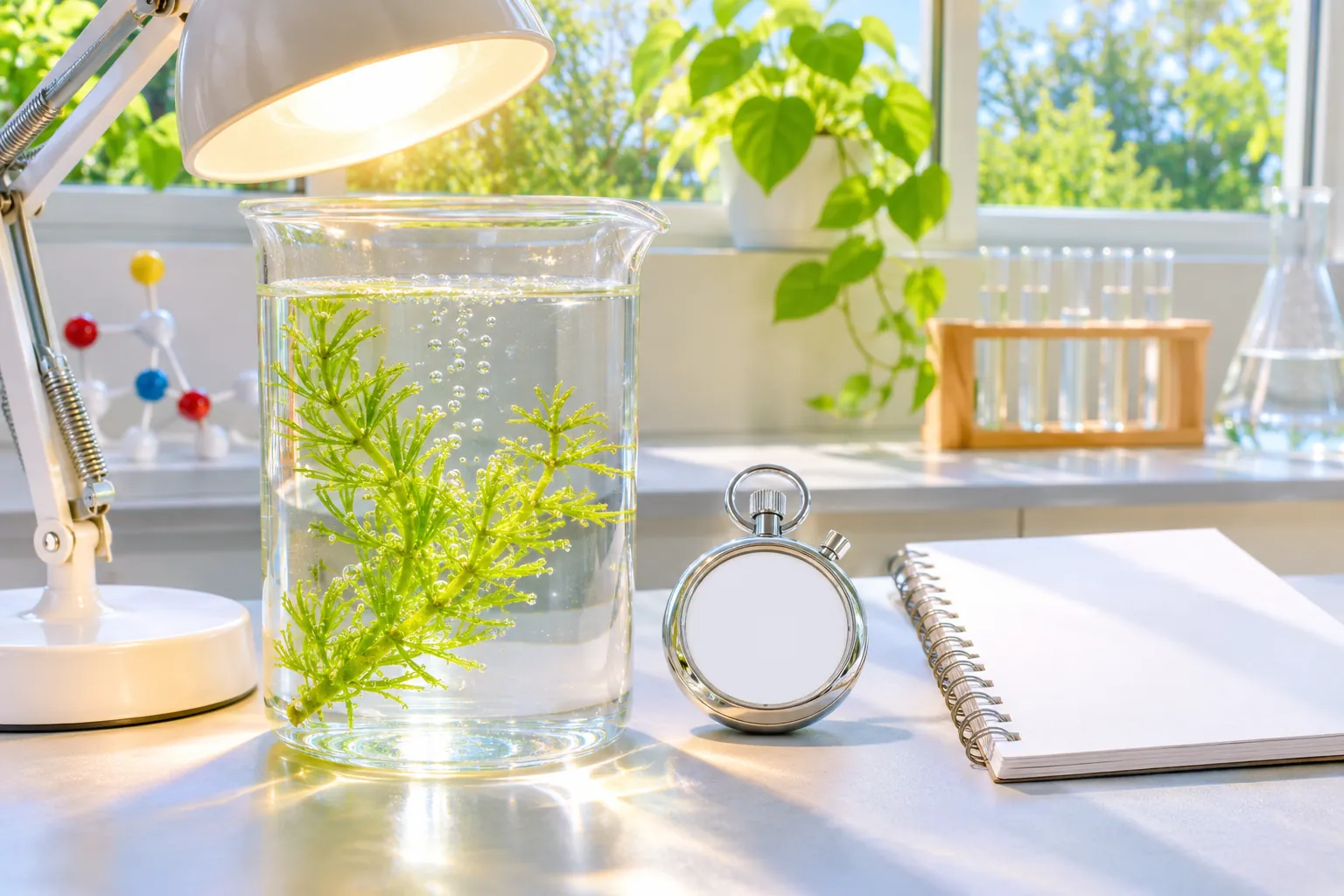
Longer, brighter days and warmer weather speed up photosynthesis. In this lab you can change each factor yourself and see which one holds the plant back.
On this page
- The pondweed bubble experiment
- How to use the virtual lab
- What the bubbles show
- How light intensity affects the rate of photosynthesis
- How carbon dioxide affects the rate
- How temperature affects the rate
- Limiting factors
- How to do the real experiment
- How to calculate the rate of photosynthesis
- Problems with counting bubbles
- Check your understanding
- Frequently asked questions
Quick answer
The rate of photosynthesis depends mainly on three things: light intensity, carbon dioxide concentration and temperature. In this virtual lab, a sprig of pondweed gives off bubbles of oxygen as it photosynthesises. The more bubbles per minute, the faster the rate. Whichever factor is in shortest supply is the limiting factor: it holds the rate back, however much of the other two there is.
Virtual lab
The pondweed bubble experiment
Change one thing at a time, wait for the bubbles to settle, then press Record this result. Your results build a table and a graph below the lab.
0bubbles per minute
| Lamp distance (cm) | Light intensity (1/d²) | CO₂ | Temp (°C) | Bubbles per minute |
|---|---|---|---|---|
| No results yet. Set up the lab and press Record this result. | ||||
How to use the virtual lab
- Leave the carbon dioxide on Medium and the temperature at 25 °C.
- Move the lamp to 10 cm and press Record this result.
- Move the lamp back 5 cm at a time, recording a result at each distance, until you reach 50 cm.
- Look at your graph. How does the number of bubbles change as the lamp moves away?
- Now set the carbon dioxide to High and repeat. Does the graph change at every distance, or only when the lamp is close?
- Finally, keep the lamp at 10 cm and try every temperature from 5 °C to 45 °C.
The line under the lab tells you which factor is limiting the rate at each moment. Watch it change as you move the lamp.
What the bubbles show
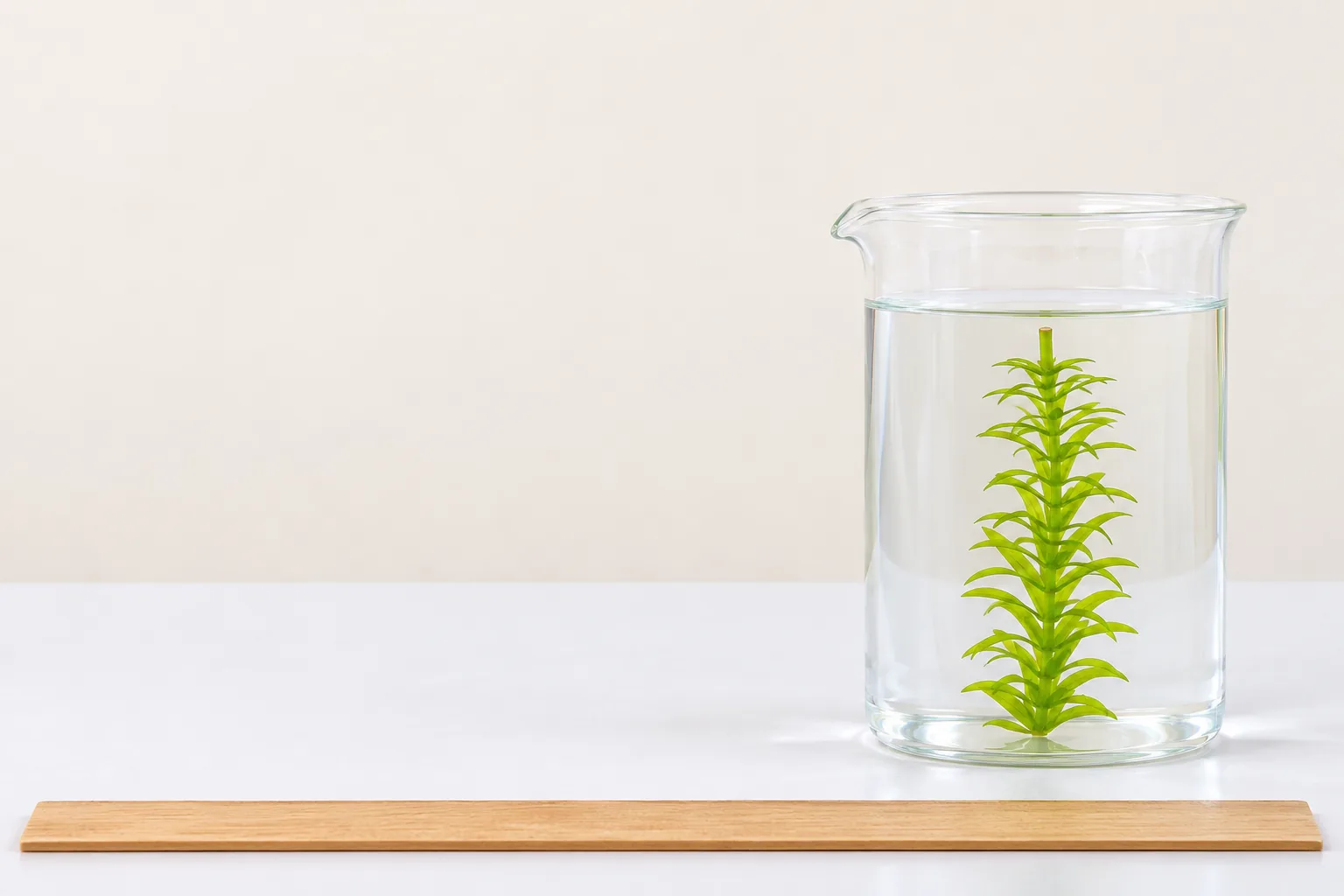
Pondweed such as Elodea lives under water, so the oxygen it makes during photosynthesis comes out as visible bubbles. The oxygen comes from water molecules split in the light-dependent reactions. Counting the bubbles that rise in one minute gives a simple measure of the rate of photosynthesis.
How light intensity affects the rate of photosynthesis
Light provides the energy for photosynthesis, so more light means a faster rate, up to a point. Moving the lamp closer increases the light intensity that reaches the plant.
Light intensity follows the inverse square law: it is proportional to 1 ÷ distance². Halve the distance and the light intensity goes up four times. That's why the rate climbs steeply when the lamp gets close.
At high light intensity the graph levels off. More light no longer helps, because something else, carbon dioxide or temperature, has become the limiting factor.
How carbon dioxide affects the rate
Carbon dioxide is one of the raw materials of photosynthesis. The Calvin cycle fixes it into sugar. In the real experiment, adding sodium hydrogencarbonate (baking soda) to the water releases more carbon dioxide for the pondweed.
More carbon dioxide raises the rate, but only when light is not the thing holding it back. With the lamp far away, adding carbon dioxide makes little difference.
How temperature affects the rate
Photosynthesis is controlled by , such as in the Calvin cycle. As the water warms up, the enzymes work faster and the rate rises. Above an optimum temperature, the enzymes start to lose their shape, or denature, and the rate falls quickly. In this virtual lab the optimum is 30 °C. Real plants vary, and many work best somewhere between about 25 °C and 35 °C.
Limiting factors
A limiting factor is whichever condition is in shortest supply. It sets the top speed of photosynthesis, like the narrowest part of a funnel.
| Factor | If it is limiting | What raises the rate |
|---|---|---|
| Light intensity | Moving the lamp closer speeds things up | More light |
| Carbon dioxide | More light makes no difference | Adding sodium hydrogencarbonate |
| Temperature | Too cold: everything is slow. Too hot: enzymes denature | Getting closer to the optimum |
Farmers use the same idea in greenhouses. They add light, warmth and extra carbon dioxide to help crops grow faster, as long as the extra cost is worth the bigger harvest.
How to do the real experiment
You can run this experiment in a school lab with simple equipment.
You will need: a boiling tube or beaker of water, a sprig of pondweed, a paperclip to weigh it down, sodium hydrogencarbonate, a lamp, a metre ruler, a stopwatch and a thermometer.
- Add a pinch of sodium hydrogencarbonate to the water so the pondweed has plenty of carbon dioxide.
- Put the pondweed in the water, cut end up, and place the lamp 10 cm away.
- Leave it for 5 minutes so the plant adjusts to the light.
- Count the bubbles that rise from the cut end in 1 minute. Repeat twice and take the mean.
- Move the lamp to 20 cm, 30 cm, 40 cm and 50 cm, and repeat steps 3 and 4 each time.
Variables: the independent variable is the distance of the lamp. The dependent variable is the number of bubbles per minute. The control variables include the temperature, the amount of carbon dioxide and using the same piece of pondweed.
Safety and accuracy: lamps get hot, so keep water away from the plug and cable. Place a beaker of water between the lamp and the plant to absorb heat, so the temperature stays the same and only the light changes.
How to calculate the rate of photosynthesis
The rate is the amount of oxygen made per minute:
rate = number of bubbles ÷ time in minutes
For example, 45 bubbles in 3 minutes gives a rate of 45 ÷ 3 = 15 bubbles per minute.
To find the light intensity at each distance, use 1 ÷ d². At 20 cm, light intensity = 1 ÷ 20² = 1 ÷ 400 = 0.0025 (in arbitrary units). Plotting the rate against 1 ÷ d² gives a straighter line than plotting it against distance.
Problems with counting bubbles
- Bubbles are different sizes, so the same count can mean different amounts of oxygen.
- Fast streams of bubbles are hard to count by eye.
- Some oxygen dissolves in the water instead of forming bubbles.
- The plant uses some of its own oxygen for respiration, so the bubbles show only the extra oxygen it makes.
A more accurate method collects the gas in an upturned measuring cylinder or a gas syringe and measures its volume per minute.
Practice questions
Check your understanding
5 questions
1. In the pondweed experiment, which gas is in the bubbles?
The bubbles are oxygen, released when water is split in the light-dependent reactions.
2. The lamp is moved from 20 cm to 10 cm away. How does the light intensity change?
Light intensity is proportional to 1 ÷ d². Halving the distance makes it 2² = 4 times greater.
3. Adding more light no longer increases the rate. What does this show?
When more light makes no difference, something else, such as carbon dioxide or temperature, is now limiting the rate.
4. Why does the rate fall sharply above about 40 °C?
Photosynthesis is controlled by enzymes. Too much heat changes their shape so they stop working.
5. When you change the distance of the lamp, what is the dependent variable?
The dependent variable is what you measure: the number of bubbles per minute.
Frequently asked questions
Why does pondweed give off bubbles?
The bubbles are oxygen made by photosynthesis. Because the plant is under water, the gas forms bubbles you can see and count.
Why put a beaker of water between the lamp and the plant?
Lamps give off heat as well as light. The beaker of water absorbs heat so the temperature stays the same, which makes it a fair test of light intensity.
What is the inverse square law for light?
Light intensity is proportional to 1 ÷ distance². If you halve the distance from the lamp, the light intensity goes up four times.
Can I use this virtual lab in class?
Yes. It's free, needs no sign-up and runs in any web browser, including on phones and interactive whiteboards.