The big why
How does a plant make food from light, air and water?
Its leaves take in light, carbon dioxide and water, and tiny chloroplasts turn them into sugar. These diagrams show every step.
On this page
- What a photosynthesis diagram shows
- Labelled diagram of a leaf cross-section
- Diagram of the two stages of photosynthesis
- Where the chloroplast fits in
- How to draw photosynthesis: an easy drawing in 5 steps
- Key facts to remember
- Check your understanding
- Quizzes, worksheets and labs
- Frequently asked questions
Quick answer
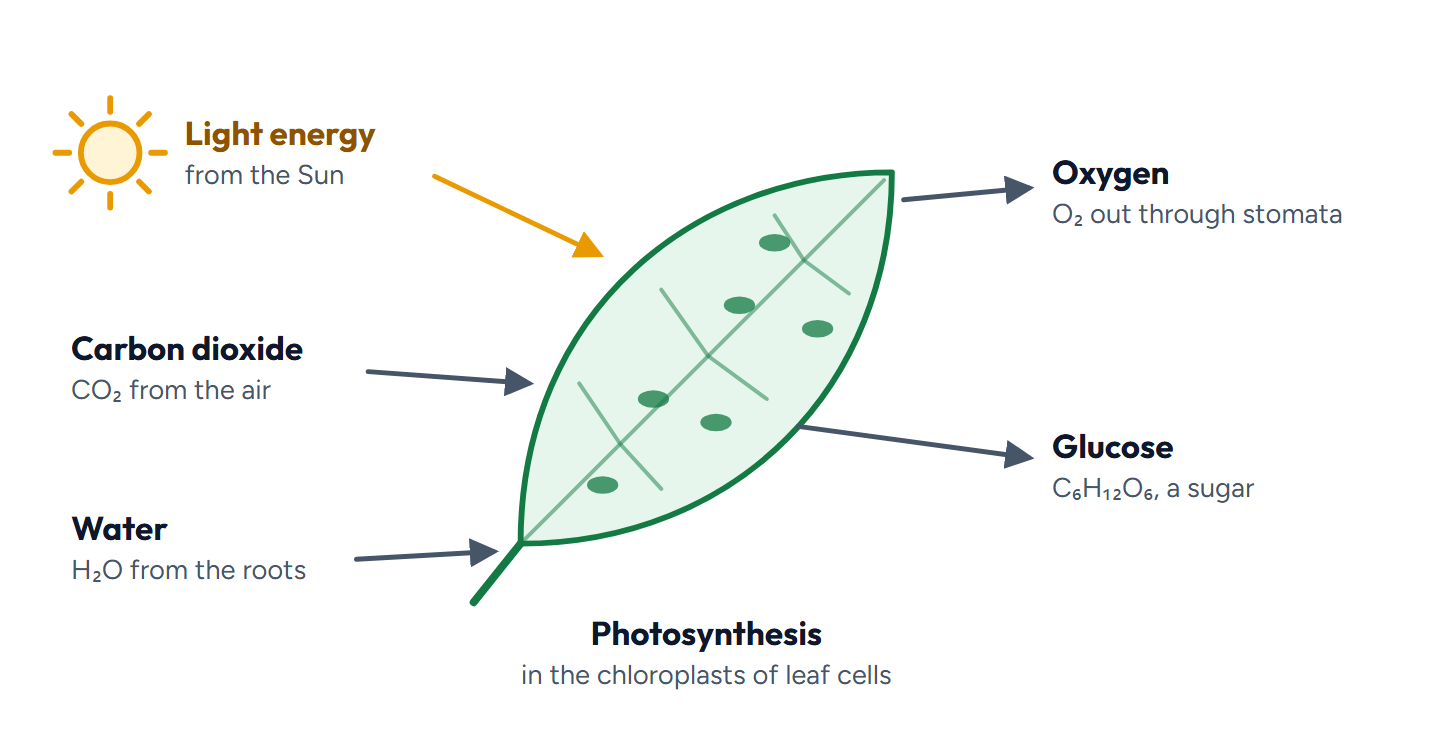
A photosynthesis diagram shows a leaf taking in three things: light energy from the Sun, carbon dioxide from the air and water from the roots. Inside the leaf's , these are turned into , a sugar the plant uses for food, and oxygen, which is released into the air.
What a photosynthesis diagram shows
The simple diagram above is the one most teachers want you to know first. It matches the word equation for photosynthesis (new to the topic? Start with what is photosynthesis?):
carbon dioxide + water → glucose + oxygen (using light energy and )
Each arrow on the diagram is one part of the photosynthesis equation:
| On the diagram | What it is | Where it comes from or goes |
|---|---|---|
| Sun | Light energy | Absorbed by chlorophyll, the green pigment in chloroplasts |
| Arrow from the air | Carbon dioxide, CO2 | Enters the leaf through tiny pores called |
| Arrow from the roots | Water, H2O | Taken up by the roots and carried to the leaf in tubes |
| Arrow out of the leaf | Oxygen, O2 | A by-product. It leaves through the stomata |
| Glucose | A sugar, C6H12O6 | Used for energy, or turned into , and other molecules |
Labelled diagram of a leaf cross-section
Exam questions often ask you to label the inside of a leaf. If you slice a leaf across and look at it under a microscope, you see layers of cells. Each layer has a job in photosynthesis.
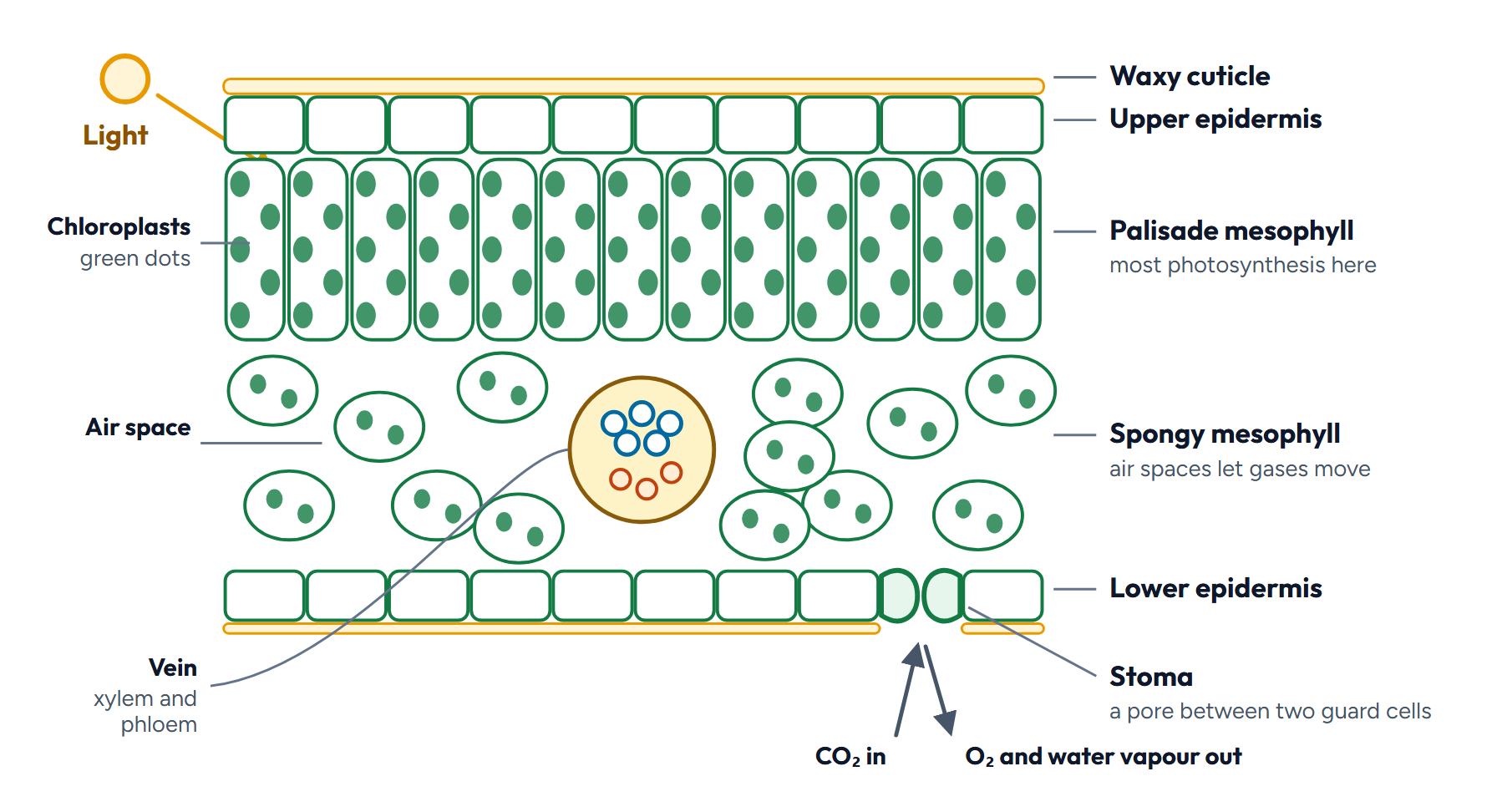
Here is what each labelled part does:
- Waxy cuticle: a clear, waterproof layer that stops the leaf drying out. Light passes straight through it.
- Upper epidermis: a single layer of clear cells that protects the leaf and lets light in.
- : tall cells packed with chloroplasts. They sit near the top of the leaf to catch the most light, so most photosynthesis happens here.
- : rounder, loosely packed cells with air spaces between them. Carbon dioxide and oxygen move through these spaces to and from the cells.
- Vein: contains xylem, which brings water up from the roots, and , which carries the sugar made in the leaf to the rest of the plant.
- Lower epidermis and stomata: the bottom layer has many small pores called stomata. Each one is opened and closed by two , which control how much gas goes in and out.
Diagram of the two stages of photosynthesis
Photosynthesis is really two linked sets of reactions. Both happen inside the chloroplast, but in different parts of it.
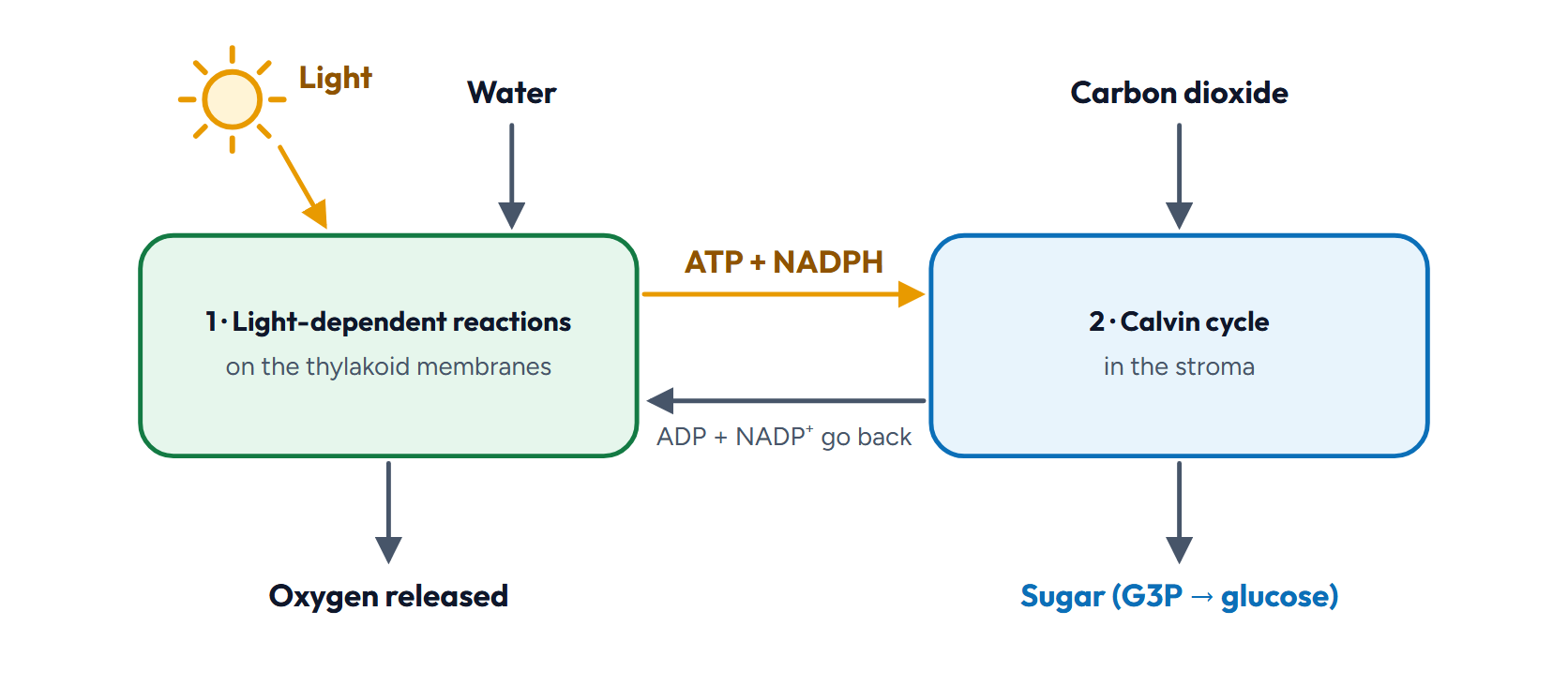
- The light-dependent reactions happen on the thylakoid membranes. Chlorophyll absorbs light, water is split, and oxygen is released. The energy is stored in two carrier molecules, ATP and NADPH.
- The Calvin cycle happens in the stroma, the fluid around the thylakoids. It uses ATP and NADPH to turn carbon dioxide into a sugar called G3P, which the plant uses to make glucose.
The two stages depend on each other. The Calvin cycle needs the ATP and NADPH from the light reactions, and it sends back ADP and NADP⁺ to be recharged.
Where the chloroplast fits in
A chloroplast is the tiny structure inside plant cells where all of this happens. For a full labelled picture of its parts, including the grana, thylakoids and stroma, see our chloroplast diagram. To follow photosynthesis from the whole plant down to the chloroplast, read where does photosynthesis take place?
How to draw photosynthesis: an easy drawing in 5 steps
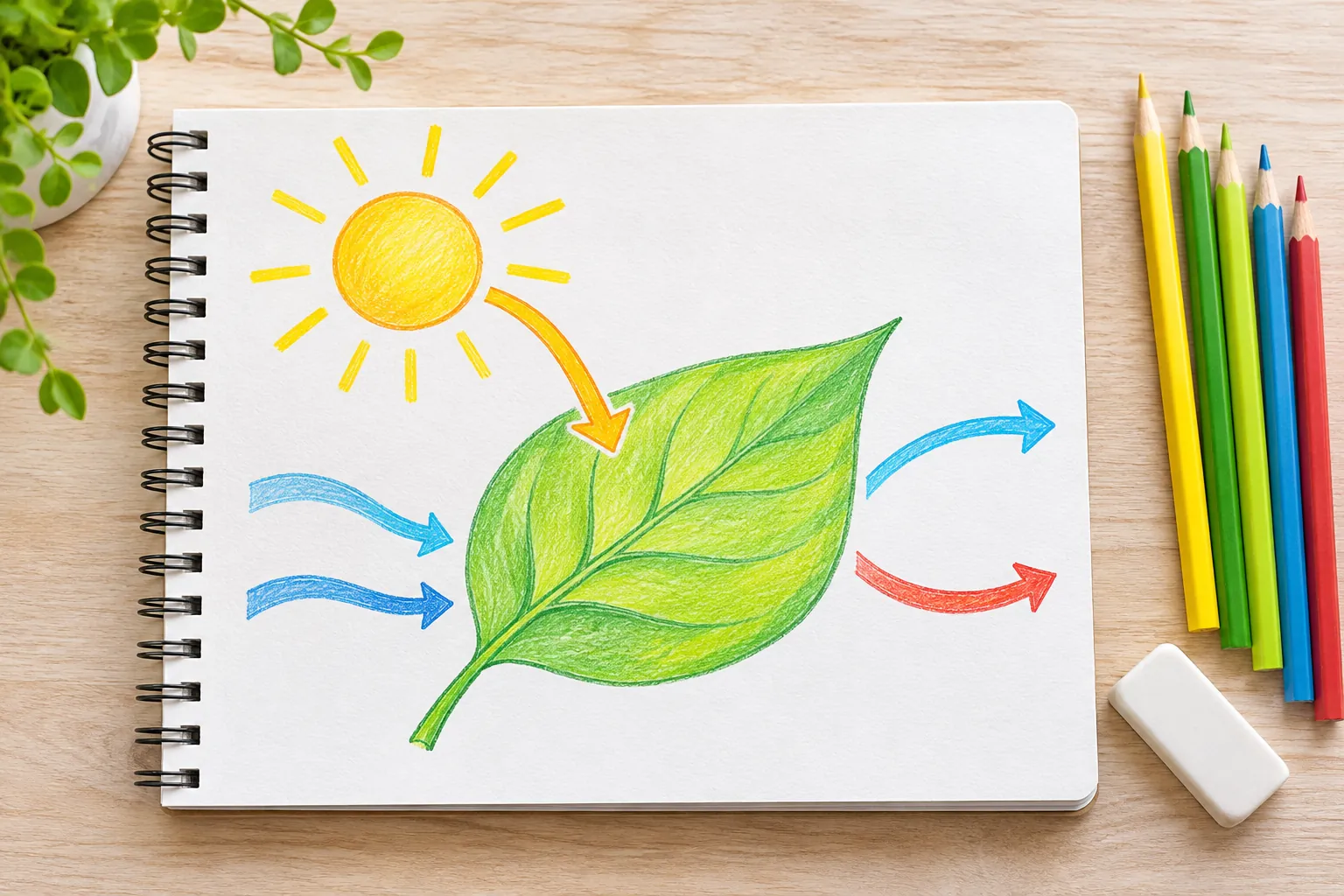
If you need a photosynthesis drawing for homework or an exam, these five steps give you a clear, fully labelled diagram in a few minutes. You only need a pencil and two colours.
Step 1
Draw the leaf
Draw a large leaf shape in the middle of the page, with a stem at the bottom and a central vein. Leave room on every side for arrows.
Step 2
Add the Sun and light
Draw a sun in the top corner and an arrow from it to the leaf. Label it light energy.
Step 3
Show what goes in
Draw an arrow from the air into the leaf labelled carbon dioxide (CO₂). Draw an arrow coming up the stem labelled water (H₂O) from the roots.
Step 4
Show what comes out
Draw an arrow out of the leaf labelled oxygen (O₂). Draw another arrow, or write inside the leaf, glucose (C₆H₁₂O₆).
Step 5
Add the equation and a title
Write the word or symbol equation under the leaf and give your diagram a title, such as "Photosynthesis in a leaf". Use green for chlorophyll and the leaf, and yellow for light, so it is easy to read.
Cheat sheet
Key facts to remember
Photosynthesis diagram
- A leaf takes in light energy, carbon dioxide and water.
- Chloroplasts turn these into glucose and oxygen.
- Carbon dioxide enters and oxygen leaves through stomata, mostly on the underside of the leaf.
- Xylem brings water up from the roots, and phloem carries sugar away from the leaf.
- Most photosynthesis happens in the palisade mesophyll, near the top of the leaf.
- On a diagram, show every input going in and every output coming out with an arrow.
From Cluecub · www.cluecub.com/photosynthesis-diagram
Practice questions
Check your understanding
5 questions
1. Which three things go into a leaf for photosynthesis?
Light provides the energy, carbon dioxide comes from the air and water comes from the roots. Glucose and oxygen are the products.
2. Which layer of a leaf carries out the most photosynthesis?
Palisade cells sit near the top of the leaf where light is strongest, and they are packed with chloroplasts.
3. What is the job of the air spaces in the spongy mesophyll?
Carbon dioxide and oxygen diffuse through the air spaces between the stomata and the cells.
4. In which part of the chloroplast does the Calvin cycle happen?
The Calvin cycle happens in the stroma. The light-dependent reactions happen on the thylakoid membranes.
5. Where does the oxygen released by photosynthesis come from?
Water is split in the light-dependent reactions, and its oxygen atoms are released as oxygen gas.
Frequently asked questions
What should a photosynthesis diagram include?
It should show light energy from the Sun, carbon dioxide going into the leaf, water coming from the roots, and glucose and oxygen as products. Good diagrams also show the chloroplasts and stomata, and the word or symbol equation.
What are the labels on a leaf cross-section diagram?
From top to bottom: waxy cuticle, upper epidermis, palisade mesophyll, spongy mesophyll with air spaces, a vein of xylem and phloem, lower epidermis, and stomata with guard cells.
Where does photosynthesis happen in a leaf?
In the chloroplasts of the leaf cells, mostly in the palisade mesophyll layer near the top of the leaf.
What are the two stages of photosynthesis?
The light-dependent reactions, on the thylakoid membranes, and the Calvin cycle, in the stroma of the chloroplast.