The big why
Why do your legs burn when you sprint?
Your muscles need energy faster than your blood can bring oxygen, so they switch to a back-up plan that makes lactic acid.
On this page
- The anaerobic respiration equations
- How anaerobic respiration works
- Anaerobic respiration in muscles
- Anaerobic respiration in yeast and plants
- Try it yourself: blow up a balloon with yeast
- Aerobic vs anaerobic respiration
- Key facts to remember
- Check your understanding
- Quizzes, worksheets and labs
- Frequently asked questions
Quick answer
Anaerobic respiration releases energy from without oxygen. In animal muscle cells, glucose is turned into . In yeast and plant cells, glucose is turned into and carbon dioxide. It happens in the and makes only 2 per glucose, compared with about 30 to 32 ATP from aerobic respiration.
The anaerobic respiration equations
There are two types of anaerobic respiration. Which one a cell uses depends on the kind of organism.
C6H12O6 no oxygenproduces 2C3H6O3
glucose → lactic acid (+ a little energy)
C6H12O6 no oxygenproduces 2C2H5OH + 2CO2
glucose → ethanol + carbon dioxide (+ a little energy)
Notice that neither equation has oxygen in it. Compare them with the aerobic cellular respiration equation, where glucose reacts with six oxygen molecules.
How anaerobic respiration works
Both types start with glycolysis, the first stage of all respiration. Glycolysis splits one glucose into two molecules of and makes 2 ATP. It doesn't need oxygen.
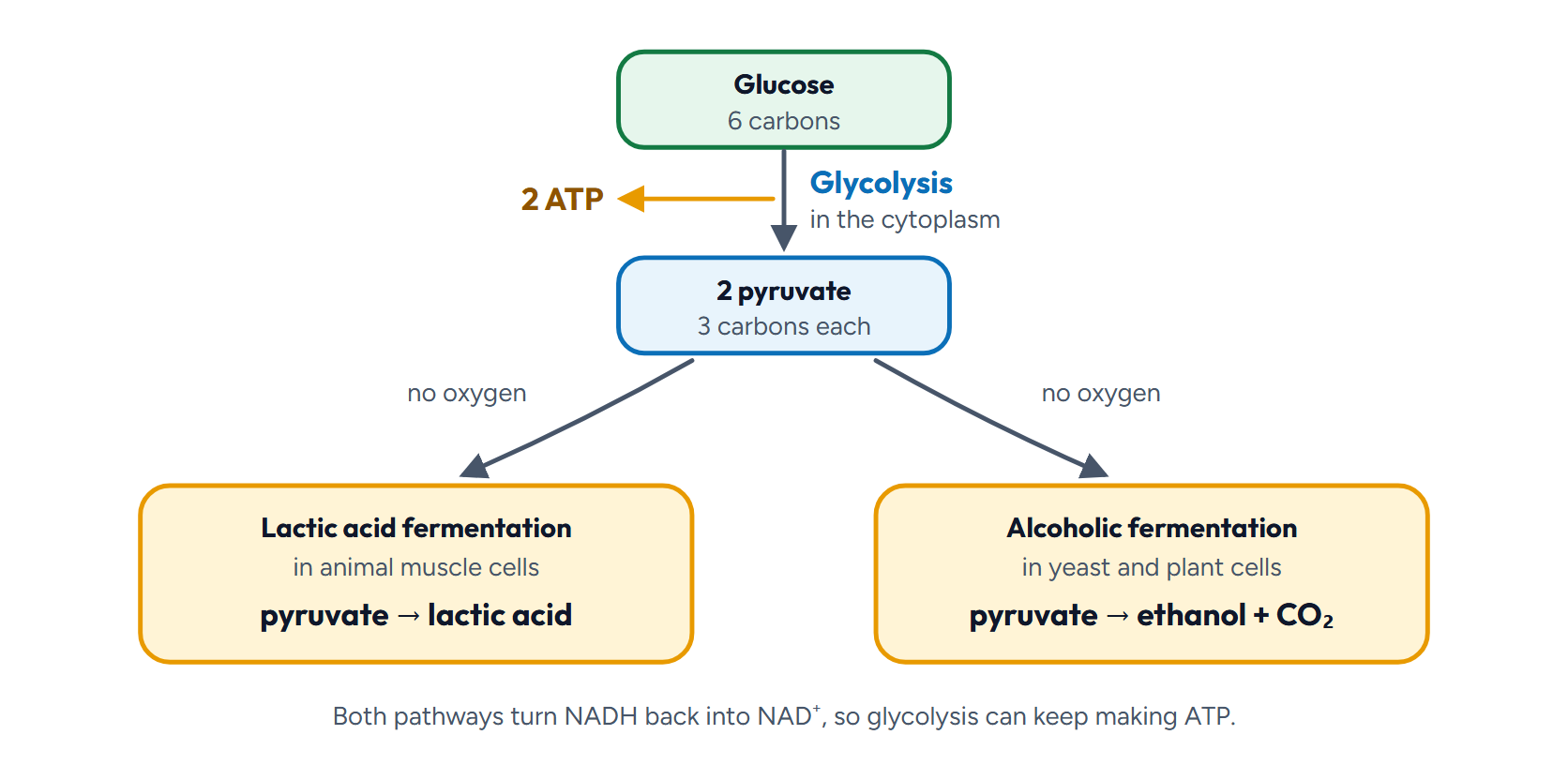
With oxygen, pyruvate would go into the to be broken down completely. Without oxygen, that route is blocked. Instead, the cell converts pyruvate into lactic acid or ethanol. This extra step matters because it recycles a carrier molecule called NAD⁺. Glycolysis needs a steady supply of NAD⁺, so without this recycling it would stop, and the cell would get no energy at all.
Anaerobic respiration in muscles
During hard exercise, such as a sprint, your muscles need energy faster than your heart and lungs can deliver oxygen. Muscle cells top up their ATP with anaerobic respiration, making lactic acid.
- Lactic acid builds up and helps cause the burning feeling and tiredness in hard-working muscles.
- After exercise, you keep breathing hard. The extra oxygen is used to break down lactic acid, mostly in the liver, which turns it back into glucose. This extra oxygen is often called the oxygen debt, or EPOC (excess post-exercise oxygen consumption).
- Training makes the heart, lungs and muscles better at supplying oxygen, so trained athletes rely less on anaerobic respiration.
Anaerobic respiration in yeast and plants
Yeast is a single-celled fungus. When it has sugar but little oxygen, it makes ethanol and carbon dioxide. People have used this for thousands of years:
- Bread: carbon dioxide bubbles get trapped in the dough and make it rise. The small amount of ethanol evaporates during baking.
- Brewing: the ethanol is the alcohol in drinks such as beer and wine, and the carbon dioxide makes some drinks fizzy.
- Biofuel: ethanol made by yeast from crops such as sugar cane and maize is mixed into some car fuels.
Plants use the same pathway when their roots are short of oxygen, for example in waterlogged soil. Ethanol is toxic to the plant, so this can only last a short time.
Many bacteria carry out lactic acid fermentation too. That is how milk is turned into yoghurt and cheese. Compare the two pathways side by side in lactic acid vs alcoholic fermentation.
Try it yourself: blow up a balloon with yeast
You can see anaerobic respiration happen in your kitchen. You need a small bottle, a balloon, dried yeast, sugar and warm water. Ask an adult to help with the warm water.
Step 1
Make the mixture
Put one sachet (about 7 g) of dried yeast and two teaspoons of sugar into the bottle. Add about 100 ml of warm water, around 35 to 40 °C, which feels warm but not hot. Swirl gently to mix.
Step 2
Add the balloon
Stretch the neck of a balloon over the top of the bottle so no gas can escape. Once the yeast has used up the small amount of air in the bottle, it carries on respiring anaerobically.
Step 3
Wait and watch
Leave the bottle somewhere warm. Within about 20 to 30 minutes the mixture gets foamy and the balloon starts to inflate with carbon dioxide.
Step 4
Compare
For a fair test, set up a second bottle without sugar, or with cold water. That balloon stays flat, because yeast needs food and warmth to respire quickly.
Aerobic vs anaerobic respiration
| Aerobic | Anaerobic | |
|---|---|---|
| Oxygen needed? | Yes | No |
| Where | Cytoplasm, then mitochondria | Cytoplasm only |
| Products | Carbon dioxide and water | Lactic acid, or ethanol and carbon dioxide |
| ATP per glucose | About 30 to 32 | 2 |
For a full comparison, read aerobic vs anaerobic respiration. To see glycolysis step by step, read our guide to glycolysis.
Cheat sheet
Key facts to remember
Anaerobic respiration
- Anaerobic respiration releases energy from glucose without oxygen.
- In animals: glucose → lactic acid.
- In yeast and plants: glucose → ethanol + carbon dioxide.
- It happens in the cytoplasm and makes only 2 ATP per glucose.
- Muscles use it during hard exercise, and the carbon dioxide from yeast makes bread rise.
From Cluecub · www.cluecub.com/anaerobic-respiration
Practice questions
Check your understanding
5 questions
1. What is the product of anaerobic respiration in human muscle cells?
Animal cells make lactic acid. Ethanol and carbon dioxide are made by yeast and plants.
2. How many ATP does anaerobic respiration make per glucose?
Only glycolysis runs, which makes a net gain of 2 ATP per glucose.
3. Which gas makes bread dough rise?
Yeast makes carbon dioxide during anaerobic respiration, and the bubbles get trapped in the dough.
4. Where in the cell does anaerobic respiration happen?
Glycolysis and fermentation both happen in the cytoplasm. The mitochondria are only used in aerobic respiration.
5. Why do cells turn pyruvate into lactic acid or ethanol?
Converting pyruvate regenerates NAD⁺. Without it, glycolysis would stop and no ATP would be made.
Frequently asked questions
What is anaerobic respiration?
It is the release of energy from glucose without using oxygen. It makes lactic acid in animals, or ethanol and carbon dioxide in yeast and plants.
What is the equation for anaerobic respiration in humans?
glucose → lactic acid, or C6H12O6 → 2C3H6O3.
What is the equation for anaerobic respiration in yeast?
glucose → ethanol + carbon dioxide, or C6H12O6 → 2C2H5OH + 2CO2.
Is anaerobic respiration the same as fermentation?
In school biology, yes. Fermentation is the name for the pathways that make lactic acid or ethanol without oxygen. See our fermentation guide for both pathways step by step.
Why does anaerobic respiration release less energy?
Glucose is only partly broken down, so much of its energy stays locked in the lactic acid or ethanol.