The big why
Where does the carbon dioxide you breathe out come from?
Most of it is released in the Krebs cycle, as the last carbon atoms from your food are stripped away inside your mitochondria.
On this page
- Where does the Krebs cycle take place?
- Where the Krebs cycle fits in
- The steps of the Krebs cycle
- Products of the Krebs cycle
- Why the Krebs cycle makes so little ATP directly
- Does the Krebs cycle need oxygen?
- More than just respiration
- Key facts to remember
- Check your understanding
- Quizzes, worksheets and labs
- Frequently asked questions
Quick answer
The Krebs cycle, also called the citric acid cycle or TCA cycle, is the third stage of . It happens in the matrix of the . Each turn takes in a 2-carbon molecule called and releases its carbon as 2 carbon dioxide. The energy is captured as 3 , 1 and 1 . The cycle turns twice for every molecule.
Where does the Krebs cycle take place?
The Krebs cycle takes place in the matrix of the mitochondria, the fluid that fills the space inside the inner mitochondrial membrane. All but one of its float freely in the matrix. The odd one out, succinate dehydrogenase, is built into the inner membrane, which is how it passes straight to the electron transport chain.
| Organism | Where the Krebs cycle happens |
|---|---|
| Plants, animals and fungi | Mitochondrial matrix |
| Bacteria (no mitochondria) |
Where the Krebs cycle fits in
Cellular respiration with oxygen has four stages. The Krebs cycle is the third.
- Glycolysis splits glucose into 2 in the cytoplasm.
- The link reaction turns each pyruvate into acetyl CoA in the mitochondrial matrix, releasing 1 carbon dioxide and making 1 NADH.
- The Krebs cycle breaks down acetyl CoA, releasing the rest of the carbon as carbon dioxide.
- The electron transport chain uses the NADH and FADH₂ to make most of the ATP.
It is named after Hans Krebs, who worked out the cycle in 1937 and shared the Nobel Prize in Physiology or Medicine in 1953. It is also called the citric acid cycle, after citrate, the first molecule made in the cycle, and the TCA cycle (tricarboxylic acid cycle), because citrate has three acid (carboxyl) groups. All three names mean the same thing.
The steps of the Krebs cycle
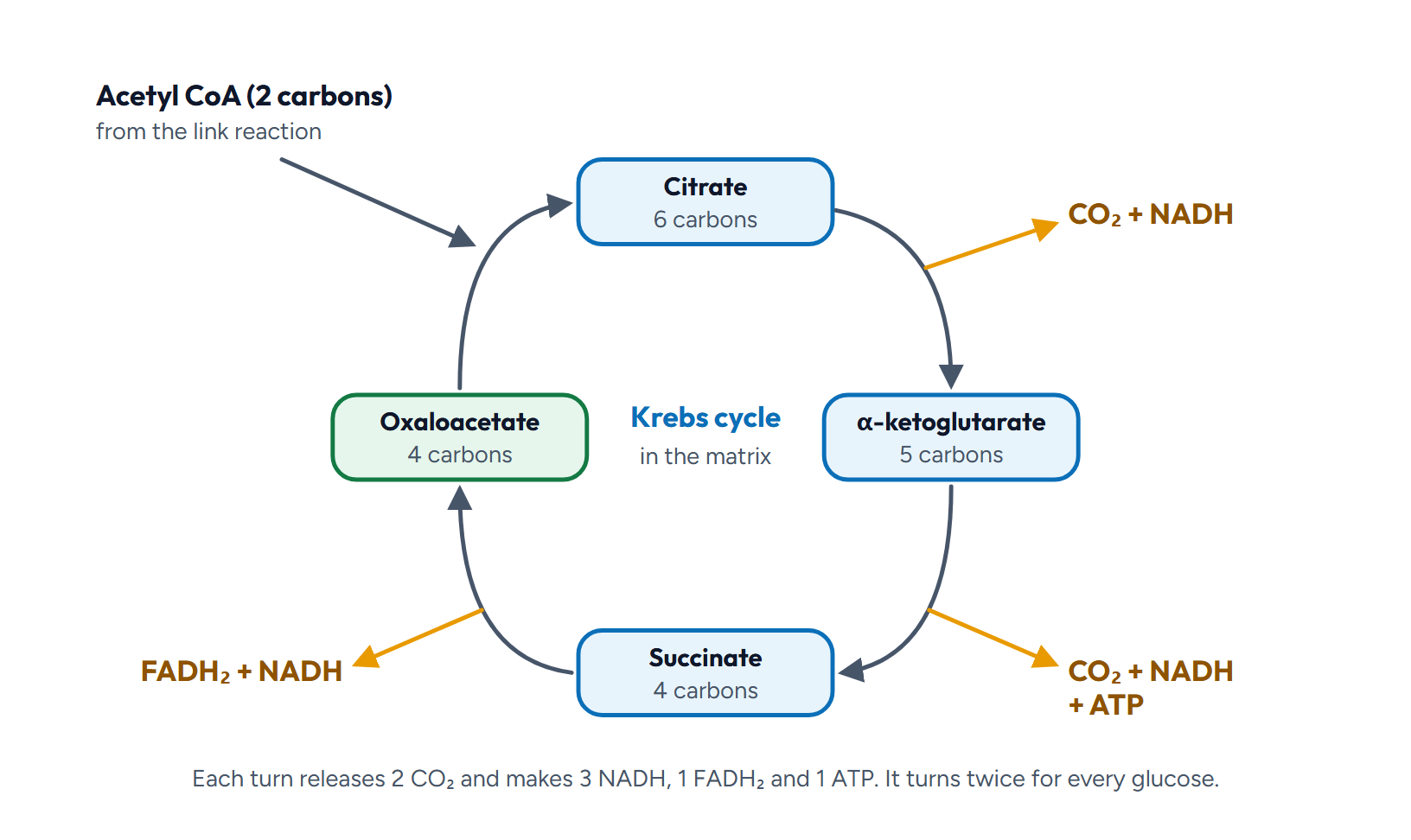
The full cycle has eight reactions, each with its own enzyme. Here they are in four easy-to-learn steps.
Step 1
Citrate is formed
Acetyl CoA (2 carbons) joins with oxaloacetate (4 carbons) to make citrate (6 carbons). Coenzyme A is released, ready to pick up another acetyl group.
- In
- Acetyl CoA
- Makes
- Citrate (6C)
Step 2
First carbon dioxide is released
Citrate is rearranged, then loses one carbon as carbon dioxide. Hydrogen is passed to NAD⁺, making NADH. The result is α-ketoglutarate, with 5 carbons.
- Releases
- 1 CO2
- Makes
- 1 NADH
Step 3
Second carbon dioxide is released
α-ketoglutarate loses another carbon as carbon dioxide and makes another NADH. The 4-carbon molecule left is then converted to succinate, and the energy released makes 1 ATP (in some cells, a similar molecule called GTP).
- Releases
- 1 CO2
- Makes
- 1 NADH and 1 ATP
Step 4
Oxaloacetate is remade
Succinate is changed step by step back into oxaloacetate. On the way, hydrogen is passed to FAD to make FADH₂, and to NAD⁺ to make one more NADH. The oxaloacetate is now ready to start the next turn.
- Makes
- 1 FADH₂ and 1 NADH
Products of the Krebs cycle
| Product | Per turn | Per glucose (2 turns) | What happens to it |
|---|---|---|---|
| Carbon dioxide | 2 | 4 | Diffuses out of the cell as waste, and is breathed out |
| NADH | 3 | 6 | Carries electrons to the electron transport chain |
| FADH₂ | 1 | 2 | Carries electrons to the electron transport chain |
| ATP | 1 | 2 | Used directly for energy |
Add the 2 carbon dioxide from the link reaction, and you get the 6 carbon dioxide in the cellular respiration equation.
Why the Krebs cycle makes so little ATP directly
The Krebs cycle makes only 2 ATP per glucose. Its real job is to load energy onto NADH and FADH₂. These carriers take high-energy electrons to the electron transport chain, which turns them into about 26 to 28 ATP. Without the Krebs cycle, the chain would have almost nothing to work with.
Does the Krebs cycle need oxygen?
Not directly. No step uses oxygen. But it still stops without oxygen. The cycle needs a steady supply of NAD⁺ and FAD, and these are only recycled when the electron transport chain passes electrons on to oxygen. With no oxygen, NADH builds up, NAD⁺ runs out, and the cycle grinds to a halt. That is why the Krebs cycle counts as part of aerobic respiration.
More than just respiration
The Krebs cycle is a hub in the cell. Acetyl CoA can also come from breaking down fats, and some amino acids from proteins enter the cycle too. In the other direction, the cell can take molecules out of the cycle to build amino acids and other substances it needs.
Cheat sheet
Key facts to remember
The Krebs cycle
- The Krebs cycle, or citric acid cycle, is the third stage of aerobic respiration.
- It happens in the matrix of the mitochondria.
- Acetyl CoA (2 carbons) joins oxaloacetate (4 carbons) to make citrate (6 carbons).
- Each turn releases 2 CO₂ and makes 3 NADH, 1 FADH₂ and 1 ATP.
- It turns twice per glucose.
- No step uses oxygen, but it stops without oxygen because NAD⁺ is no longer recycled.
From Cluecub · www.cluecub.com/krebs-cycle
Practice questions
Check your understanding
5 questions
1. Where does the Krebs cycle take place?
The Krebs cycle enzymes are in the matrix, the fluid inside the mitochondrion.
2. Which molecule joins oxaloacetate to start the cycle?
Acetyl CoA (2 carbons) joins oxaloacetate (4 carbons) to make citrate (6 carbons).
3. How many carbon dioxide molecules are released per turn of the Krebs cycle?
Each turn releases 2 carbon dioxide, one for each carbon that came in as acetyl CoA.
4. How many NADH are made per glucose in the Krebs cycle?
Each turn makes 3 NADH, and the cycle turns twice per glucose, so 6 in total.
5. Why does the Krebs cycle stop when there is no oxygen?
Without oxygen, the electron transport chain stops, so NADH and FADH₂ can't be turned back into NAD⁺ and FAD.
Frequently asked questions
What is the Krebs cycle in simple terms?
It is a cycle of reactions in the mitochondria that breaks down acetyl CoA from food, releasing carbon dioxide and loading energy onto NADH and FADH₂.
What are the products of the Krebs cycle?
Per glucose (two turns): 4 carbon dioxide, 6 NADH, 2 FADH₂ and 2 ATP.
Why is it called the citric acid cycle?
Because the first molecule made in the cycle is citrate, a form of citric acid, the acid found in lemons and oranges.
Where does the Krebs cycle take place?
In the matrix of the mitochondria. In bacteria, which have no mitochondria, it happens in the cytoplasm.
Is the TCA cycle the same as the Krebs cycle?
Yes. The Krebs cycle, the citric acid cycle and the TCA (tricarboxylic acid) cycle are three names for the same cycle.
Is the Krebs cycle aerobic?
Yes. It doesn't use oxygen directly, but it only keeps running when oxygen is available to recycle NAD⁺ and FAD through the electron transport chain.