The big why
Where does the wood in a tree come from?
Mostly from the air. A tree builds its trunk from carbon dioxide, joined to water using the energy in sunlight.
On this page
- Photosynthesis definition
- What are the reactants and products of photosynthesis?
- The photosynthesis process, step by step
- Where does photosynthesis happen?
- Why is photosynthesis important?
- What affects the rate of photosynthesis?
- Who discovered photosynthesis?
- Photosynthesis and cellular respiration
- Key facts to remember
- Check your understanding
- Quizzes, worksheets and labs
- Frequently asked questions
Quick answer
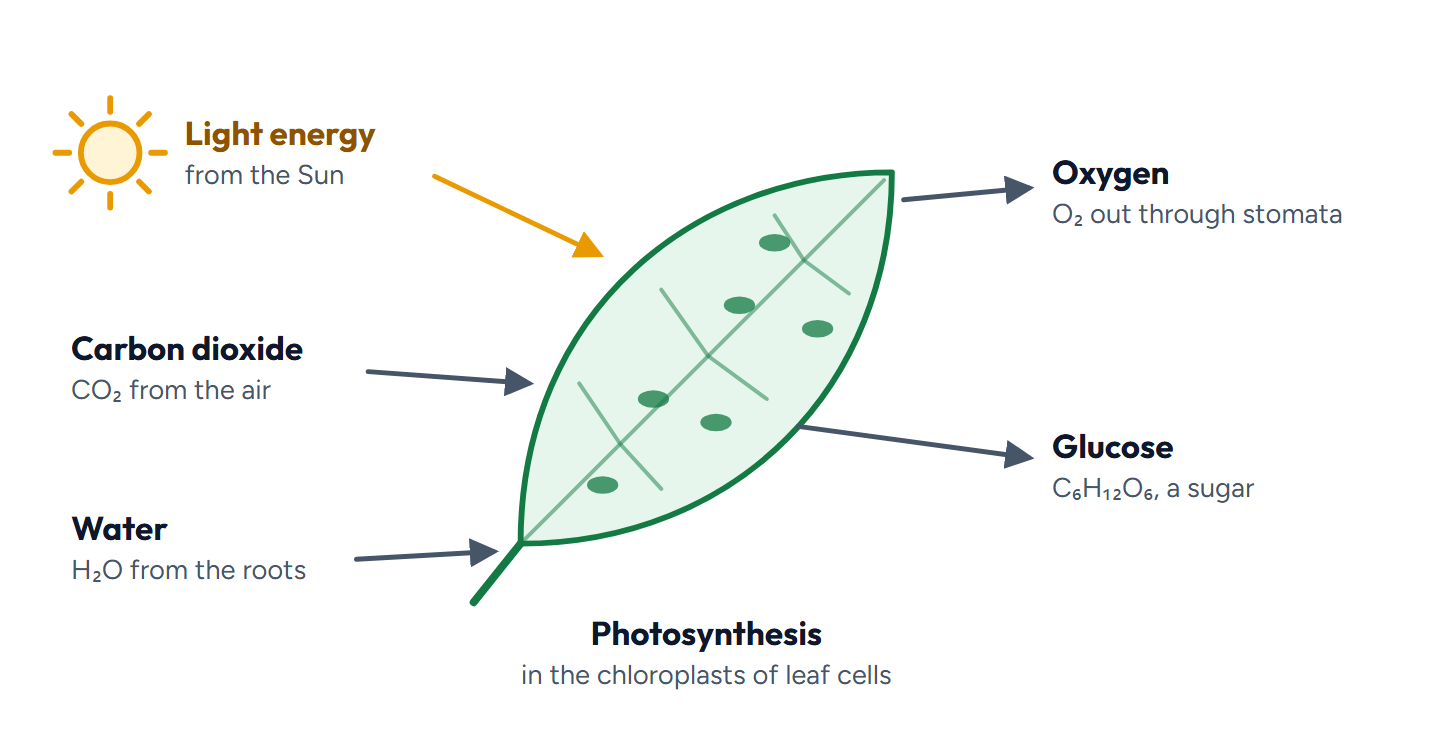
Photosynthesis is the process that plants, algae and some bacteria use to make their own food. They use light energy from the Sun to turn carbon dioxide and water into , a sugar, and release oxygen as a by-product. It happens in the , where a green pigment called chlorophyll absorbs the light.
6CO2 + 6H2O light, produces C6H12O6 + 6O2
carbon dioxide + water → glucose + oxygen
Photosynthesis definition
Here is the definition of photosynthesis at three levels. Use the one that matches your course.
| Level | Definition |
|---|---|
| Simple | Photosynthesis is how plants make their own food using sunlight, water and air. |
| Middle school and GCSE | Photosynthesis is the process in which plants use light energy to turn carbon dioxide and water into glucose and oxygen. |
| Biology (high school and AP) | Photosynthesis is the conversion of light energy into chemical energy, in which carbon dioxide is reduced to sugar using taken from water, releasing oxygen. |
The word comes from two Greek words: photo, meaning light, and synthesis, meaning putting together. So photosynthesis means "putting together with light". Plants put small molecules together into sugar, and light supplies the energy.
Living things that make their own food this way are called producers, or autotrophs. Animals, fungi and most bacteria can't photosynthesise, so they depend on producers for food.
What are the reactants and products of photosynthesis?
The reactants are what goes in. The products are what comes out.
| Substance | Formula | Where it comes from or goes | |
|---|---|---|---|
| Reactant | Carbon dioxide | CO2 | Enters the leaf from the air through tiny pores called stomata |
| Reactant | Water | H2O | Taken up by the roots and carried to the leaves in the |
| Energy | Light | none | Absorbed by chlorophyll in the chloroplasts |
| Product | Glucose | C6H12O6 | Used for energy, stored as , or built into and other molecules |
| Product | Oxygen | O2 | Released into the air through the |
Light is not a reactant, because it is energy and not a substance. Chlorophyll is not a reactant either, because it isn't used up. That's why both are written above the arrow in the equation. To see how the numbers in the balanced equation work, read the photosynthesis equation guide.
The photosynthesis process, step by step
Photosynthesis looks like one simple reaction in the equation, but in the cell it happens in many small steps. Step through the main ones.
Step 1
Light is absorbed
Chlorophyll in the membranes of the chloroplast absorbs light, mostly red and blue light. Green light is reflected, which is why leaves look green.
- Where
- Thylakoid membranes
Step 2
Water is split
The light energy is used to split water molecules. This releases electrons, hydrogen ions and oxygen. The oxygen leaves the leaf as a waste gas.
- Releases
- O2
Step 3
Energy is stored in carriers
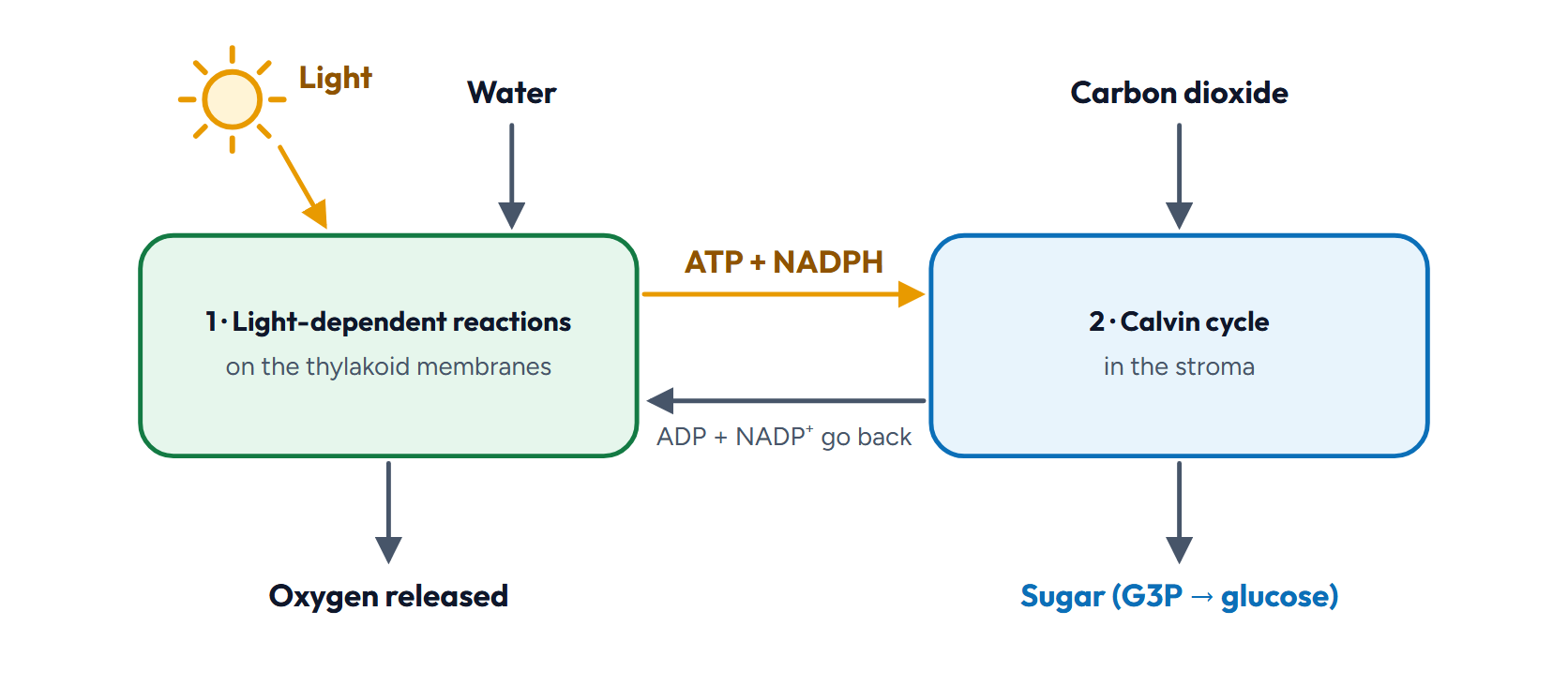
The energised electrons pass along a chain of proteins. Their energy is used to make two energy carriers, and . Steps 1 to 3 are the light-dependent reactions.
- Makes
- ATP and NADPH
Step 4
Carbon dioxide comes in
Carbon dioxide into the leaf through the stomata and reaches the stroma, the fluid inside the chloroplast.
- Where
- Stroma
Step 5
Carbon dioxide is turned into sugar
In the Calvin cycle, the enzyme RuBisCO fixes carbon dioxide. Then ATP and NADPH are used to turn it into a three-carbon sugar, which the plant joins together to make glucose.
- Makes
- Glucose, C6H12O6
Step 6
The plant uses the glucose
Glucose is used in respiration to release energy, stored as starch, turned into cellulose for cell walls, or used to make proteins, fats and oils.
- Stored as
- Starch
These steps fall into the two stages of photosynthesis.
| Stage | Where | Uses | Makes |
|---|---|---|---|
| 1. Light-dependent reactions | Thylakoid membranes | Light, water | ATP, NADPH, oxygen |
| 2. Calvin cycle (light-independent reactions) | Stroma | Carbon dioxide, ATP, NADPH | Sugar (G3P, used to make glucose) |
Where does photosynthesis happen?
Photosynthesis happens in the chloroplasts. In a plant, most chloroplasts are in the leaves, packed into the palisade cells near the top surface where the light is strongest. Inside each chloroplast, the light-dependent reactions happen on the thylakoid membranes and the Calvin cycle happens in the stroma.
For the full zoom-in from plant to organelle, read where does photosynthesis take place? To see every part of the organelle, see the chloroplast diagram.
Why is photosynthesis important?
The purpose of photosynthesis, for the plant, is to make food. But almost every living thing on Earth depends on it.
- It makes food. Plants use the glucose to grow. Animals eat plants, or eat animals that ate plants, so nearly every food chain starts with photosynthesis.
- It makes oxygen. Almost all the oxygen in the air was released by photosynthesis. Plants and algae keep topping it up.
- It removes carbon dioxide. Photosynthesis takes carbon dioxide out of the air, which is an important part of the carbon cycle and slows the build-up of this greenhouse gas.
- It stores energy. Coal, oil and natural gas formed from living things that photosynthesised millions of years ago. Their energy first came from sunlight.
What affects the rate of photosynthesis?
Photosynthesis goes faster when a plant has more of what it needs, up to a point.
- Light intensity. More light means faster photosynthesis, until something else runs short.
- Carbon dioxide. More carbon dioxide speeds it up, until something else runs short.
- Temperature. Warmth speeds up the enzymes, but above about 40 °C they stop working.
- Water. A plant short of water closes its stomata, so less carbon dioxide gets in.
Whichever factor is in shortest supply holds the rate back. This is called the limiting factor. Try changing each one yourself in the virtual photosynthesis lab.
Who discovered photosynthesis?
No single person discovered it. It was pieced together over about 300 years.
| When | Who | What they found |
|---|---|---|
| 1640s | Jan van Helmont | A willow tree gained a lot of mass while its soil lost very little, so plants don't simply eat soil |
| 1771 | Joseph Priestley | A plant could "restore" air in a sealed jar after a candle had burned out in it. We now know it released oxygen |
| 1779 | Jan Ingenhousz | Plants only do this in light, and only their green parts |
| 1940s–1950s | Melvin Calvin and colleagues | Worked out the Calvin cycle, the steps that turn carbon dioxide into sugar |
Photosynthesis and cellular respiration
Photosynthesis stores energy in glucose. Cellular respiration releases it again, in plants as well as animals. The two equations are mirror images: the products of one are the reactants of the other. See photosynthesis vs cellular respiration for a full comparison.
Explaining photosynthesis to a younger child? Try photosynthesis for kids, with easy experiments to do at home.
Cheat sheet
Key facts to remember
What is photosynthesis?
- Photosynthesis is the process plants, algae and some bacteria use to make glucose from carbon dioxide and water, using light energy.
- Word equation: carbon dioxide + water → glucose + oxygen.
- Balanced equation: 6CO2 + 6H2O → C6H12O6 + 6O2.
- Reactants: carbon dioxide and water. Products: glucose and oxygen.
- It happens in chloroplasts, where chlorophyll absorbs the light.
- It has two stages: the light-dependent reactions and the Calvin cycle.
From Cluecub · www.cluecub.com/what-is-photosynthesis
Practice questions
Check your understanding
5 questions
1. What is photosynthesis?
Photosynthesis uses light energy to turn carbon dioxide and water into glucose and oxygen. Releasing energy from glucose is respiration.
2. What are the reactants of photosynthesis?
Carbon dioxide and water go in. Glucose and oxygen come out.
3. Which pigment absorbs light for photosynthesis?
Chlorophyll, in the chloroplasts, absorbs mostly red and blue light.
4. Where does the oxygen released by photosynthesis come from?
The oxygen comes from water molecules, which are split in the light-dependent reactions.
5. What does the word photosynthesis mean?
It comes from the Greek photo (light) and synthesis (putting together).
Frequently asked questions
What is photosynthesis in simple words?
It is how plants make their own food. They use energy from sunlight to turn water and carbon dioxide from the air into sugar, and they give off oxygen.
What is the definition of photosynthesis in biology?
Photosynthesis is the process by which plants, algae and some bacteria convert light energy into chemical energy, using carbon dioxide and water to make glucose and releasing oxygen.
What are the reactants and products of photosynthesis?
The reactants are carbon dioxide and water. The products are glucose and oxygen. Light energy is needed but is not a reactant.
What is the main purpose of photosynthesis?
To make glucose, the plant's food. The plant uses it for energy, growth and storage. As a by-product, photosynthesis releases the oxygen that most living things need.
What are the two stages of photosynthesis?
The light-dependent reactions, on the thylakoid membranes, and the Calvin cycle (light-independent reactions), in the stroma of the chloroplast.